
Comparing Tolkien's Thieves To Beowulf and the Old English Context by savannahhorrell
Posted on ; updated on
This paper was previously presented at Mereth Aderthad 2025 on 19 July 2025.
Introduction
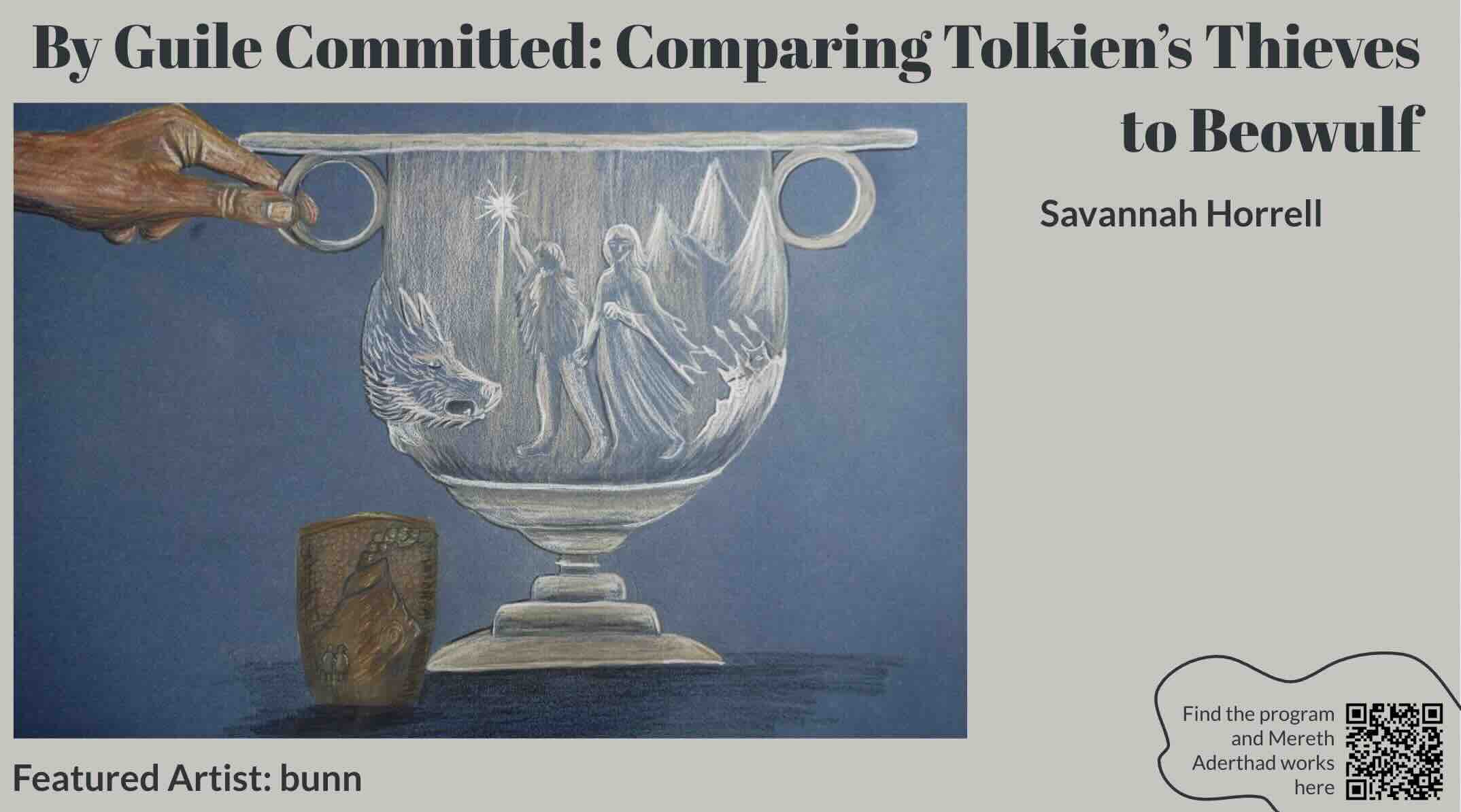
How does a thief become a hero? Every world mythology offers its own answer; the constructed mythology of Middle-earth is no different. Theft is central to several of the oldest and most foundational stories of J.R.R. Tolkien’s Legendarium. The Hobbit, the first Middle-earth story to see publication, has as its eponymous protagonist a “burglar” who is contracted to steal an already stolen hoard out from under a dragon. He is repeatedly named “thief” by Gollum for his purloining of the One Ring and his ultimate solution to the siege of a mountain required covert gem-smuggling.1 In what Tolkien considered “the chief of the stories of The Silmarillion,” Beren and Lúthien, an outlaw and a runaway, successfully steal a jewel to wed, earning one of the few happy endings of their era.2 Even Frodo and Samwise, in their mission to destroy the One Ring, act as reverse thieves, utilizing stealth and disguise to infiltrate Mordor. Frodo, too, is referred to as a thief for his ownership of the One Ring.3
The mythology of Middle-earth clearly has a cachet for heroic thieves and cunning victories. However, one of the histories that sparked Tolkien’s imagined world took a much dimmer view of theft. Anglo-Saxons, who lived in England and parts of Northern Europe until the Norman Conquest in 1066, prosecuted theft more stringently than homicide.4 A thief caught in the act could be killed without trial and their family was denied all rights to restitution.5 Repeated theft could merit a sentence of outlawry, a punishment meant to both physically and spiritually exclude the perpetrator from society.6 Not only was theft strictly punished, it was also socially proscribed. The act of theft carried connotations of subterfuge and stealth, and was therefore associated with cowardice, oathbreaking, and gender-transgression.7
Beowulf, an Anglo-Saxon poem written in Old English, features as a minor character a thief whose actions closely mirror Bilbo’s in the Hobbit. However, this thief is a runaway slave described in Tolkien’s translation as a “nameless man” and a “thrall”.8 Though he is dragooned into helping the heroes, his ultimate fate is left ambiguous. The thief in Beowulf becomes, as historian Andersson says, “the thief as a social outcast”.9 Bilbo Baggins, his Tolkienian counterpart, is a property-owner of means, the main character and survivor of his own narrative. Though an eccentric, he is not on the social or narrative margins. Neither are Beren, Lúthien, or even Frodo; they are all of high status within their societies, the central characters of their stories, and all find acclaim, if not a happy ending, by the close of their tales.
Anglo-Saxon influence can be seen in the mead-halls of Rohan and the Doom of Mandos.10 Old English lexicography inspired terms like “ent” and “orc”.11 One could make the argument that Tolkien chose to deviate from Anglo-Saxon morality even as he retained Anglo-Saxon aesthetics. However, the views of characters within Middle-earth disprove this as well. The word thief is used in an overwhelmingly negative or pejorative manner by characters across The Hobbit, The Lord of the Rings, and The Silmarillion. A lexical analysis of theft related terms across the three books reveals patterns: thief or thieve are almost entirely used as insults, steal and its variants are more commonly neutral, robbery is rarely used but never positively.12 When the act of stealing is described it is often eluded through innuendo or judicious word choice—including use of the term “burglar” which only appears in The Hobbit. A thief remains a reviled figure within the text even as multiple characters steal their way to victory.
Tolkien closes the morality gap between Anglo-Saxon legalism and fairy-story justice by having each “good thief” (as Thorin deems Bilbo at the end of The Hobbit) follow a formula of boasts, self-incrimination, and wealth redistribution.13 The most stigmatized elements of theft—that of subterfuge and cowardice—are softened by having the thieves name themselves prior to acting. Even this only goes so far to undo the contradiction; the internal conflict between stigmatization of theft and the embrace of it can be seen in the extra-textual Prologue and Appendices to The Lord of the Rings, where Bilbo is identified as a “‘thief’” in quotation marks.14 Though the heroic thief as an archetype would have been unthinkable to the Anglo-Saxons, their presentation within Tolkien’s imagined world is tinged by an Anglo-Saxon lens.
1 Drout, “‘ Beowulf: The Monsters and the Critics’ Seventy-Five Years Later”; Seamus Heaney, Beowulf (Bilingual Edition), 1st ed (W. W. Norton & Company, Incorporated, 2001). xi; The bilingual edition of the Heaney translation, published in 2001, was chosen as a supplement to Tolkien’s own translation of Beowulf for several reasons: First, it presents the text directly across from the original old English. Second, as the translation was published before the public release of Tolkien’s own translation (which was completed before Heaney was born) one can safely say that the two translations had no direct influence over one another and stand as independent interpretations of the text.
2 Ibid. “Riddles in the Dark”, “A Thief in the Night.”
3 Ibid. “The Council of Elrond.”
4 Andersson, “The Thief in Beowulf.”
5 T.B Lambert, “Theft, Homicide, and Crime in Late Anglo-Saxon Law,” Past and Present 214 (February 2012): 3—43, https://doi.org/10.1093/pastj/gtr040.
6 Theodore M Andersson, “The Thief in Beowulf,” Speculum 59, no. 3 (1984): 493—508, https://doi.org/10.2307/2846296.
7 Frederick Levi Attenborough, The Laws of the Earliest English Kings (Legare Street Press, 2021). 47, 127.
8 Beowulf. Line 1860.
9 The Letters of J. R. R. Tolkien. “163. To W.H. Auden”; Ibid. “7. To the Electors of the Rawlinson and Bosworth Professorship of Anglo-Saxon, University of Oxford.”
10 Beowulf. ‘Introduction to the Translation.”
11 The Letters of J. R. R. Tolkien. “9. To Susan Dagnall, George Allen, and Unwin Ltd.”
12 The Letters of J. R. R. Tolkien. “9. To Susan Dagnall, George Allen, and Unwin Ltd.”
13 The Letters of J. R. R. Tolkien. “157. From a letter to Katherine Farrer”, “144. To Naomi Mitchison.”
14 Conor McCarthy, “Outside the Law in the Middle Ages,” in Outlaws and Spies: Legal Exclusion in Law and Literature (Edinburgh University Press, 2020). 22-23.
Part 1: Stigma in Society
Legal documents and law codes make up one of the largest bodies of Old English texts, and therefore one of the greatest sources on Anglo-Saxon cultural views. Written in the vernacular Old English, rather than ecclesiastical Latin, and regularly reissued by successive kings, they are also an evolving document that marks the subtle shifts in legal opinion across several centuries.1 Legal codes are divided based on era and the king who issued them. Beowulf was written in the 11th century, a recording of a poem several centuries older.2 The first commonly discussed Old English laws—that of Æthelberht—were issued in the 7th century, the last, those of Æthelstan, in the early 10th century.3 Without going into the minutiae of the legal codes, several themes can be seen.
Starting with the legal code of Ine, published in the mid 690s, it was legal to kill a thief caught in the act of stealing, provided the perpetrator reported the act promptly and swore an oath to appropriate authorities. No wergeld (traditional man-price given to the deceased's kinsmen) would be paid.4 This could be an instant death sentence, meted out at the discretion of bystanders. Simply travelling off the road without signalling the intent to do so loudly enough could be grounds to be assumed a thief.5 By the reign of Æthelstan this had moderated somewhat to an order that:
No thief shall be spared, who is seized in the act, if he is over 12 years old and [if the value of the goods is] more than 8 pence.
(Attenborough, The Laws of the Earliest English Kings. 127.)
Four pence is cited earlier in the ordinances as the price of a ram; theft could become a lethal endeavor upon stealing a good rack of meat or a small household object. The amount stolen was less significant than the act of theft. To quote Holmes in The Common Law, “Nor would it matter that the thief afterwards changed his mind and returned the goods. From the point of view of attempt, the crime was already complete when the property was carried off.”6
Prior to Ine’s laws, theft was punished with only a fine; the perpetrator had to pay back a significant fee on top of the item’s value to the aggrieved.7 Monetary compensation being replaced by corporal, even capital, punishment in later law codes suggests a social structure which over time became more suspicious of the rehabilitative potential of thieves. Theft was not always a shortcut to death. Allowances were made for thieves to be seized and handed over to the king’s justice, permitted to pay a hefty ransom or mutilated to discourage recidivism.8 However the threat of death or outlawry for thieves, especially repeated thieves, lingers over the later legal codes.
It wasn’t just the perpetrators of theft who saw draconian punishments. Aiding, abetting, or harboring a thief was also a crime, with punishments including asset forfeiture, forfeiture of wergeld, or death.9 This legal principle, that defending or knowingly associating with a thief was an offense on par with theft itself can be seen through legal codes from Ine to Æthelstan.10 Homicide merited a milder punishment than abetting a thief; the one exception was killing under the king’s roof.11 Indeed, under some definitions, homicide was not a crime at all—consequences for killing, though significant, were largely meted out by group social dynamics which demanded the payment of weregeld and the settlement of feuds, whereas theft was punished by a universal legal authority in the king.12
The king’s jurisdiction over issues of theft but not homicide may be because theft was seen as a greater threat to the social fabric. Theft threatened the principles of possession which governed a gift-driven society; in a social structure where status was determined not just by what you owned but what you could give to people, a thief was a threat not just to the individual but to the whole.13 Another explanation is that theft, done in secret, was a dishonourable act and its perpetrators were uniquely stigmatized by the Anglo-Saxon worldview.14
The legal distinction made between open robbery and secret theft gives credence to this later theory. Robbery, the taking of something in the open by an individual not seeking to hide their identity, was treated differently in the legal codes than covert theft. In the code of Ine, an act of robbery results in the restoration of what was taken and a fine of 60 shillings, whereas a captured thief, is to be killed or pay the full sum of their own wergeld as ransom15 To quote one historian: “The successful thief was an anonymous figure who left his victims impotent, with no knowledge of where to direct their anger. He was invulnerable to redress through feuding in a way that the honourable killer was not.”16 Open, announced seizure was fundamentally honorable in a way that secretive theft was not, and secretive theft is mentioned far more often in the legal corpus as a result.17 In J.R Schwyter’s analysis of theft related words in Old English legal texts, he found the most common word roots to be “þeof-” and “stel-”, ‘thief’ and ‘steal’ respectively. There were 103 instances of “þeof-” words in the legal codes and lawsuit documents analyzed, along with 62 instances of “stel-” words. In comparison there were only 19 instances of “reaf-”; the root word for rob.18
The distinction between theft and robbery is also noted in Middle-earth; in The Hobbit Thorin says, “But none of our gold shall thieves take or the violent carry off while we are alive.”19 In the last chapters of The Lord of the Rings Sharkey’s ruffians are specifically called out for “robbing and plundering”, this set of actions, one can presume, is different than theft, though still merits harsh recrimination.20
The legal stigmatization of theft went hand-in-hand with social stigmatization. Analyzing related Icelandic laws and fictional narratives, Andersson found that accusations of theft, when untrue, were considered to be uniquely injurious, a kind of defamation which could be prosecuted in turn.21 Theft is often accompanied by implications of other illicit activities—the accused thief might also be accused of witchcraft, necromancy, and behaving in an unmanly manner.22 Thieves were often foreigners and of low birth.23 To quote Andersson, “the thief is typically pictured as an outsider, a sorcerer, and a sexual deviant.”24 The archetype of an outsider thief, miserable and ill-fated, is given a more sympathetic sheen in Beowulf. Although a suspiciously Anglo-Saxon type of stigmatization is present in the texts of Middle-earth (see section 3) the specific archetype of the wretched thief is absent. The sole exception is, perhaps, Gollum, the ultimate outlaw, cast miles and centuries from his home by a moment of greed—yet even his primary crimes are those of violence, not of stealth.
Theft is the first cited cause for outlawry in Old English laws—the legal justification for striking down a thief caught in the act itself “had its origin in days when the criminal taken in the act was ipso facto an outlaw.”25 Outlawry, literally putting someone outside of the protection of the law, was simultaneously a sentence of displacement and of dehumanization. The outlaw was neither permitted nor protected; they could not enter cities, partake of religious or social life, expect safety on the road or trust their own fellows. Within the legal corpus, outlawry is prescribed for those who cannot be found, for those who flee justice, and for those who repeatedly steal.26 Even those who could not be fully outlawed might be asked to quit the area via a process known as abjuration, a sort of negotiated exile.27
In Middle-earth, the outlaw features with some regularity: Túrin, Tuor, and Beren are all referred to as outlaws at various points, with Túrin spending some time amid a group of “houseless and desperate men”.28 The crimes of these outlaws are not described in depth, meaning none of them are explicitly outlawed for theft, not like Gollum is. In The Lord of the Rings Frodo is told that, “He took to thieving, and going about muttering to himself, and gurgling in his throat. So they called him Gollum and cursed him and told him to go far away; and his grandmother, desiring peace, expelled him from the family and turned him out of her hole.”29 Here we see familiar aspects: theft as an ultimate violation of the social contract, exile and exclusion as a means of excising the thief from the social fabric. None of these elements are uniquely Anglo-Saxon, however, nor are they proof that Tolkien had Anglo-Saxon cultural baggage in mind when weaving the moral fabric of his secondary world. How much of the legal and social context above was known to Tolkien, much less influential in his work?
The foundational translation of Old English law by Attenborough, a reprint of which is cited above, was first published in 1922 and was itself an update to the first English translation published 80 years prior.30 The material would have been more than accessible to Tolkien as a scholar of Anglo-Saxon language. However, we don’t need to merely conjecture that Tolkien knew about the tenor of Anglo-Saxon laws. In a 1945 letter to his son, Christopher, he remarked that he “read till 11.50, browsing through the packed and to me enthralling pages of Stenton’s Anglo-Saxon England”.31 Stenton’s book, though more of an overview when it comes to the state of law, does reinforce the themes covered above. When discussing tenth century governing bodies called hundreds, Stenton says that they collected punitive fines “in particular from those who disobeyed its orders in regard to the pursuit of thieves” and discussing Æthelstan he notes that “most of his laws deal with the suppression of thieves”.32 The import of theft in the Anglo-Saxon consciousness was not only known in Tolkien’s time, it was keenly known to Tolkien, not just through the legal code but also through Beowulf, where the figure of the thief plays a small but critical role.
1 Beowulf. Line 65; Jürg Rainer Schwyter, ed., Old English Legal Language: The Lexical Field of Theft, North-Western European Language Evolution. Supplement 0900-8675, vol. 15 (Odense University Press, 1996). 27.
2 The Lord of the Rings. “Prologue: Of the Finding of the Ring”, “Appendix B.”
3 Tree and Leaf. “On Fairy-Stories.”
4 The Letters of J. R. R. Tolkien. “131. To Milton Waldman”; The Silmarillion. “Of Beren and Luthien.”
5 The Hobbit. “The Return Journey.”
6 The Hobbit.”Inside Information.”
7 See Part 3.
8 Beowulf. Line 1859-1860.
9 The Hobbit. “Inside Information.”
10 Beowulf. Line 1861-1862.
11 Ibid. Line 1919-1920.
12 Beowulf. Line 2023
13 When asked about the influence of Beowulf on The Hobbit by a reader, Tolkien said: “Beowulf is among my most valued sources; though it was not consciously present to the mind in the process of writing, in which the episode of the theft arose naturally (and almost inevitably) from the circumstances. It is difficult to think of any other way of conducting the story at that point. I fancy the author of Beowulf would say much the same.” (The Letters of J. R. R. Tolkien. “25. To the editor of the Observer.”)
14 Heaney, Beowulf (Bilingual Edition). Line 2215; Bosworth et al., “Nát-Hwilc.”
15 Andersson, “The Thief in Beowulf”; Heaney, Beowulf (Bilingual Edition). Lines 2223, 2226, 2285; Bosworth et al., “Þreá-Nídla”; Bosworth et al., “Syn-Bysig.”
16 Andersson, “The Thief in Beowulf.”
17 Beowulf. Lines 2022-2023.
18 Heaney, Beowulf (Bilingual Edition). Line 2219.
19 Attenborough, The Laws of the Earliest English Kings. a3.
20 The Letters of J. R. R. Tolkien. “95. To Christopher Tolkien.”
21 F. M. Stenton, Anglo-Saxon England, 3d ed, The Oxford History of England 2 (Clarendon Press, 1971). 299, 354.
22 Sarah Harlan-Haughey, The Ecology of the English Outlaw in Medieval Literature: From Fen to Greenwood, Outlaws in Literature, History, and Culture (Routledge, Taylor & Francis Group, 2016). 62.
23 Beowulf. “Commentary 14; *18.”
24 Attenborough, The Laws of the Earliest English Kings. 2, 112.
25 Ibid. 29, 41, 47
26 Attenborough, The Laws of the Earliest English Kings. 31, 43.
27Ibid. 39, 157.
28 Lambert, “Theft, Homicide, and Crime in Late Anglo-Saxon Law”; Attenborough, The Laws of the Earliest English Kings. 39.
29 Attenborough. 17; Hamilton, “The Punishment Fits the Crime: Ownership, Gift- Giving, and Theft in Anglo-Saxon England.”
30 Lambert, “Theft, Homicide, and Crime in Late Anglo-Saxon Law.”
31 Hamilton, “The Punishment Fits the Crime: Ownership, Gift- Giving, and Theft in Anglo-Saxon England.”
32 Hamilton, “The Punishment Fits the Crime: Ownership, Gift- Giving, and Theft in Anglo-Saxon England”; Lambert, “Theft, Homicide, and Crime in Late Anglo-Saxon Law”; Andersson, “The Thief in Beowulf.”
Part 2: Beowulf and the Thief
The epic Beowulf had a strong influence on Tolkien’s scholarship and literary works but especially on The Hobbit. Tolkien first learned Old English at King Edward’s School and went on to become the Rowlinson and Bosworth Chair of Anglo-Saxon studies at Oxford in 1925.1 Prior to this position he held a readership in Leeds. It was during this period, from 1920-1926, that he worked on his translation of Beowulf; though the translation was not published until after his death.2 Shortly after completing his translation, he began to work in force on the manuscript of The Hobbit .3 In November of 1936 he gave the lecture “Beowulf: The Monsters and the Critics” which would go on to shape the next generation of Beowulf translations and criticism, including the Heaney translation which will be used later on in this paper.4 In 1937 the first edition of The Hobbit was published.5
The effects of this chronological overlap can be seen in the similarities between the two tales.6 One of the central points of The Hobbit—a burglar employed by a king and his eleven sworn companions to help roust a dragon stealing a cup and awaking the wrath of a dragon who sleeps atop a hoard of ancient gold—bears a remarkable similarity to a section near the end of Beowulf.7 Beginning at line 1855 in the Tolkien translation and line 2210 in the Heaney translation we are introduced to a thief creeping into a dragon’s den deep under the earth by a “path little known to men”.8 This little known path closely resembles the enchanted door which Bilbo uses to access the caves of Erebor.9 The man seizes “a goblet deep, bright with gems” and then flees from the sleeping dragon.10 This sequence, from the infiltration of the dragon’s lair to the seizure of the cup, to the frightened flight, is followed beat for beat by Bilbo.
The thief in Beowulf brings the cup back to his master in a plea for mercy.11 The dragon awakens, wroth, and begins to seek out the thief. The thief disappears for several verses and then reappears in the company of Beowulf himself, as the thirteenth of his companions but a “captive” nonetheless.12 The specific number thirteen again is echoed in The Hobbit, where Thorin’s companions number fourteen but are left at thirteen for much of their adventure with the exclusion of Gandalf. The unlucky thirteenth thief shows Beowulf and his fellow warriors to the dragon’s lair and there he vanishes from the story.
What similarities there are between the burglar of The Hobbit and the thief of Beowulf fall apart when the circumstances of the thief are more closely examined. As brief as their appearance is, every description of the thief is one of contempt—pity at best, dismissal at worst. The first term used to describe him is “niða nāt-hwylc” (‘someone, I don’t know who’).13 Though Tolkien describes him as a “thrall”, whether the thief is directly referred to as a slave (“þeow”) in the Old English text is debated because of the fractured nature of the original manuscript.14 Regardless, the thief is described as oppressed (“þrēa-nēdlan”), wretched (“fēasceaftum”) and troubled (“syn-bysig” lit: ‘sin-busy’).15 As Andersson puts it: “the thief is a dispossessed outcast fleeing hostility, in need of refuge, and guilty of some misdoing.”16 By contrast, Tolkien’s thieves are born to power. They invariably come from rank—a princess, a gentlehobbit, a dispossessed heir, two Lords of the Noldor. Even Gollum’s grandmother is said to have been a matriarch among his people.17
Though capable of sneaking past a dragon, the work of Beowulf’s thief is dismissed as “þēofes cræfte”, a term which implies deception and stealth; both of which have their own moral overtone in the Anglo-Saxon milieu.18 Later, as the thief is pressed into service by Beowulf, his final description is thus:
sē ðæs orleges ōr onstealde,
hæft hyge-giōmor, sceolde hēan ðonon
(Heaney, Beowulf (Bilingual Edition). Lines 2407-2408)
Which Tolkien renders as “who had wrought the beginning of that warfare, a captive with a gloomy heart.”19 This thief is not a happy or free man. Compare the primary thieves of Tolkien’s work, who undertake their quests of their own will (in one case with a drawn up employment contract!) and who find explicable and thoroughly detailed endings. We know what happened to Bilbo, to Beren, to Lúthien, to Gollum, and to Frodo. Not one of them remains a loose end or a discarded set piece.
Keeping in mind the harsh penalties inflicted on thieves in the legal codes, the treatment of the thief in Beowulf is almost sympathetic. However, it is still shaped by the morality of the period. A thief can be wretched, pitied, but not heroic. Other mentions of thieves in contemporaneous Old English poems are similarly scathing , including a verse in the Maxims II, a poem about the ordering of the world, which claims,
“A thief must go forth in murky weather. The monster must dwell in the fen, alone in his realm. The female, the woman, must visit her lover with secret cunning—if she has no wish to prosper among her people so that someone will purchase her with rings.”
(Bradley, Anglo-Saxon Poetry. 514.)
A thief was on par with a monster and theft was an act similar to infidelity in duplicitousness. This background of stigma allows the thief to be excluded otherwise, up to the ultimate act of social exclusion, outlawry.
No Old English poems with hero-outlaws are recorded prior to 1000, although contemporaneous Germanic epics feature protagonists afoul of the law and would have been known to Anglo-Saxons.20 These outlaws are largely not thieves but robbers, acting with violence rather than stealth. Harlan-Haughey argues that Anglo-Saxon outlaws are bestial figures, existing in damp and untouchable spaces, associated with wolves and bears.21 By succeeding with brute force and eschewing trickery, an outlaw can be a protagonist; a thief cannot. At first, this scathing view of theft seems irreconcilable with the heroic burglaries of Middle-earth, however closer inspection of the texts suggest that the stigma towards theft—or at least acts called theft—carries over from Middle-earth’s Anglo-Saxon roots.
1 Jill Diane Hamilton, “The Punishment Fits the Crime: Ownership, Gift- Giving, and Theft in Anglo-Saxon England” (Masters, Western Michigan University, 2008), https://scholarworks.wmich.edu/masters_theses/4148. Schwyter, Old English Legal Language. 17.
2 Attenborough, The Laws of the Earliest English Kings. 41.
3 Hamilton, “The Punishment Fits the Crime: Ownership, Gift- Giving, and Theft in Anglo-Saxon England.”
4 Schwyter, Old English Legal Language. 46.
5 Lambert, “Theft, Homicide, and Crime in Late Anglo-Saxon Law.”
6 The Lord of the Rings. “A Long-Expected Party”, “The Council of Elrond.”
7 The Silmarillion. “Of the Flight of the Noldor.”
8 Ibid. “The Breaking of the Fellowship.”
9 Ibid.“The Ring Goes South.”
10 The Lord of the Rings. “The Taming of Sméagol”; The Hobbit. “Riddles in the Dark.”
11 The Lord of the Rings. “Many Partings.”
12 The Silmarillion. “Of Beren and Lúthien”, “Of Túrin Turambar”; The Lord of the Rings. “The Tower of Cirith Ungol”; The Hobbit. “The Gathering of the Clouds.”
13 The Lord of the Rings. “The Siege of Gondor”, “The Houses of Healing.”
14 Schwyter, Old English Legal Language.
15 Ibid. “The Council of Elrond.”
16 See supplementary material for a full table of word-instances and classifications.
17 The Hobbit. “Roast Mutton”, “Barrels out of Bond.”
18 Ibid. “The Return Journey.”
19 Note: “Thieves” is considered part of the lexeme “thief” whereas “theft” is not—for the purposes of this analysis I’ve combined several related lexemes and derivatives of the same rootword.
20 The Lord of the Rings. “Shortcut to Mushrooms.”
21 The Silmarillion. “Of Beren and Lúthien”, “Of the Voyage of Eärendil.”
Part 3: Views from Middle-earth
Though heroes in Middle-earth may engage in theft, “thief” and related words are never used in a positive context. Characters from Doriath to Gondor use the implication of theft to impugn the character of others. Gollum uses the word thief as an invective repeatedly.1 So does Saruman.2 When the Fellowship of the Ring sets out on their quest, the goal of which is trespass and the destruction of contested property, Boromir says “I will not go forth as a thief in the night.”3 Later, as he makes his case to Frodo, he claims, “I am a true man, neither thief nor tracker.”4 As he seeks to rebuke the Valar, Feanor declares, “Yea, a thief shall reveal thieves!”5 Frodo, Glaurung, Thingol, Thorin—a wide variety of characters brandish accusations of theft to slander and attack.6 The label “thief” is not one which any character—hero or villain—wants to claim. Notably, Bilbo, at several points, seeks to refute accusations of theft, saying “I’m not a thief, whatever he said,” and “I only wished to claim the treasure as my very own in those days, and to be rid of the name of thief that was put on me.”7
To get a clearer picture of the overall views of unlawful taking in Middle-earth it is useful to not just look at how words are used but how often. J.R Schwyter in his study of Old English legal language looked at lexemes, individual units of the lexicon.8 A similar approach can be applied to the major Tolkienian texts. To do so, I identified four clear categories of theft-words, “thieve”, “steal”, “burgle”, and “rob”, then searched for instances of both the lexeme and some derivative words. The specific word lists used were “thief, thieve, thieves, thieved, theft, thieving”, “steal, steals, stealing, stole, stolen, stealest”, “burglar, burglars, burgle, burgled, burgling, burglary”, and “rob, robs, robbed, robbing, robber, robbery.”9 After being collated words were sorted according to the tone with which they were used.10 If used in either direct or reported dialogue to denigrate or impugn, it was classified as derogatory—this included instances where characters sought to avoid a label due to its perceived negative connotations. If used in a positive manner in direct or reported dialogue it was complimentary. If they simply described a person or action, or was not directly connected to a character voice, it was descriptive. Instances where the tone was too complex to place were labelled unclassified. The results can be seen below.
Notably, thieve lexemes were primarily used in a derogatory manner in all three texts. Steal lexemes tended to be majority descriptive, with several instances where they were used to describe fragrances wafting over a room or the encroachment of shadow.11 Rob lexemes did not appear with enough frequency to come to conclusions about their use—though their lack of use is itself notable since it mirrors a similar paucity in the Old English legal corpus. Meanwhile burgle lexemes appeared exclusively in The Hobbit. There are a total of 38 instances of burglary words in The Hobbit and zero in The Silmarillion or The Lord of the Rings. Even when Bilbo is described by the servants of Sauron in The Lord of the Rings it is as a “thief”, a label which Bilbo actively rejects.12
“Burglar” exists as a sort of textual innuendo, a way for a plot and a protagonist to be centered around theft without engendering the negative connotations attached to a thief. For all their similarities, Bilbo Baggins is not the thief of Beowulf, because he’s rarely ever referred to as a thief at all. That this conceit is necessary drives home how ground into the Anglo-Saxon inspired setting the stigma surrounding theft is. Burglary and burglars can be referred to positively, and are within The Hobbit—reference is made to “a really first class and legendary burglar” and Bilbo, upon rescuing the dwarves, is complimented as “a pretty fine burglar.”13 Altogether only a bit over a fifth of the burgle lexemes in The Hobbit are complimentary; the majority are simply descriptive. However this stands in stark contrast with the complete lack of complimentary uses of the term “thief”. The only occasion the word or its derivatives is used in an arguably positive manner is at the end of The Hobbit, when a dying Thorin bids goodbye to Bilbo, saying, ““Farewell, good thief.”14 Even here, “good” is contrasted with “thief” as if a “good thief” is itself exceptional enough to require clarifying.
Although “burglar” is not used in the other two texts, euphemism is still employed to obscure acts of theft. When describing his childhood acts of mushroom theft, Frodo says “trespassing after his mushrooms,” the term “stolen” is only used internally, several paragraphs later, to describe his guilt and fear.15 In The Silmarillion it is said that Beren and Lúthien attempted to “bear out of Angband” a Silmaril, while Maedhros and Maglor “laid hands on the jewels.”16 Early in the Ainulindalë, Manwë admonishes his brother, “This kingdom thou shalt not take for thine own, wrongfully.”17 The swanships of Alqualondë are “seized” and “take[n] away by force,” again delineating between violent and stealthy taking, the same robbery/theft dichotomy noted in the Old English legal texts.18 Terms like “stole” and “theft” are applied with great judiciousness especially in The Silmarillion. Objects might be plundered or taken but the narrative voice reserves stealing for archvillains—Morgoth, Ungoliant, Maeglin—and for acts involving secrecy and deceit (the theft of the Silmarils under cover of artificial darkness here qualifies). Characters save accusations of theft for moments of great import, as if they, like the heroes of Andersson’s Icelandic epics, might be countersued for defamation if they bandy the word too lightly. Despite having slightly more words than The Hobbit and a plot similarly centered on the reclamation of lost treasure, The Silmarillion uses ‘thief’ and ‘steal’ words less than half as often as The Hobbit does.
The more intense the Old English register, the more carefully Tolkien chooses his vocabulary, eschewing the intensely connotated “thief” in favor of coy alternatives. Conversely, the more modern parlance of The Hobbit allows for more descriptive uses of thieve words, along with several outright positive uses of ‘steal’, most notably from the Elvenking who says to Bilbo upon their parting “I name you elf-friend and blessed. May your shadow never grow less (or stealing would be too easy)! Farewell!”19 Here the casual parentheses and bright exclamation mark offset the impact of the otherwise weighty theft-term, bringing it forth out of the Anglo-Saxon and into a more modern milieu.
In addition to innuendo and judicious word choice, Tolkien repeatedly uses other means to close the gap between his hero-thieves and the anti-theft cultural context they inhabit. By positioning his heroic thieves as nobility, having them name and claim their acts, and ending with the redistribution of spoils, Tolkien ends up hewing quite close to the Anglo-Saxon heroic ideal.
1 The Hobbit. “The Gathering of the Clouds.”
2 The Lord of the Rings. “The Scouring of the Shire.”
3 Andersson, “The Thief in Beowulf.”
4 Ibid.
5 Attenborough, The Laws of the Earliest English Kings. 69, 128; Hamilton, “The Punishment Fits the Crime: Ownership, Gift- Giving, and Theft in Anglo-Saxon England.”
6 Oliver Wendell Holmes, The Common Law (Harvard University Press, 2009), https://doi.org/10.2307/j.ctt13x0kkk.
7 Attenborough, The Laws of the Earliest English Kings. 45, 49, 129, 131, 157.
8 Ibid.
9 Ibid.
10 Frederick Pollock and Frederic William Maitland, The History of English Law, Second (Cambridge University Press, 1898); McCarthy, “Outside the Law in the Middle Ages.”
11 McCarthy, “Outside the Law in the Middle Ages”; Attenborough, The Laws of the Earliest English Kings. 65, 129
12 The Silmarillion. “Of Beren and Lúthien”, “Of Tuor and the Fall of Gondolin”, “Of Túrin Turambar.”
13 The Lord of the Rings. “The Shadow of the Past.”
14 William Chester Jordan, From England to France (Princeton University Press, 2015). “Abjuring the Realm.” 16.
15 Ibid.
16 The Hobbit. “The Return Journey.”
17 Ibid. “Ainulindalë.”
18 Ibid. “Of the Flight of the Noldor.”
19 Beowulf. Line 1868; Andersson, “The Thief in Beowulf.”
Part 4: Creating a Heroic Thief
Who was the Anglo-Saxon hero and how did they deviate from other models of heroism? Drawing from the larger-than-life heroic traditions of neighboring Norse and Germanic peoples, the Anglo-Saxon hero is a warrior.1 Beowulf is said to have “trusted in his strength and the grasp of his own mighty hands.”2 Other poems, like the The Battle of Maldoon follow this focus on martial prowess; even the bereft narrator of The Wanderer laments the passing of “brave warrior thanes.”3 Furthermore, a hero was expected to be a leader among men, able to command other warriors in combat and reward them generously for their service off the battlefield.4 A brave, supernaturally strong lord, generous to underlings and harsh with foes—this was the heroic ideal.
Ritual boasting and the distribution of gifts were vital in maintaining heroic credibility. The boast, a formalized statement of origins and intent, especially before entering combat. Beowulf, in Tolkien’s translation, says, “Now shall this sword’s edge, hard and tempered blade, do battle for the hoard.”5
Although they are consciously not warriors, Tolkien’s hero-thieves also boast, in their own manner, by engaging in conversation with the people they’re about to steal from. If the great offense of a thief, to Anglo-Saxon sensibilities, is secrecy, then a thief who introduces themself escapes most of the moral stain of theft. Before casting Morgoth into sleep, Lúthien “name[s] her own name” and asks to sing for him. Bilbo introduces himself by name to Gollum and by epithets to Smaug, boasting to the latter that he is “the clue-finder, the web-cutter, the stinging fly.” This is a fully fledged boast, comparable to Beowulf’s statement that “no sword-edge” killed Grendel.6
Gift-giving is also a significant function of the Anglo-Saxon hero, and a linchpin in Tolkien’s characterization of his heroic thieves. The ability to give up treasure was perhaps even more important than the ability to win it, and Tolkien’s heroic thieves excel at giving up what they win. Beren willingly hands over a Silmaril, a feat repeated only by Eärendil. Bilbo is not only a generous host, noted for his wonderful parties, he’s also willing to surrender all his worldly possessions and set out on an adventure, leaving his home and the One Ring, also a remarkably sticky object, to his nephew. In The Hobbit he hands over both the Arkenstone—stating that he’s willing to give up his share of the treasure to redeem it—-and later offers the Elvenking a necklace of “silver and pearls” to make up for stealing from his larder.7 Frodo also ably steps off the stage at the end of his story, leaving his home and legacy in the hands of Sam Gamgee.
The redistribution of wealth isn’t just a characteristic of Anglo-Saxon heroes. Outlaw heroes and “social bandits” (a category invented by Eric Hobsawm to encompass cultural heroes who act outside of the law with the approval of their legally oppressed community) often share what they steal as a way of establishing their hero bonafides.8 Although Tolkien’s heroic thieves don’t fit other aspects of the social-bandit framework, their habits of stealing from the rich (dragons and dark tyrants count) and giving to the poor are classic outlaw hero.9
Status is the final tool with which Tolkien disarms the stigmatization of theft. As seen in Beowulf, the Anglo-Saxon thief was, nearly by definition, a wretched figure. Enslaved, guilt-ridden, never in control of their own narrative. A high-status thief is almost as much of an oxymoron as a good thief—shame is key to the alienation of the thief and shame is harder to enforce on someone with power. By positioning his thieves near the top of their respective class structures, Tolkien counters the possibility of Beowulfian ostracisation. Elusive terminology, boasting, the willing surrender of loot, and the shield of social standing, all help the heroic-thief get by in a hostile setting.
1 The Lord of the Rings. “The Shadow of the Past.”
2 Robert Goldberg, “Frodo As Beowulf: Tolkien Reshapes the Anglo-Saxon Heroic Ideal,” Mallorn: The Journal of the Tolkien Society, no. 44 (August 2006): 29-34.
3 Beowulf. Line 1282.
4 S. A. J. Bradley, Anglo-Saxon Poetry, Everyman’s Library (J. M. Dent C. E. Tuttle, 1995). 323, 518.
5 Goldberg, “Frodo As Beowulf: Tolkien Reshapes the Anglo-Saxon Heroic Ideal”; Beowulf.
6 Beowulf. Line 2106-2107.
7 Beowulf. Line 2104.
8 Graham Seal, “The Robin Hood Principle: Folklore, History, and the Social Bandit,” Journal of Folklore Research 46, no. 1 (2009): 67-89.
9 Seal, “The Robin Hood Principle: Folklore, History, and the Social Bandit.”
Conclusion
Having established the unique standing of Tolkien’s heroic thieves, it may be valuable to ask: why go to all this trouble to allow his protagonists to steal? Two quotes help explain the repeated motif of theft. The first, from a letter to Milton Waldman, describes the story of Beren and Lúthien thus:
“Here we meet, among other things, the first example of the motive (to become dominant in Hobbits) that the great policies of world history, ‘the wheels of the world’, are often turned not by the Lords and Governors, even gods, but by the seemingly unknown and weak.”
(The Letters of J. R. R. Tolkien. “131. To Milton Waldman.”)
The power of the seemingly powerless was a theme which Tolkien returned to often in his created mythology of Middle-earth. Theft equalizes, even a hobbit can steal from a dragon, even a maiden and a human can take a Silmaril from a sleeping elder king. Frodo and Sam infiltrate Mordor not because they are preternaturally strong, as Beowulf is, but because they are small enough to slip through defenses and tenacious enough to survive the harsh landscape. Theft threatened the fabric of Anglo-Saxon society because it endangered the principles of possession and stymied retribution. A thief can use guile and “þēofes cræft” to upset hierarchies and undermine the power of dragons and kings.
The implausibility of the heroic thief is another reason why they must exist. To quote Tolkien in his essay “On Fairy Stories”, “If men really could not distinguish between frogs and men, fairy-stories about frog-kings would not have arisen.”1 The fact that a heroic thief is unheard of within the specific historical context he was inspired by was all the more reason to write about it. Fantasy is not about exploring what is but what could be. If Tolkien’s Middle-earth were a mere imitation of the Anglo-Saxon canon it would likely be a very charming and engaging imitation. By diverging, drawing inspiration from other stories, pushing the boundaries of its own internal logic, it becomes more than the source material alone.
As we’ve seen, the discrepancy between the Anglo-Saxon stigmatization of theft, as seen in Beowulf and other Old English texts, and the heroic thefts of Middle-Earth, does impact the shape of the story. Characters avoid the label of thief, even as they engage in actions which would undeniably qualify under Anglo-Saxon law, including unlawful seizure, trespass, and deception. In The Hobbit the term “burglar” is used to avoid stigmatization; The Lord of the Rings and The Silmarillion use other round-about phrases to refer to stealing. And by stealing in the open, under their own names, and freely giving away what they take, Tolkien’s characters dodge the dishonorable associations of the thief.
These contortions are necessary because Tolkien’s secondary world contains multitudes. It accurately reflects the ancient perspective of Beowulf’s author, to whom a thief was a harbinger of strife and a bearer of shame, and of a Victorian, raised with popular stories of “gentleman thieves” such as A.J Raffles.2 Balancing these two nearly incompatible worldviews and slipping the final result into the mythos of Middle-earth unnoticed is itself a feat worthy of any thief or burglar.
1 The Hobbit. “The Return Journey.”
2 Eloise Moss, “How I Had Liked This Villain! How I Had Admired Him,” Journal of British Studies 53, no. 1 (2014): 136-61, https://doi.org/10.1017/jbr.2013.209.
Works Cited
Andersson, Theodore M. “The Thief in Beowulf.” Speculum 59, no. 3 (1984): 493—508. https://doi.org/10.2307/2846296.
Attenborough, Frederick Levi. The Laws of the Earliest English Kings. Legare Street Press, 2021.
Bosworth, Joseph, Thomas Northcote Toller, Sean Christ, and Ondřej Tichy. “nát-hwilc.” In An Anglo-Saxon Dictionary Online. Faculty of Arts, Charles University, 2014. https://bosworthtoller.com/23445.
Bosworth, Joseph, Thomas Northcote Toller, Sean Christ, and Ondřej Tichy. “syn-bysig.” In An Anglo-Saxon Dictionary Online. Faculty of Arts, Charles University, 2014. https://bosworthtoller.com/30028.
Bosworth, Joseph, Thomas Northcote Toller, Sean Christ, and Ondřej Tichy. “þreá-nídla.” In An Anglo-Saxon Dictionary Online. Faculty of Arts, Charles University, 2014. https://bosworthtoller.com/32009.
Bradley, S. A. J. Anglo-Saxon Poetry. Everyman’s Library. J. M. Dent C. E. Tuttle, 1995.
Drout, Micheal C. “‘ Beowulf: The Monsters and the Critics’ Seventy-Five Years Later,.” Mythlore: A Journal of J.R.R. Tolkien, C.S. Lewis, Charles Williams, and Mythopoeic Literature 30, no. 1 (2011).
Goldberg, Robert. “Frodo As Beowulf: Tolkien Reshapes the Anglo-Saxon Heroic Ideal.” Mallorn: The Journal of the Tolkien Society, no. 44 (August 2006): 29—34.
Hamilton, Jill Diane. “The Punishment Fits the Crime: Ownership, Gift- Giving, and Theft in Anglo-Saxon England.” Masters, Western Michigan University, 2008. https://scholarworks.wmich.edu/masters_theses/4148.
Harlan-Haughey, Sarah. The Ecology of the English Outlaw in Medieval Literature: From Fen to Greenwood. Outlaws in Literature, History, and Culture. Routledge, Taylor & Francis Group, 2016.
Heaney, Seamus. Beowulf (Bilingual Edition). 1st ed. W. W. Norton & Company, Incorporated, 2001.
Holmes, Oliver Wendell. The Common Law. Harvard University Press, 2009. https://doi.org/10.2307/j.ctt13x0kkk.
Jordan, William Chester. From England to France. Princeton University Press, 2015.
Lambert, T.B. “Theft, Homicide, and Crime in Late Anglo-Saxon Law.” Past and Present 214 (February 2012): 3—43. https://doi.org/10.1093/pastj/gtr040.
McCarthy, Conor. “Outside the Law in the Middle Ages.” In Outlaws and Spies: Legal Exclusion in Law and Literature. Edinburgh University Press, 2020.
Moss, Eloise. “How I Had Liked This Villain! How I Had Admired Him.” Journal of British Studies 53, no. 1 (2014): 136—61. https://doi.org/10.1017/jbr.2013.209.
Pollock, Frederick, and Frederic William Maitland. The History of English Law. Second. Cambridge University Press, 1898.
Schwyter, Jürg Rainer, ed. Old English Legal Language: The Lexical Field of Theft. North-Western European Language Evolution. Supplement 0900-8675, vol. 15. Odense University Press, 1996.
Seal, Graham. “The Robin Hood Principle: Folklore, History, and the Social Bandit.” Journal of Folklore Research 46, no. 1 (2009): 67—89.
Stenton, F. M. Anglo-Saxon England. 3d ed. The Oxford History of England 2. Clarendon Press, 1971.
Tolkien, J. R. R. Beowulf: A Translation and Commentary. 1st ed. With Christopher Tolkien. HarperCollins Publishers, 2014.
Tolkien, J. R. R. The Letters of J. R. R. Tolkien. Edited by Humphrey Carpenter and Christopher Tolkien. Houghton Mifflin, 1981.
Tolkien, J. R. R. The Lord of the Rings. Illustrated edition. Houghton Mifflin, 2021.
Tolkien, J. R. R. The Silmarillion. Collector’s edition. Edited by Christopher Tolkien. William Morrow, 2024.
Tolkien, J. R. R. Tree and Leaf. Unwin Books, 1975.
Tolkien, J.R.R. The Hobbit. Illustrated edition. William Morrow, 2023.

