
Gil-galad was an Elven King: Kingship and Personhood in the last High King of the Noldor by maglor-my-beloved
Posted on ; updated on
This paper was previously presented at Mereth Aderthad 2025 on 19 July 2025.
Video
Transcript
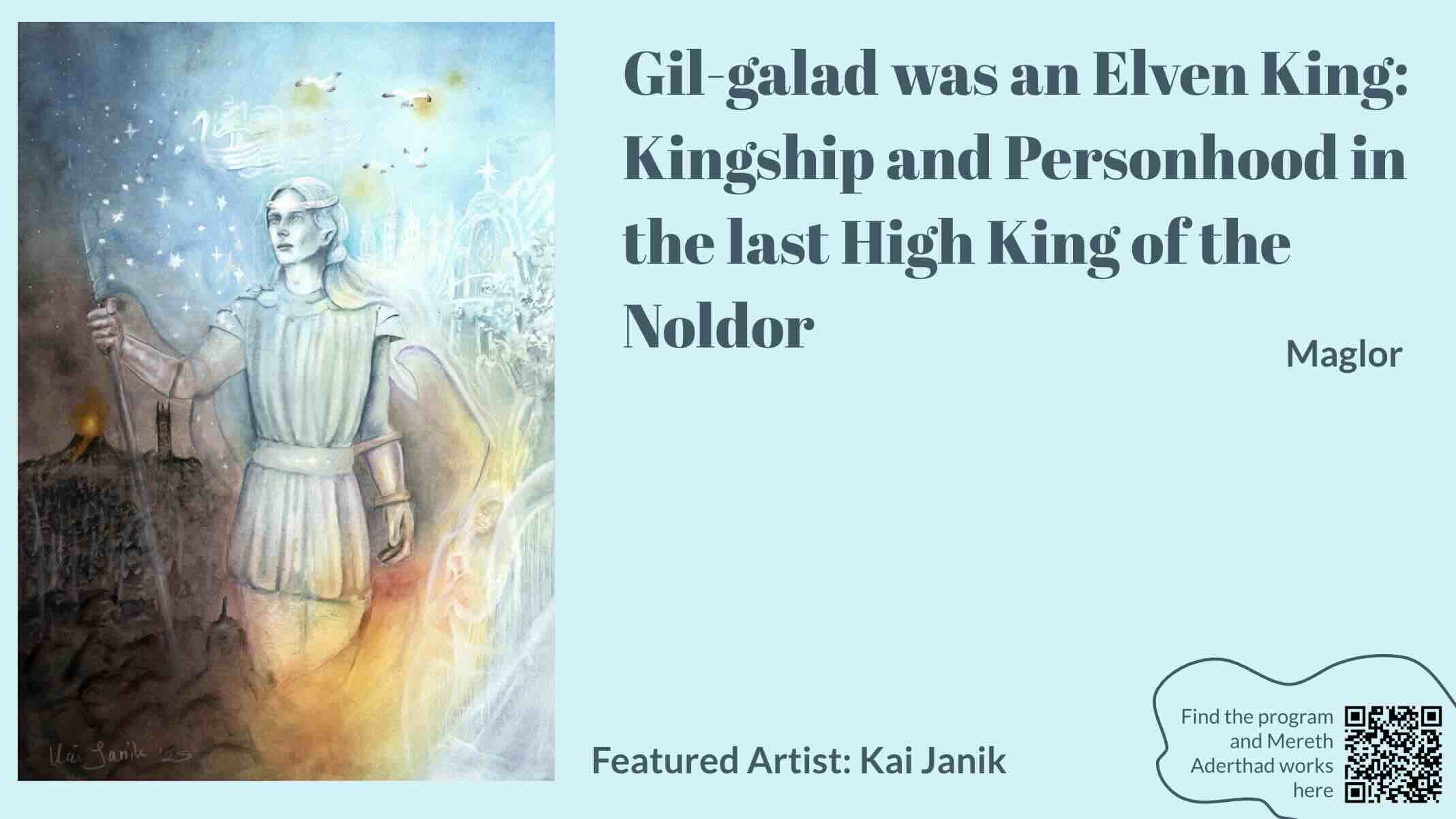
Gil-galad was an Elven king. Kingship and Identity in the last High King of the Noldor.
“Who was Gil-galad?” Merry asks in the Fellowship of the Ring. And Sam responds by reciting an old lay, beginning with “Gil-galad was an Elven king.” But surely there is more to him than that. Right? Now, to explore what we know and don't know about Gil-galad.
I searched Tolkien's relevant writings for any mentions of him, and found… As you can see, quite a few. For my analysis, I then removed any index entries, such as Aeglos, spear of Gil-galad and references such as “for that story on Gil-galad, see page whatever.” I then compiled all remaining lines into a spreadsheet, and arranged them so they can be filtered by things like topic, other characters mentioned, etc. The spreadsheet will be publicly available once I've cleaned it up a little bit.
Now, what am I doing with all of this data? Two things. First, I want to summarize all that we know about Gil-galad. And second, I want to analyze what we do not know.
Starting with what we do know about him. His name, or names, because he has quite a few of them. First, the one he's most referred to by. Obviously, Gil-galad, which means either ‘Starlight’ or ‘Star of Radiance.’ And it's generally considered an epesse. His given name is Ereinion, which means Scion of Kings. In The Peoples of Middle-earth, we find Artanaro, or Rodnor, which likely means ‘Noble Fire.’ In an urgent letter to Meneldur, we find Finellach, which likely means either ‘Flame of Hair and Eye,’ or ‘Flame-eyed Finwe.’ And last, we have Finwain, from The Nature of Middle-earth, which likely means ‘Young Finwe.’
His appearance is never described in detail. We know that he has silver hair, according to Nature of Middle-earth, and bright eyes that he got his name from. He is generally associated with silver. “The countless stars of heaven's field were mirrored in his silver shield."
His parentage is likely the most heavily discussed topic about Gil-galad. I won't be going in detail here, because many people other than me have done that, and it's honestly not all that relevant for this. The one thing we know for certain is that he's a descendant of Finwe. And some earliest conceptions of him, he was a descendant of Feanor. ‘The renowned,’ according to Elrond. Which Christopher Tolkien commented on, “it would be interesting to know his parentage,” which I agree, it sure would be. But Tolkien soon moved away from that. In The Parentage of Gil-galad's section in The Peoples of Middle-earth, we find that he was first considered the son of Finrod, and at that point, brother of Galadriel, who was, at that point Finrod's daughter. Then he became the son of Orodreth, son of Finrod, and the brother of Finduilas. But later, Tolkien said Finrod had no children, and Orodreth became Angrod’s son. The idea that Gil is Fingon’s son comes from a note on Fingolfin's death. But Christopher Tolkien later says that it was not the last of his father's speculations, and although he went with that version in the Silmarillion, he then admitted that it would have been better to have left the parentage obscure.
Well, if we don't know whose kid he is, do we at least know what he was up to during his childhood? Not really. We know that whoever his father was, he sent him to the Havens of Falas as a young child, either alone or with his mother, who is never mentioned again. When the Havens were destroyed by Morgoth. Gil-galad and Cirdan escaped and established a refuge upon the Isle of Balar. When news of Gondolin’s fall and Turgon's death reached them, Gil-galad became king of the Noldor. They tried to come to Elwing’s rescue during the Third Kinslaying, but were too late, so the survivors came with them afterwards. We know nothing of what he was doing during the War of Wrath, but we do know that afterwards, he was one of the elves who remained in Middle Earth along with Elrond. In the Second Age, Gil-galad played a role in all three of the major events, the rise and fall of Numenor, with whom Gil-galad had an alliance. The whole Annatar situation in the War of the Elves and Sauron. And of course, the Last Alliance, which is certainly his most famous accomplishment. It was formed by Gil-galad and Elendil, who led their armies to Mordor and besieged Sauron.
During this, all elves followed Gil-galad. Although the Sylvan elves seemed to have been reluctant in doing so. And eventually, Oropher charged before Gil-galad’s command, and then died.
Gil-galad’s last fight with Sauron was fought on the slopes of Orodruin. It is said that only Elrond and Cirdan stood with him. Most versions just say that Sauron fought with Gil-galad and Elendil. The one version has that he fought with Gil-galad, and the Elendil came to his rescue. Either way, both of them died. Though there is one early version, where Gil-galad is the one to take the ring from Sauron before being destroyed by Sauron's fire.
After that, he lives on in the legacy he leaves behind. His story is known to the learned and lore. He is regarded as one of the greatest Eldar of his time. There's a lay written about him, in an ancient tongue that Sam quotes in the Lord of the Rings, which calls him “the last whose realm was fair and free.” Some of his people remain at the havens of Lindon with Cirdan. In an early draft of Lord of the Rings, Gandalf tells Frodo. “Let us not speak of horrible things without need. They belong to the ancient days, and let us hope that they will never again arise.” At least Gil-Galad accomplished that. And this, I think, is where his legacy really lies.
Now that we've looked at what we know about Gil-galad, let's look at what we don't know. Gil-galad was an elven king. We know that. But what else was he? To explore that, let's start at the beginning, with his backstory. First, his very vague parentage. He is definitely tied to Finwe and thus the kingship. But not much else. His names, Ereinion and Finwain also clearly tie him to the royal line, but no particular branch of it, emphasizing that he is definitely king, without giving any further details.
And among the many changes, Tolkien never seemed quite certain where to place him. The only things that remain unchanged is that he is king, and that he dies fighting Sauron.
He has almost no backstory before becoming king. He is sent to the Havens of Falas as a young child, and escaped their destruction. And that's all we know. And his actual becoming king is very vague as well. We don't know how old he is at the time. Though given available information, he was likely very young, especially since he did not become king after Fingon died. Which means either he is not Fingon's son, or he was too young at the time. This lack of information leads to him feeling unmoored in the narrative, as though he sprang fully formed from the ground when the Noldor needed a new king. Like his entire narrative purpose is being king. Contributing to this is the fact that all his actions are within the context of kingship.
He always acts as a king. Never just as a person. There is very little to establish personality, especially compared to the other kings of the Noldor, all of whom act outside the kingship as well. Some of their most defining actions occur outside that context. For example, Feanor with the Silmarils. Fingon's rescue of Maedhros. The situation with Finwe and Miriel and Indis.
One clear way to show that is that he is the only one of the Noldor kings who doesn't have a single line of dialogue anywhere. For this, I used Dawn Felagund's amazing spreadsheet on dialogue in the Silmarillion, which I will link to in my paper. It shows that all of the other High Kings, from Finwe to Turgon, all have at least one line of dialogue in the Silmarillion alone. Gil-galad gets nothing at all in the Silmarillion. And all he gets across all of Tolkien's writing is his one letter to Meneldur. The only time he expresses himself rather than being talked about.
And when we look at Gil-galad in the narrative, we see that he has almost always talked about. We are always looking at him from the outside. We look at him from the lens of Numenorean history, and the role he played in that, especially in the Unfinished Tales. And then in Lord of the Rings. We look back at him from the Third Age, and see his legacy, his greatest deeds, see what he is remembered for. But we never see the person. Gil-galad’s never the main character of the story he is in, despite his historical importance. He's a side character in the tale of Numenor. He's a side character in the Annatar story, with a focus being on Celebrimbor and the Rings. Then Elrond and Imladris. In the Last Alliance, he shares the spotlight with Elendil and that story is more about the war and Sauron's downfall. And even in his death, the narrative focuses on Sauron's downfall and the ring and the aftermath and not on Gil-galad.
The one thing that his death does, though, is tie him even closer to the royal line, as his death mirrors elements of the deaths of previous High Kings. Feanor and Maedhros in the fire. Fingon and forming an alliance, and leading an army to the Dark Lord's doorstep. And Fingolfin, in fighting that Dark Lord up close, and wounding him against all hope.
His death becomes the main thing that he is remembered for. And yet, we don't even know how he was mourned. Although that -- we know that he was, “of him the harpers sadly sing.” Nor are we told where or how he was buried. Again, unlike the other kings, like Fingolfin and Fingon. Elrond was presumably sad about his death, but we're not actually told that either.
We know very little about his interpersonal relationships in general. We don't get to see him interact with his various parents or parental figures or his siblings, in the version where he has them. Compared to the other Finweans, for whom family relationships and feelings about them play an important role in defining them. See Feanor’s whole thing. Fingon and Maedhros, Finwe, etc. Nor do we see him thinking about his parents. We don't see him missing his father. We get no info on his mother's fate. We don't see him mourning Fingon after the Nirnaeth. Or Orodreth and Finduilas after the fall of Nargothrond or Finrod after his death. In fact, we barely get any emotion from him at all.
The only time we get to see him actually have an emotion on page, it is anxiety, which is very relatable. But with the other kings, we get to see much more emotions. The most extreme example being Feanor, who experiences ten emotions at any given moment. But even with the others, we get some information, or at least hints on what they're thinking and feeling.
I've mentioned that Gil-galad feels like he's always an accessory to other people's stories, never the main character, although as High King of the Noldor. He is certainly an important historical figure, especially as he is the longest-lived and longest-reigning High King in Middle-earth. And I think this also true not just for Gil-galad. He is, importantly, High King of the Noldor in the Second Age, and by the second age, the time of the Noldor has passed. They were the main characters of the First Age. And now the focus of the narrative shifts to Men, to Numenor. The elves are still there, still present in the world and influencing the story, but they begin to fade into the background. And their king with them.
So, we've looked at Gil-galad. And we found a lot of blank space. Now, what do we do with all this blank space? We could say a blank page. How boring. Close the book, and move on to other, more colorful, fleshed-out characters. Or, we could see the blank page as a canvas, and have fun. One of the main reasons I, and certainly many of us, love creating fanworks for the Legendarium is that it is a large, interesting world, with enough empty space to play around in. And Gil-galad is a large and interesting character, with enough empty space to play around in. And there are so many fun things to do with them, so much potential, so many little hints just begging to be explored. And just for fun, I will end this presentation by sharing some of my favorites. First, his lack of established personality outside of kingship, and his likely a young age when he became king can make for a character who truly has no identity outside of kingship. If I'm a child king, perhaps, whose life has been so consumed by his duty that even he himself hardly knows who he is without it. His uncertain and varied parentage lead to countless incredibly creative interpretations across this fandom. And even the little hints Tolkien himself gives us are fascinating. A descendant of Feanor, the renowned.
His death at Sauron’s hand is one of the most well-established facts of Gil-galad. Or is it? Certainly, Tolkien intended for it to be. But between “and where he dwelleth, none can say.” And the ominously specific “But Gil-galad was lost, and Elendil was dead," fom an earlier draft of the Council of Elrond. He leaves open the eerie possibility that Gil-galad might not be quite so dead after all. And a very personal favorite of mine is aromantic Gil-galad, a favorite shared by at least part of the fandom, as both “aromantic Ereinion Gil-galad," and “aromantic asexual Ereinion Gil-galad” are official tags on Ao3.
Now, to conclude, Gil-galad was an elven king. And since the narrative does not afford him the chance to be anything else, it seems that it falls to us, the fandom. To answer Merry's question. Who was Gil-galad? And I think we're doing an excellent job.

