
Inedibles by Dawn Felagund
Fanwork Notes
Grundy did most of the heavy lifting for the Great Beleriand Bake-Off challenge, but when I copyedited it and put it on the site, I kept noticing prompts that had some delicious double entendres. When writing challenge descriptions, I often include the reminder that challenge prompts are always open to twists and loopholes, so when Himring and I decided to cohost an instadrabbling session together, we decided to head in this direction: challenge prompts that were taken beyond baking, exploiting all those twists and loopholes and myriad meanings.
These works come out of that instadrabble session. They are called "inedibles" because they do not mention baking at all. They definitely don't have anything to do with Christmas. They definitely do allude to the Solstice on which they fell: the constant cycle of life, death, and renewal; the clinging to light amidst the deep dark; senescence and cold and promise.
As such, some of them are dark. Check the notes on each piece for warnings. Quenya names, when used, are translated in the endnotes.
- Fanwork Information
-
Summary:
Various short pieces for the Great Beleriand Bake-Off PLUS! Instadrabbling session that Himring and I cohosted on the SWG's Discord. Maglor learns perfectionism from his father. Nerdanel becomes of the subject of the national epic of ugly girls. 1980s!Maglor discovers Lúthien as a calendar girl, and medieval!Maglor gets paid in gold. Tilion muses on the end of the world and his prophesied violent death.
Major Characters: Maglor, Fëanor, Lúthien Tinúviel, Nerdanel, Tilion
Major Relationships: Fëanor/Nerdanel
Genre: Ficlet, Fixed-Length Ficlet, General
Challenges: Great Beleriand Bake-Off
Rating: Creator Chooses Not to Rate
Warnings: Check Notes for Warnings
This fanwork belongs to the series
Chapters: 5 Word Count: 1, 439 Posted on Updated on This fanwork is a work in progress.
Like Him
Maglor wants Fëanor to teach him a new game so that he can fit in better with the young intellectuals of Tirion. What he learns instead will prove far more enduring. A triple drabble.
Prompt: fatherless pie
Excerpt from the song "Cat's in the Cradle" by Harry Chapin:
My son turned ten just the other day.
He said, "Thanks for the ball, Dad, come on let's play!
Can you teach me to throw?" I said, "Not today,
I got a lot to do." He said, "That's okay."
And he walked away but his smile never dimmed.
It said, "I'm gonna be like him, yeah,
You know I'm gonna be like him."
And four words from "The Fall of Gil-galad": harpers - keen - afar - none
This work is also personal. I am a workaholic, and I come by it honestly. I did not even think my dad liked me until he and I worked together at a restaurant when I was sixteen, and he realized my work ethic was like his. My dad taught me to use computers (as a girl, when this was not the way), so the SWG is partly to his credit.
Read Like Him
Macalaurë waited for the hammerfalls to go silent before he took down the box. He'd been given it by his father for his last begetting day: a strategy game favored among the Noldorin intellectual elite. Nelyo had mastered it years before and played with a fluid ease among the daughters and sons of Tirion's scholars, swilling wine and flirting and pausing in his debates only long enough to inch a piece, seemingly without thought, toward victory.
Macalaurë attended as the harper, in the room but from afar, as though out to sea, watching the lights ashore, and indeed, he'd spend the day mastering a new song for the next gathering, playing until a harpstring snicked and lacerated his finger deep enough to bleed. So when Fëanáro's work ended, he lowered the game from the shelf and brushed the dust from it and brought it to his father, in hopes that it might welcome him past the musician's stage and into the communion of Tirion's elite.
He found Fëanáro still in the forge, wrapping a burned hand. His father's shoulders hunched around the wounded hand, his keen eyes dimmed, and Macalaurë trod silently enough to observe this before Fëanáro felt his presence and straightened.
Macalaurë offered the box, feeling stupid even as he did. "I wondered if you might teach me …"
Why did someone who composed pieces accessible to none but a few harpers that arose at Cuiviénen let his voice trail into uncertainty, mediocrity? He saw that question in his father's eyes. He straightened his shoulders. The box still dangled between them.
Fëanáro's gaze softened a bit. "Not today," he said. "I have this to finish. I will be at it until late."
Back in his room, Macalaurë reshelved the box. He bandaged his finger and returned to work.
Chapter End Notes
Macalaurë = Maglor
Nelyo = Maedhros
Fëanáro = Fëanor
Ugly Girls
Lúthien danced into the most romantic of legends, but Nerdanel is renowned by the ugly girls for a different sort of triumph. A drabble.
Prompt: toad-in-the-hole
“There was panic in the parlour and howling in the hall” (From "Toad’s Last Little Song" in The Wind in the Willows by Kenneth Grahame)
There is a nod to the "buns" prompt in here too.
Dedicated to my fellow fans who have been or are ugly girls.
Read Ugly Girls
If the Tale of Tinúviel was the paean of moon-eyed romantics, the tale of Nerdanel was the national epic of ugly girls. The way everyone sat upright and smiling when Fëanor entered hand-in-hand with her, with her split ends and her freckles and her muscles. But when he took her home to bed oh! the panic in the parlor! the howling in the hall! Brilliant, bright-eyed, callipygian, keen-witted, fine-shaped, raven-haired, silver-tongued, High-Prince-of-the-Noldor Curu-fin-wë Fë-a-náro (his name stretched to a savor of a dozen words) wasted on her. Pushing coarse hair behind jug ears, ugly girls deliver the tale in triumph.
Lúthien in Bullet Points
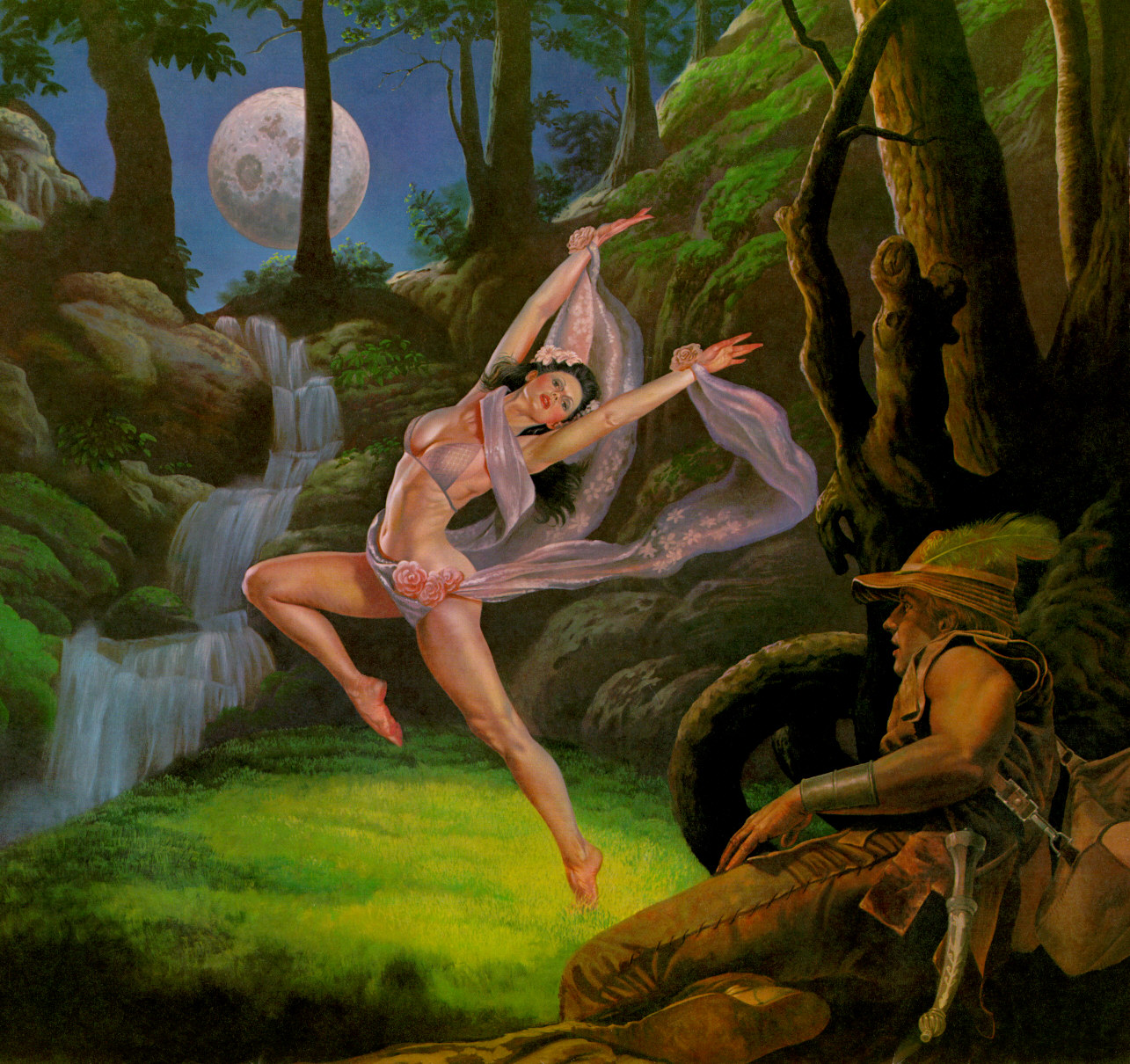
Maglor is an accountant in the 1980s, trying to blend into his world but unable to resist collecting artifacts that allude to his past. When a Tolkien calendar arrives with Lúthien presented as a pin-up girl, he contemplates her depiction through the centuries compared to who she really was. A triple drabble. There are allusions to sex and violence and their overlap in this one.
Prompt: cheesecake
Cheesecake has a rather old-fangled double meaning as a sexy image of a woman. The specific prompt for this piece is Rowena Morrill's (in?)famous artwork of Lúthien dancing for Beren. Is this how I imagine this scene, Lúthien, Beren? Not at all, but I give Rowena credit for seizing on 80s fantasy and popular culture and going all in. Feathered hat off to you, Rowena!
Read Lúthien in Bullet Points
Maglor had maintained an interest in the renderings of his people's history across the centuries. He was neither an expert nor connoisseur; he merely acquired artifacts at his convenience (not waiting in a line or anything like that), maybe by mail order or secondhand. He had a small collection that would be difficult to explain and likely dismissed as an old man's eccentricities—that is, if he was ever to age beyond the body of a middle-aged accountant (he would not).
When Rowena Morrill's calendar arrived and he paged to May, he said, "Oh," when he saw Lúthien: not an exclamation, just a bullet point in an ever-unspooling list that could be headed Well That's New. He certainly couldn't put it up in the office, though it might make him "righteous" enough (quote-unquote) to net an invitation to after-work drinks with the accountants who left one too many buttons undone (in his opinion, of course), revealing a furze of chest hair or parentheses of cleavage.
By now, Lúthien had stepped onto the stage of history in the roles of goddess and witch and damsel and temptress. This was just the latest iteration—and not the least-clad of them! She'd been carved onto the prows of ships, played by rouged men with melons in their bodices, and invoked in frantic Beltaine couplings. She could withstand being May's pin-up girl.
But he'd known her. Only in passing and, truly, mostly by reputation, but neither she nor her mother were to be trifled with: like wolf bitches, supple as the night, eyes afire with incinerating starlight, teeth not-unstained by blood. Even while his brothers lived, tales of her had been subdued to propriety—but it had not been benign magic that tamed even Curufin's hunger for the Silmaril to docility, that stripped Sauron to a naked fëa.
Payment in Gold
Maglor-in-history again, now in the Middle Ages, receives a payment in gold that does not meet his expectations of the past. A perfect drabble.
Prompt: gold coins
Read Payment in Gold
Maglor was paid once in a small drawstring bag of gold coins given by a prince to the finest singer in the land. At home, he spread them on the table and moved the candle so light quavered across them.
Aulë's ichor, Curufin called gold: hard-won, precious, the stuff of gods. That it had been reduced to identical chips stamped with a misshapen face! (He could draw better!) It should grace crowns, hands, cup wine, or sing as harpsong.
But none remained to fashion it.
He curled upon a straw mattress and did not rise when the thieves took it.
Moonfall
Tilion has a lot of time to think now that steering the Moon has become a routine job free of dragons and dark lords. He knows his place in the prophesy and that he will die violently, and he wonders if he can aspire to the dignity he has observed of the mortals in Middle-earth. A ficlet with dark themes related to death and references to blood and violence.
Prompt: mooncake
This ficlet responds to the quote, "not until the Sun passes and the Moon falls, shall it be known of what substance [the Silmarils] were made," with another nod to the "buns" prompt.
Read Moonfall
Tilion's job had become dull. Now that the assaults of Melkor and the threat of Ancalagon and, yes, the lusts for Arien were dissipated, he took his seat, long since molded to his posterior, and draped the reins across the well-worn crease of his hand and fell into muscle memory, twitching his wrists this way and that, uttering "git!" and "whooooa" without bothering to hear his own voice. He knew where eddies of wind would threaten the chariot and compensated flawlessly, so that an astronomer in his stone tower by the sea might set his telescope to the Moon's arc and always find Tilion's heavy-lidded face filling his viewfinder.
Steering the Moon gave a man a lot of time to think. And watch. He watched what transpired in Middle-earth. He saw many people die: heroes with swords that Tilion's arms-gone-frail probably could not lift, who spilled blood without a whisper of regret; he watched them beg for their lives at the points of swords or on the verges of cliffs. The tears of heroes contained the same salt as those of babes new-born.
He watched rich men who left their people to waste to dust by starvation's slow hand blubber when the relative mercy of a pitchfork pressed their own throats—their dying cries the same pitch as the orphans they'd made.
Tilion thought about this. He knew the prophecy. He would crash to the earth and die at the world's end. From his seat steering the Moon, he'd seen crashes of all sorts, in the progression of transit technology, and he knew the ugliness of limbs and heads and guts entangled with conveyance. Cantilevers and pistons and gears crushed flesh no matter what powered them, horse or steam or magic. He sometimes pondered his slender arms with his veins the color of the full-moon night and wondered what they would spill, when mangled, and how it would feel. How much would it hurt? He wondered if he'd scream and sob and beg like the people he watched from the seat of the Moon.
He reminded himself that people died quietly all the time, in dignity if not silence: the mothers blood-soaked in childbed, the grandfathers whose hourglass drained dry, the little children who caught disease like a cat catching butterflies. The butterflies, for that matter.
Tilion made up his mind that he would die like that, when the prophecy came to pass. He'd had millennia, after all, to live and steer the Moon that marked people's lives and watch what transpired. Under his light, loves were kindled. Peace forged, stronger than steel. Stories told that gave another gasp at life to the mothers and the grandfathers and the little children and the butterflies—and yes, the heroes and the rich men too. They were given dignity in the stories by those who remembered and loved them, despite their flaws. Tilion contemplated the bones of his hands, the blue-tinged nails that he clipped the night before he made new, palms damp with dew. He didn't want any of these small, precious things to fall to ruin, but no one did, he supposed, and yet all did. He would not be alone in going, when his time came.
The wind eddied and his wrists twitched and an astronomer showed her daughter the changeless face of the moon as he sank behind the mountains: another day closer to moonfall, but he'd be ready when the time came. Steering the Moon gave a man a lot of time to think.


Moonfall, and others
This fic seems especially suitable for the winter solstice, among the rest!
There is certainly a lot of darkness that Tilion has seen.
But he manages to think less dark thoughts as he goes on, despite his circumstances, which could certainly induce depression.
I was also struck by your suggestion of physical deterioration. But I guess he really does not have much chance at archery anymore!
I liked your two astronomers, a subtle contrast.
I loved the rest of the drabbles, too. The ones about Maglor all resonated.
I had Solstice themes in…
I had Solstice themes in mind more for this one than the rest, so I'm stoked that you picked up on that!
I probably don't buy into my own idea of physical deterioration, from a "canon" perspective lol. It was much more a creative choice, in this particular piece, in wanting to show the "waning" (heh) of an "immortal" being who has started to think about the end. (Hey, he still has those ever-growing nails to clip! :D)
Thank you, as always, for reading and commenting. <3
A side thought, this made me…
A side thought, this made me think that his deterioration is shaped through his thinking about his end, in a similar way to how the Ainur shaped the world. Witnessing all the cycles of events going on and on through the ages could only have a marked impact. I really appreciate this one.
(And also enjoyed the other drabblea in the instadrabbling channel)
Oooh, I like this…
Oooh, I like this interpretation! Kind of how Sauron lost his ability to take fair form after a while, when evil began to define his identity (as perhaps senescence is defining Tilion's).
Thank you for reading and commenting! I'm glad you liked them! ^_^
Glad you enjoyed the double…
Glad you enjoyed the double entendres! I was trying to make sure there was scope enough for folks to get out of the kitchen if they wanted! And I love both your instadrabbling prompts and your drabbles, though I think "Ugly Girls" was my favorite. (I am a sucker for Wind in the Willows, and Toad's Last Little Song is a favorite!)
When I was formatting the…
When I was formatting the challenge for the site and copyediting, I kept finding all these ways to twist the prompts, and instadrabbling provided the perfect opportunity to let what usually exists only in my head out to play a bit! I am also partial to "Ugly Girls," so I'm glad you liked it too. Thanks for reading and commenting!