Cultus Dispatches: Revelations from Marquette's Fanzine Dataset
In September 2026, Marquette University released a dataset about their Tolkien fanzine collection. Analysis of the data reveals what these fanzines contained and show how pre-internet Tolkien fandom responded to the publication of "The Silmarillion."

SWG News
New Challenge: Unquote
Choose a prompt from our selection of misheard, miswritten, and misrepresented unquotes that are in no way part of the actual "Silmarillon."
Site Etiquette Update: Fandom and Money
We have updated our policy in our Site Etiquette around linking to sites that collect money.
Character of the Month: Eönwë
This month's biography focuses on Eönwë, who started with a variety of identities but settled into the role of Manwë's herald, exemplifying the values of strong leadership and justice.
New & Updated Fanworks
[Writing] The Day Transcending Night by StarSpray
The Rings have been forged. The armies of Mordor are marching into Eriador. Eregion burns.
Far away from it all, by the shores of the Sea, Celegorm remembers his name.
[Writing] The last son of Feanor by ford_of_bruinen
Maglor long after elves have left middle earth
[Writing] Darling Enemy by octopus_fool
Eärendil thought he would have the sky to himself.
[Writing] Room in the Heart by Dagstjarna
Newlywed Indis begins acquainting herself with married life, both its highs and lows.
[Writing] The Parting Birds by Dagstjarna
Dior tells Elwing a bedtime story.
[Writing] Eä's Redemption by AaronAzrael
This is my new poetical attempt to add my own interpretation to Tolkien's Cosmology as to Eru's Creation and the Valar's minds and behind-the-scene providence reasons and mechanisms.. I often review Eä as part of our own world, just in another dimension, this is why I have always seriously…
[Writing] From That Rubble by StarSpray
Fëanor shrugged, studying the contents of his wine glass. “Something must be done about that house. It will fall down eventually.”
“It does not follow that it must be you that tears it down single-handedly. Are you sure you do not want help?”
“It’s not as though I…
Current Challenge
Unquote
Choose a prompt from our selection of misheard, miswritten, and misrepresented unquotes that are in no way part of the actual "Silmarillon." Read more ...
Random Challenge
Middle-earth Museum
Stroll the halls of an imaginary Middle-earth Museum and choose one (or more!) objects from our prompt list to inspire the creation of a fanwork. Read more ...
New in References
Fandom before the Time of the Trees: Revelations from Marquette's Fanzine Dataset by Dawn Walls-Thumma
In September 2026, Marquette University released a dataset about their Tolkien fanzine collection. Analysis of the data reveals what these fanzines contained and show how pre-internet Tolkien fandom responded to the publication of "The Silmarillion."
Across the history of the "Silmarillion," Eönwë's role settles on a character who leads without taking upon himself the power to mete out justice and who acts with equanimity across some of the most harrowing conflicts in the early legendarium.
Speak Friend and Enter: Trends in Fandom Entry Year by Dawn Walls-Thumma
Across three surveys and ten years, the Tolkien Fanfiction Survey has document when authors began writing. These data reveal trends in how film promotions, the films themselves, the books, and other historical contexts have influenced not only who writes but how long they stay.
Featured Themed Collection
Beyond the Silmarillion
[Writing] IN THE SHIRE-RECKONING by Diane Finnis-Robb
-This novel was completed for Hobbit Day 2026 and will be updated in serialized fashion here as I make final edits; so feedback is very much welcome.
-It is a multi-generational novel spanning a period of time from the formation of the Shire to the Great Plague in Year Thirty-six and…
[Writing] For a Better World by Ellynn
Thirteen years before the War of the Ring, an orcling — more intelligent and more curious than most — is born in Mordor. His curiosity will lead him to both incredible discoveries and perilous situations, all of which will shape him into a leader unlike any Mordor has ever known. But to become…
[Writing] Sun on the Daisies by StarSpray
“Oh.” Frodo’s voice was soft, almost more sigh than sound. “Sam, look.”
Around the World and Web
14th International Tolkien Mailing Competition
The Hungarian Tolkien Society invites you to join the international “Quendi” category of the Tolkien Mailing Competition: five rounds of quizzes, riddles and creative tasks. This category is organised in English, open to any individual participant, and also to teams of 2–5 people. The five rounds of the competition will last from November to April.
Tolkien Food Week 2026
fandom event from the 2-8th nov 2026 where we share recipes, fics and comfort food for body and soul.
The White Oliphaunt 2026
The White Oliphaunt gift exchange, a yearly event where Tolkien fans sign up to exchange humorous gifts with each other.
Glorfindel Week 2026
A Tumblr fandom week dedicated to the elf Glorfindel.
Silmarillion Secret Stockings 2026
A fandom event to celebrate the end of year holidays with prompt-based gifts.
dye me, nocturne by skywardstruck
| | |
2. Daeron
Daeron is drawn to the shores by a haunting melody, and encounters Maglor, for the first time since the Mereth Aderthad.
Once, the Ered Luin was an impenetrable wall dividing Beleriand from the rest of Middle-earth. Now, in the aftermath of the War of Wrath, Beleriand is no more, the sea has broken through, the River Lhûn divides the mountain range in two, and those left in Middle-earth must pick up the pieces of a land crumbled by war.
Daeron, the greatest minstrel among the Sindar, journeys down the river to the west, in search of his fellow Elves, after many long years in self-imposed exile. He must hold out hope that he will find purpose again; it is hope that keeps his voice alive, even as he wanders, his accomplishments forgotten, alone and burdened by jealousy and resentment. Though he loved Lúthien like a sister, he was sundered from her when she chose mortality, leaving everyone she loved behind in death. And in his fruitless attempts to protect her, Daeron became the villain in her story, a sacrifice that amounted to nothing in the end.
Glaerorn would surely be ashamed of him, if she knew what he had become. Glaerorn, his older cousin who so dutifully and patiently taught him how best to connect with his voice, to carve the most beautiful flutes from the bark, to resonate his fëa with the voices of the trees. “The power which rests in your song is your greatest weapon,” she once said. “You must use that power... to sway the hearts of all who hear you, to find meaning where there is nothing, a path forward in your darkest hour.”
Daeron walks through darkness now, for he is no one anymore. But the hope of finding someone, anyone to fill the hole in his heart, keeps him searching. Perhaps he can find Glaerorn, rest his heart in the comfort of her guidance.
As he travels, he hears stories of events that have transpired since his departure, the same stories, told again and again as he searches for signs of his old life. Travelers from the west of the mountains tell Daeron of the fall of Doriath. How Thingol’s heir, Dior, the fairest of all the children of the world, was cruelly slain by the Sons of Fëanor, along with his beloved wife Nimloth— though not before Dior slew Celegorm the cruel with his own hands. And how the sons of Dior were lost after the massacre, left to starve in the woods, no one at all knowing of their fate. Daeron’s beloved home, gone, destroyed, drenched in blood before the sinking of the continent.
The travelers tell of the terrible attack on the Havens of Sirion— refugees from Doriath, Gondolin, lands of the Haladin, cruelly slain by the forces of the Sons of Fëanor, all to claim a single Silmaril kept in the hands of Elwing, granddaughter of Lúthien. “It was the worst, the most horrific of all of the kinslayings,” a fellow Sinda heading east tells him. “The Lady Elwing was pushed to her death, only saved by Ulmo’s grace...”
“And what of the survivors?” Daeron asks.
“I managed to escape the worst of it,” the traveler replies, “but it was likely they were scattered, as I was. I know a few of the survivors reside in Lindon now; I have just come from there. Whatever you are seeking, perhaps in Lindon you will find answers.”
“If from Lindon you have come... what can you tell me of Glaerorn, or her kin?” Daeron inquires further, desperate for news of his older cousin and mentor. “She was a flute-maker, the greatest in Doriath, a talented singer and teacher...” He knows there is little chance a random traveler will know, but he asks anyway, for leads have been few and far between.
“I have not heard that name in some time,” the traveler admits, regret in their voice. “The last I heard of her, she was protecting the Lady Elwing’s twin children, Elrond and Elros, from the kinslayers in Sirion— whether she managed to escape herself or was slain, I do not know.”
“I... I see.” It is all Daeron can say, for a fate unknown terrifies him more than anything.
“I am terribly sorry I could not be of more help...”
“Do not... be burdened by my troubles,” Daeron pleads. “I wish you well on your journey.” He bows his head, going on his way, keeping his true feelings inside. Daeron refuses to let anyone see his weakness, for ever since Lúthien was lost to him, Daeron vowed the song of his heart would be his alone.
❧
Daeron continues his travels west, still in search of Glaerorn. However, his heart is heavy now, confronted with the possibility that his dearest cousin could be dead, murdered by the hands of kinslayers. Perhaps someone in Lindon will know more of her fate. Never let go of hope, he tells himself again, even if he is beginning to believe it less. Glaerorn could still be alive, Daeron knows, and yet, the horrific image in his head will not leave him— what if it’s true? He begs silently yet fervently for some kind of sign, any way forward—
In the silence, a single note rings out, almost forming into words as if it were a message from far away. Though Daeron cannot understand it yet, he knows it to be a voice, at least, and someone who is just as lost as him. So he takes out his flute, a gift from Glaerorn, his most prized possession— and answers back with a note of his own, harmonizing, letting his feelings flow through the instrument and along the wavelength of the Music. The distant singer calls to Daeron, full of loneliness, guilt, resentment and longing all at once; it is everything Daeron feels now, and he wonders, if he followed the voice to its source, would the singer understand?
What can you do, when you have nothing left anymore?
And so Daeron follows the voice, caring not on what paths it takes him. The voice sings of family, lost to blade and flame. It sings of sacrifice, becoming the villain in the story, if it meant fighting for those they loved. But it also sings of regret, a funeral march and a lament all at once, for nothing can erase the pain they had wrought on others, nothing can return them to the way they once were, loved and respected by all for their talents and accomplishments. The voice seems to draw out every burden in Daeron’s heart, for the song is his, too, as the sorrowful notes of his flute join with the pained tones of the singer’s voice. And atop a hill, Daeron can perceive the beautiful shores of Forlindon, the sparkling waves resonating with the music as if mourning alongside the singer; still, they beckon him forward on the path, as Daeron gives himself up to the music, wandering ever closer to the sea.
Daeron knows not how much time has passed, when he finally reaches the shores. As he regains his senses, searching for the owner of that anguished voice— he sees a figure off in the distance, with long, curly black hair blowing in the wind, hands reaching for the frame of a golden harp. Daeron treads carefully towards the singer, hoping to catch a glimpse of their face.
Another wave crashes onto the sand as the singer turns around, eyes full of tears, gazing at Daeron in disbelief, as if he is nothing more than a dream. But the music pauses only for a moment, and soon enough, flute and harp become one.
❧
The Music lasts for some time, the sweet notes of Daeron’s wooden flute soaring above the gentle, sorrowful notes of the stranger’s harp. Daeron is not lost in the music for long, however, as he soon begins to notice some of the features of his surroundings: the grains of sand between his feet, glittering from Arien’s reflection; the worn-down cabin past the rocks; the vastness of the sea. He notices more about the strange singer, as well. His eyes are drawn to the raggedy clothes, the fading light in their eyes, and the singer’s left hand, blackened as if scorched by flame. Daeron realizes neither he nor the stranger beside him have revealed much to each other, and now he wonders, what could have led to this? What is the cause, of the sorrow in this stranger’s heart, the burn upon their hand? And the more Daeron observes the stranger, with their loose wavy curls, distant gaze, sweet tenor voice— the more Daeron wonders if perhaps, he has met them before.
And then, the Music comes to a halt.
“You have stopped,” the stranger observes, speaking softly, with a tone suggesting curiosity rather than disappointment. “Did you wish to ask something of me?”
Daeron hesitates, if only for being taken aback by the stranger’s speaking voice. It is a prince’s voice, one he swears he remembers from somewhere. And those glowing eyes— if it is the light of Valinor, surely a prince of the Noldor sits before him....
“You have traveled far, to reach me,” the stranger adds, noticing Daeron hasn’t asked his question yet. “If my voice has made you stray from your path, made you weary, helpless in its wake... I understand, if you cannot forgive me for the hurt I have caused you—”
“None of that,” Daeron interrupts, not interested in the stranger’s calculated self-pity. “Just.... tell me, who are you?”
“I am Maglor, son of Fëanor,” he answers, without a single reservation, though he pauses soon after to observe, as if he knows how Daeron will react. “The last son of Fëanor.”
“Then you—”
“Yes, I am a kinslayer,” Maglor states plainly, a strange smile forming on his face, burnt hand placed delicately on his chest. “Corrupted, lost, with no hope of redemption.”
Daeron narrows his gaze. How strange, that the song should lead him here, to Maglor, the minstrel who had swayed his heart during the Mereth Aderthad, a kinslayer who killed so many in his family’s relentless, bloody pursuit of the Silmarils, that cursed gem which led Lúthien to— no, he cannot dwell on this now, not when he has spent so long escaping his grief. And it would be wrong, anyway, to blame this fallen prince, for the actions of Doriath’s foolish, vain king.
Anyone in their right mind would warn Daeron, to be careful when dealing with kinslayers. But something about Maglor doesn’t sit right with him. The kinslayer is clearly remorseful, Daeron observes, but why, then, did the song lead me here? What does he want from me?
Daeron decides he will only ask for information, nothing more. Vengeance, he leaves to those whose hearts burn more fiercely than his own. So he asks about the obvious.
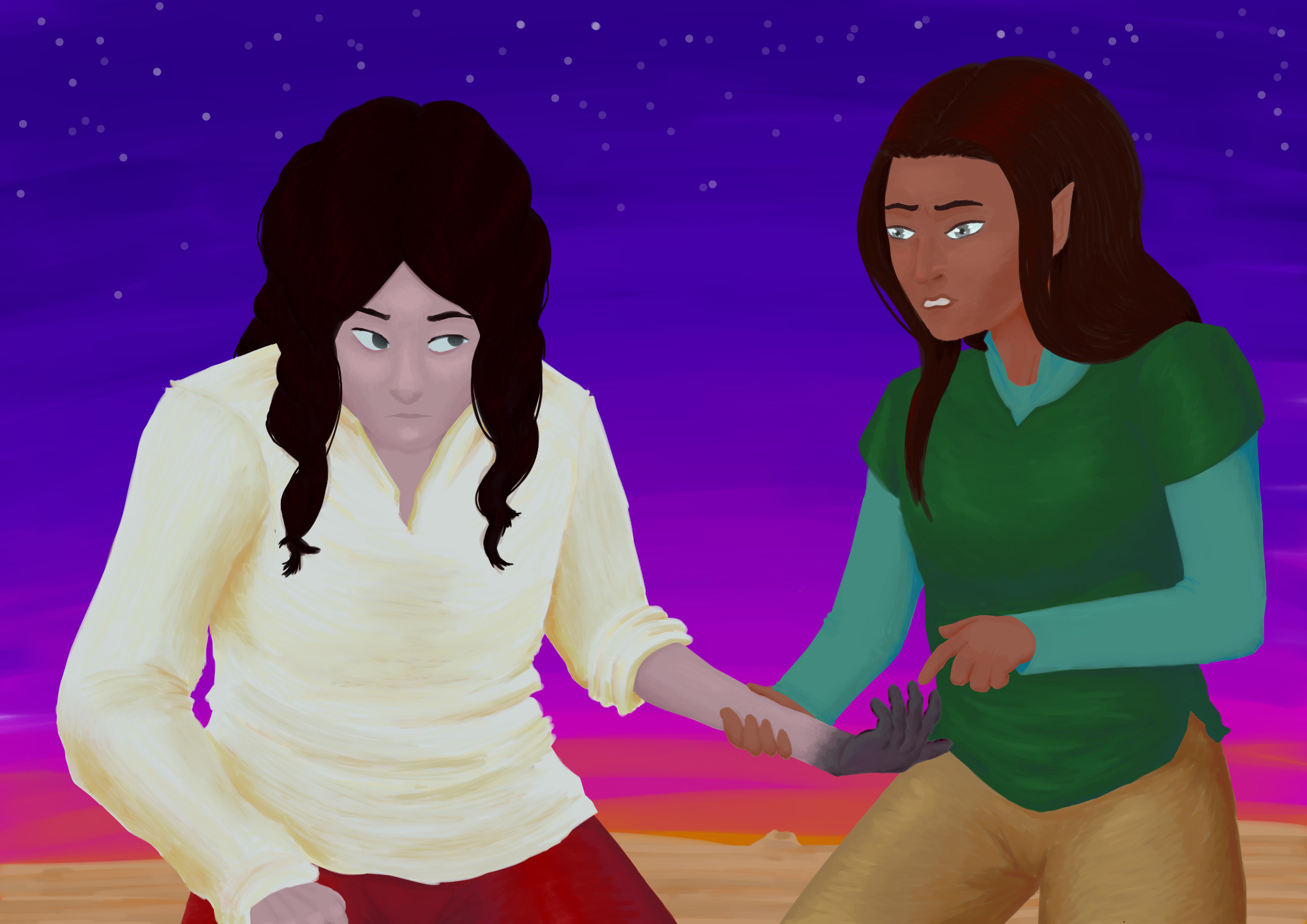
“That blackened hand of yours. How did this happen to you?” asks Daeron, kneeling before Maglor.
“Oh, this...” Maglor mumbles, extending his arm a bit to allow Daeron to inspect it. “I was punished. After everything I’d done, I could no longer... ai!” It stings Maglor a little, when Daeron rubs a finger across his hand, feeling the heat radiating from it, and Maglor winces. Daeron notices this right away, eyebrows furrowed in worry, and lets the unburnt skin of Maglor’s arm rest in his palm instead.
“Punished you? Who punished you? How?”
“When the Silmarils were made... Elbereth hallowed them, so that if evil hands ever touched them, they would be burned, and face the judgement of the Valar,” Maglor explains, carefully looking up at Daeron, as if trying to gauge his thoughts. “Though we had sworn an oath to recover them, no matter who or what opposed us, all of it was in vain, from the very beginning... everything I’ve sacrificed, everyone I’ve lost, all of it..." Maglor’s voice shakes, and Daeron isn’t sure what to think, but he knows he cannot let his emotions get the better of him.
Especially not when Maglor has that look in his eyes, demanding pity without saying anything at all.
“Of course the Silmaril would burn you,” Daeron asserts, growing more frustrated, and he wonders if Maglor is aware of what he’s doing. “You’re a kinslayer; how many of my own kin have you killed with those hands? Nothing, no amount of remorse will erase what you’ve done.”
“I know,” Maglor assures him, “But I cannot erase these feelings of regret, either. I shall carry them with me until the end of Arda, and I have accepted this fate for myself,” he explains with a gentle smile. “It is only right. I can feel how your heart weeps for those you have lost, how the grief still tears away at you unceasingly, and I too weep alongside you, even though I do not know who you are...”
“You may call me Daeron,” he replies, wondering how much about himself he should reveal, especially since Maglor didn’t seem to recognize him before. Then Daeron remembers his pride, everything that had been forgotten about him once Lúthien and Beren were immortalized as heroes, and his tone changes. “Daeron, of Doriath,” he says, more self-assured as he stands to introduce himself. “Inventor of the Cirth alphabet. Loremaster of King Thingol. The greatest minstrel among the Sindar.”
“Ah... the one who played for us, at the great feast, all that time ago...” Maglor reminisces.
“The very same.”
“Then it must have been fate!” Maglor declares, breathing a sigh of relief. “That you, of all people, should hear my song, and find me here...”
“I hardly know you; we only met briefly on one occasion,” Daeron retorts. “Other than my noteworthy accomplishments, what makes me so significant?”
“You...” Maglor pauses, observing Daeron with an unnerving gaze. “You’ve come here looking for someone, haven’t you?”
Daeron curses himself, for being so easy to read.
“What do you really want, Maglor?” he asks, his patience thinning. “I have nothing left anymore. You aren’t going to get anything out of me, that I can promise you, why have you called me here?”
“Whatever you are imagining... I seek nothing of the sort,” Maglor insists, “for I too, have lost everything. Do you not wish to know what became of that person? The one you’re searching for?”
Daeron hesitates to say her name now. He would leave himself vulnerable, thinking of his beloved mentor, and how long he wandered in self-pity and jealousy, cursing everyone who led to his fall. Mentioning her name, stirring up all of the emotions that come with it, letting himself be vulnerable to Maglor’s manipulation— all of it will only give the kinslayer everything he wants. Maglor will never understand that feeling, not someone as cruel and heartless as him, with no regard at all for the sanctity of life, only selfish regret after the fact.
Unfortunately, as Daeron soon realizes, Maglor is probably one of the few people left who can tell him of Glaerorn’s fate. That news is all Daeron wants, and Maglor seems to be eager to give it to him. Would it hurt so much to play his game? What does Daeron have left to lose, anyway?
“Glaerorn, the flute-maker.. my mentor, and cousin,” Daeron finally says. “That performance you heard from me, at the Mereth Aderthad... Glaerorn taught me that song. The melody, the technique, all of it. She made the flute for me,” he explains, keeping a close eye on Maglor’s body language. “The last anyone heard of her, she was protecting Lady Elwing’s children at Sirion... Surely you would know of her fate. You started the violence yourself, murdering all of those helpless people. Tell me, what happened to Glaerorn?”
Maglor’s eyes widen, and his brows furrow in the silence, seemingly deep in thought about what he should say. Daeron cannot read Maglor’s thoughts, for his fëa is unrecognizable from what it once was, made twisted from his horrific deeds. But Daeron can tell that Maglor recognizes that name, and for a fleeting moment, Daeron notices a chilling smile on Maglor’s face.
“I am terribly sorry...” Maglor answers in a soft, shuddering voice, afraid to meet Daeron’s gaze.
“For what? Answer me swiftly; I grow weary of this game, Maglor.”
“Your search, o Daeron... it ends here,” Maglor finally answers. His expression darkens, though he speaks with more certainty now, as if he had been waiting for this moment for a long time. “Glaerorn... is lost.”
“Lost...?”
“Indeed. For she died on my blade... I was the one who killed her.”

