
Six Demographic Takeaways from the 2025 Tolkien Fanfiction Survey by Dawn Walls-Thumma
Posted on ; updated on
This article is part of the newsletter column Cultus Dispatches.
Since antiquity, the 5W+H have been used to gather information and fully tell a story. The first W asks, "Who?" and answering this question was a prevailing concern in the early years of fan studies research. Who is a fan? Who writes fanfiction? While the first question is very complex given the breadth of what constitutions fandom (sports fandom? soap opera fandom? comic fandom?), the second tended to settle more readily on a predictable set of answers: Fanfiction is a genre of the disempowered. It is a woman's genre. It is a queer genre. It was a genre where fans of color and fans with disabilities could subvert mainstream texts to see characters like themselves elevated—or simply included.
This is a vast oversimplification representing an ideal about a key function (according to scholars) of transformative or fanworks. No fan studies scholar would say it is that simple, but compared to mainstream fiction, the trends hold true for the most part.
In 2015, I ran the first iteration of what is now the longitudinal Tolkien Fanfiction Survey, which welcomes both writers and readers of Tolkien-based fanfiction. In 2020, I was joined by fellow scholar Maria K. Alberto, and last year, we ran the third installment of the survey, resulting in three sets of data spanning ten years. One of the changes Maria and I made in 2020 was to add more demographic questions: the who of Tolkien-based fanfiction. Survey participants were asked about their gender, age, race/ethnicity, religion, first language, and level of educational attainment. Participants were also asked whether they experienced marginalization based on any of these identities. With the exception of language and education, questions were open-ended or included an option for participants to self-describe. Participants could also skip any questions they didn't want to answer. In 2015, 970 people participated in the survey, followed by 746 people in 2020; in 2025, 436 people participated.
In 2022, I wrote the article Who Are We? Tolkien Fanfiction and Demographics based on the results of the 2020 survey. This article considers what, in the past five (or sometimes ten) years has changed and what has stayed the same.
Takeaway #1. "Fanfiction Is a Woman's Genre" Gets Complicated
 When I first started doing fan studies research, "fanfiction writers are 90% women" was canon. It was initially stated in 1980 by Johana Cantor, restated in the foundational scholarship on fanfiction in the early '90s, and backed up by a few studies in the 2010s, including the original data for the 2015 Tolkien Fanfiction Survey. I discuss these studies in some detail in the Who Are We? article.
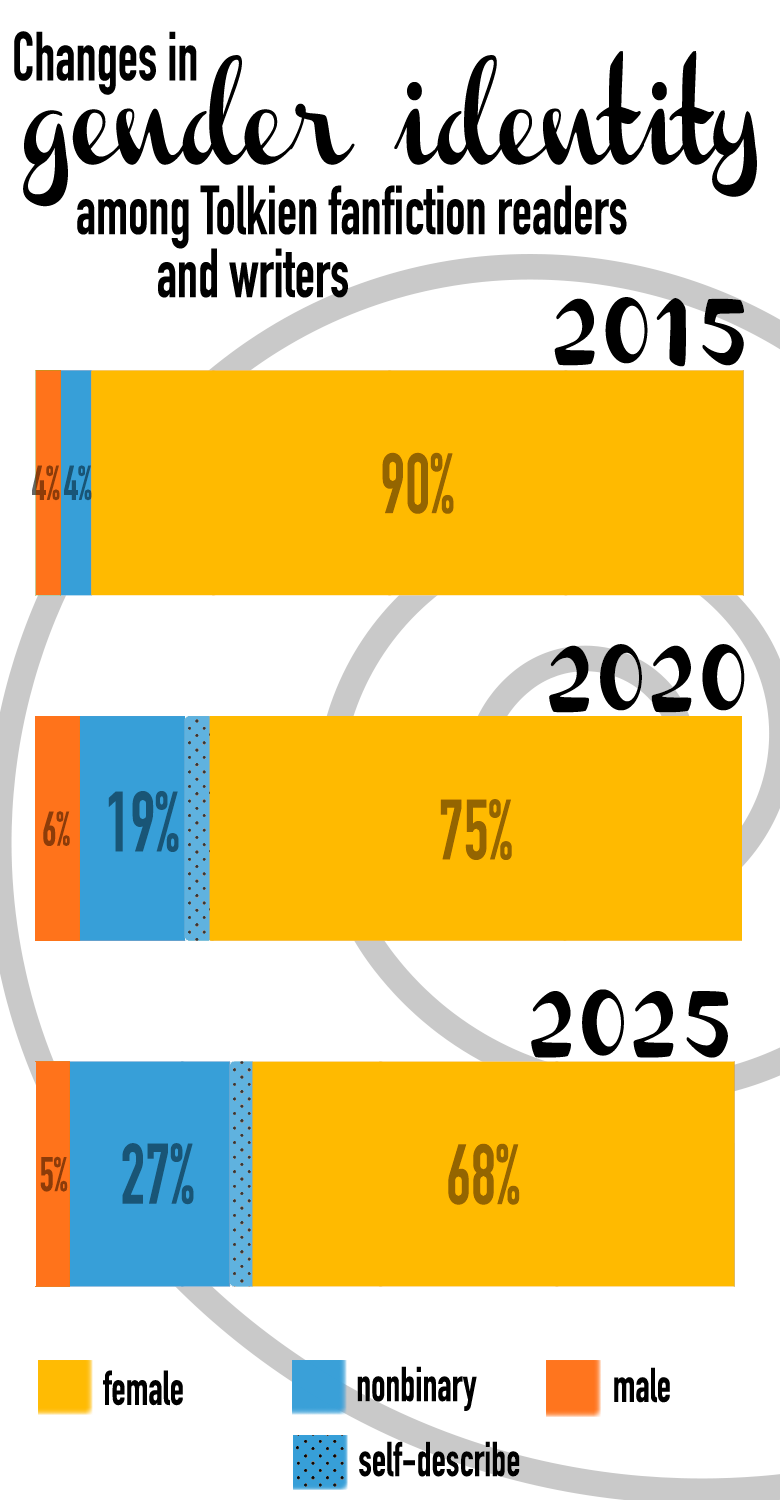
Probably the most substantial demographic shift across the ten years described by the Tolkien Fanfiction Survey is the reevaluation of "fanfiction as a women's genre." In the 2022 article, I note a decrease in survey participants who identify as women. The number of fans identifying as women dropped from 90% in 2015 to 75% in 2020, then further down to 68% in 2025—a 22% plummet in ten years.
So what is happening here? It is not increased participation by men, which has remained fairly steady—4%, 6%, and 5% of participants in 2015, 2020, and 2025 were men, respectively.
Instead, the explanation is an increase in nonbinary fans writing and reading Tolkien-based fanfiction. In 2015, 4% of participants chose a nonbinary or other identity as a gender minority. By 2020, 19% of participants identified as nonbinary or self-described as a gender minority.1 By 2025, that number was 27%. The data to the right show this demographic shift across the three surveys.
I want to take a step back and consider these data in the larger context. In 1980, Cantor introduced the idea that fanfiction writers are 90% women, a number that held steady through the 2015 Tolkien Fanfiction Survey—thirty-five years. In ten years, that "canon" was completely upended, and while women are still a majority, that majority is no longer such that "fanfiction is a women's genre" is a simple given. In a single decade, the fandom has diversified substantially in terms of gender identity.
Part of this is likely an increase in people who identify as nonbinary overall. It was difficult to find data supporting this—it seems interest in nonbinary identities among demographers is fairly new, so I could not find longitudinal data to present alongside my own—but a 2022 study from the Pew Research Center offers two interesting insights. First, 1% of all US adults identify as nonbinary; second, the number of US adults who know someone who is nonbinary is increasing. The latter data is important because it suggests that nonbinary identities—or at least openness about nonbinary identities—is more common, at least in the US, which partially explains the dramatic shift in the survey data across the last ten years.
But this is still a partial explanation because the survey data, where 24% of participants identified as nonbinary and 3% self-described as other gender minorities in 2025, looms large next to the 1% of nonbinary American adults. Tolkien fanfiction spaces, in other words, attract nonbinary and other gender-minority folks at much higher rate than would be expected based on their prevalence in the population overall.
Here, I want to pan back an even larger context. I entered the Tolkien fanfiction fandom in 2004, and at the time, many communities were openly hostile to writing about LGBTQ+ characters—i.e., slash fiction—which I cannot imagine created a welcoming or safe climate for LGBTQ+ fans. Even as other fandoms came to see representation of diverse characters as an acknowledgement of social justice and human rights, there were pockets of Tolkien fanfiction fandom that felt emboldened by their assumptions of Tolkien's intent to deny the existence of LBGTQ+ characters in Middle-earth and treat those who transgressed these self-invented rules with disdain, cruelty, and on at least one occasion that I know of, threats. The data we see now about the participation of LGBTQ+ fans is not to suggest that we've won; that fandom spaces are supportive or even safe all of the time. But the data do suggest that we've made progress.
Takeaway #2. Tolkien Fanfiction Fandom Is Getting Old.
Previously, I have written that while fanfiction is seen as a young person's pursuit, readers and writers of fanfiction based on Tolkien's world tend to be older than what is reported in other large demographic surveys, such as the AO3 Census. Age data is one of just two demographic questions that appeared on all three surveys,2 giving us a look at how the fandom has aged across the past ten years.
And it has. The graph below shows the number of fans in each age band for the three surveys. Despite the number of participants decreasing across each of the three surveys, the number of fans in the older age bands hold steady, meaning they are in fact a larger proportion of fanfiction readers and writers overall. In addition, the younger age bands show substantially fewer fans. The 18-19 band is especially interesting, suggesting that very few teen fans have entered the fandom in the past five years compared to previous surveys.
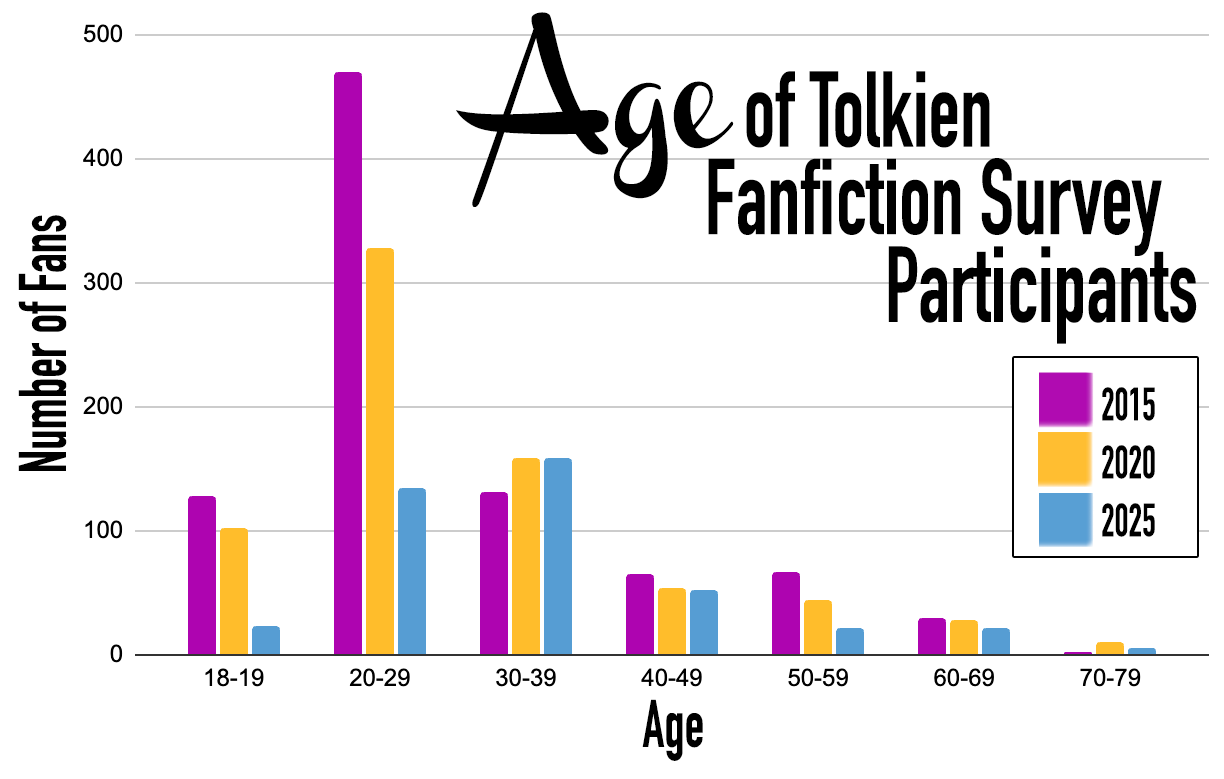
Thirty is popularly seen as the cutoff between youth and adulthood—"never trust anyone over thirty" and all that. With that in mind, it is illustrative to see how many survey participants were thirty or older: 33% in 2015, 41% in 2020, and 62% in 2025. Put another way, in 2015, two out of three fanfiction readers/writers you met would have been under thirty. Ten years later, the opposite is true: nearly two out of three are over thirty.
One of the questions asked of authors is, "For how many years have you been writing Tolkien-based fanfiction?" These data, coupled with the age data, suggest that Tolkien fanfiction fandom is aging due to a decreasing influx of new, young fans. Authors who had been writing five years or less represented
- 55% of authors in 2015. These authors would have entered the fandom while the Hobbit film trilogy was in full swing.
- 52% of authors in 2020, which would have included authors who entered the fandom at the end of the Hobbit films.
- 49% of authors in 2025, which included authors who joined the fandom during the first two seasons of The Rings of Power.
This is coupled with a tendency of Tolkien fanfiction writers to participate in the fandom across years or even decades. Reframing the third bullet point above, the 2025 survey is the first time when we see more than half of authors with more than five years of experience in the fandom. Along those same lines, the median number of years writing for all authors increased from five years in 2015 and 2020 to six years in 2025. Looking at the graph, one can almost see the spike of twentysomething Hobbit fans found in the 2015 and 2020 data aging into their thirties in the 2025 data, where thirtysomethings become the most prevalent demographic.
Takeaway #3: Tolkien Fanfiction—Still White, Still Western
One of the more difficult demographic questions to answer concerns race and ethnicity, not because the question is particularly hard to pose but because the Tolkien fanfiction community is international, and race and ethnicity are defined differently around the world, e.g., the number of US residents who identify by their ancestry rather than as Americans ("We're Irish and Polish!") or the notion that there are no Black people in Africa. There was no checklist that captured every possible way a person might identify themselves, and a prepopulated list might encourage selecting descriptions that aren't actually used in that participant's context. Maria and I probably spent more time discussing this one survey item than any other before deciding to just leave it as a free-response field so that people could define their race or ethnicity in as much or as little detail as they wanted (or not at all).
However, this means that these data will necessarily be incomplete. Some people record their race (i.e., describe their appearance), some their ethnicity, and some their national identity. Most do not include all three. So the exact same participant might describe herself as "white" or "Irish-American white" or "white American" or "Irish."
Even incomplete, however, the 2020 and 2025 data show that Tolkien fanfiction fandom is largely white and Western. In the 2025 data,
- 74% of participants described themselves as white,
- 29% indicated European residence or ancestry, and
- 11% reported that they lived in the Americas.
I also counted the number of participants who would fit under the identity of Black, Indigenous, or Person of Color (BIPOC)—perhaps counterintuitively, given that Maria and I wanted to avoid shoehorning the rest of the world into a US understanding of race. However, white and Western as the fandom is and especially given the long and ongoing struggles against racism that BIPOC fans experience in the fanworks fandom, scifi and fantasy fandoms, and Tolkien fandom specifically, I felt it might be useful to see how fans most likely to experience racism are (or aren't) participating in fanfiction communities.
In 2020, about 13% of survey participants were BIPOC based on self-description. In 2025, that number falls slightly to 11%. This parallels a near-identical 2% drop in the number of participants who identified being marginalized based on race or color: 6% in 2020 and 4% in 2025.
In Takeaway #1, I proposed that a cultural shift within many fanfiction communities has allowed Tolkien fanfiction spaces to welcome people who identify as gender minorities well above what we'd expect from their proportions in the population as a whole—and this despite a fandom history that has, at times and in places, been openly homophobic and transphobic. Does observing the opposite of BIPOC fans mean that we are not making similar progress in addressing racism? I'm a white American, so I cannot say, but I do know that my twenty-plus years involved with Tolkien-based fanfiction has seen racism as a constant problem, the response to which has often been to wave it away (although it was not specific to Tolkien fandom, see RaceFail '09 for the OG example for just how long this has been going on). At the same time, there is Deepa D's essay I Didn't Dream of Dragons, which speaks to the particular obstacles, even absent racism, that BIPOC fans experience when writing in canons like Tolkien:
Dragons are not universal. If I am defensive, it is because I have had to learn how to love Tolkien while trying to find myself in the unmapped lands in the East where the Green and Blue wizards disappeared to.
Takeaway #4: Atheism Edges Slightly Ahead of Christianity
Tolkien's devout religious beliefs—he has been known to describe The Lord of the Rings as a "fundamentally religious and Catholic work"3 when his audience would appreciate such a declaration—have complicated the fandom's cultures as bringing religion into popular culture tends to do. In some early internet fanfiction communities, it was not uncommon to encounter fans and authors who equated compliance with religious values (always conservative Christian) with respect for Tolkien and his world or with adherence to the canon, Tolkien's own words on religion and allegory in his works be damned.
In the first decade of the online fandom, these folks certainly gave an impression of being numerous, and in the 2020 survey, Christianity was indeed the religion most common among participants. However, as I noted at the time, it was trailed only slightly by atheism.
In the 2025 survey, the two swapped places, with atheism the most commonly reported religious belief and Christianity in a very close second—26.1% and 25.8%. This is not a significant difference statistically—it is barely a difference at all—but historically, given the role religion has played in Tolkien fan communities, it nonetheless feels notable.
Nonreligious fans make up a slight majority of participants. "Nonreligious" includes the atheists, agnostics, and people who entered things like "none" or "nonreligious" or "n/a" when asked about religion. In 2020, they were 55% of participants, and in 2025, they were 53%. Those who indicated that they were "not religious but spiritual" saw a slight increase from 5% to 7% between 2020 and 2025.
Therefore, about a quarter of Tolkien fans are Christians, and about 60% are nonreligious or spiritual without specific religious beliefs or practices. The remaining 15% include just about every religion in the world, though the two most dominant are paganism and animism (8%) and Judaism (5%).
Takeaway #5: Tolkien Fandom Is Increasingly Educated
If the race/ethnicity and religion data have held more or less steady between the 2020 and 2025 surveys, the education data has not. This item asks, "What is the highest degree or level of education you have completed?" and offers six choices, plus the option of "Prefer Not to Say." In the 2025 data, the number of participants who chose ""High School" dropped substantially. Participants with a Bachelor's degree remained steady (37% in both surveys), but participants with education beyond that increased. You can see the data in the graph below.
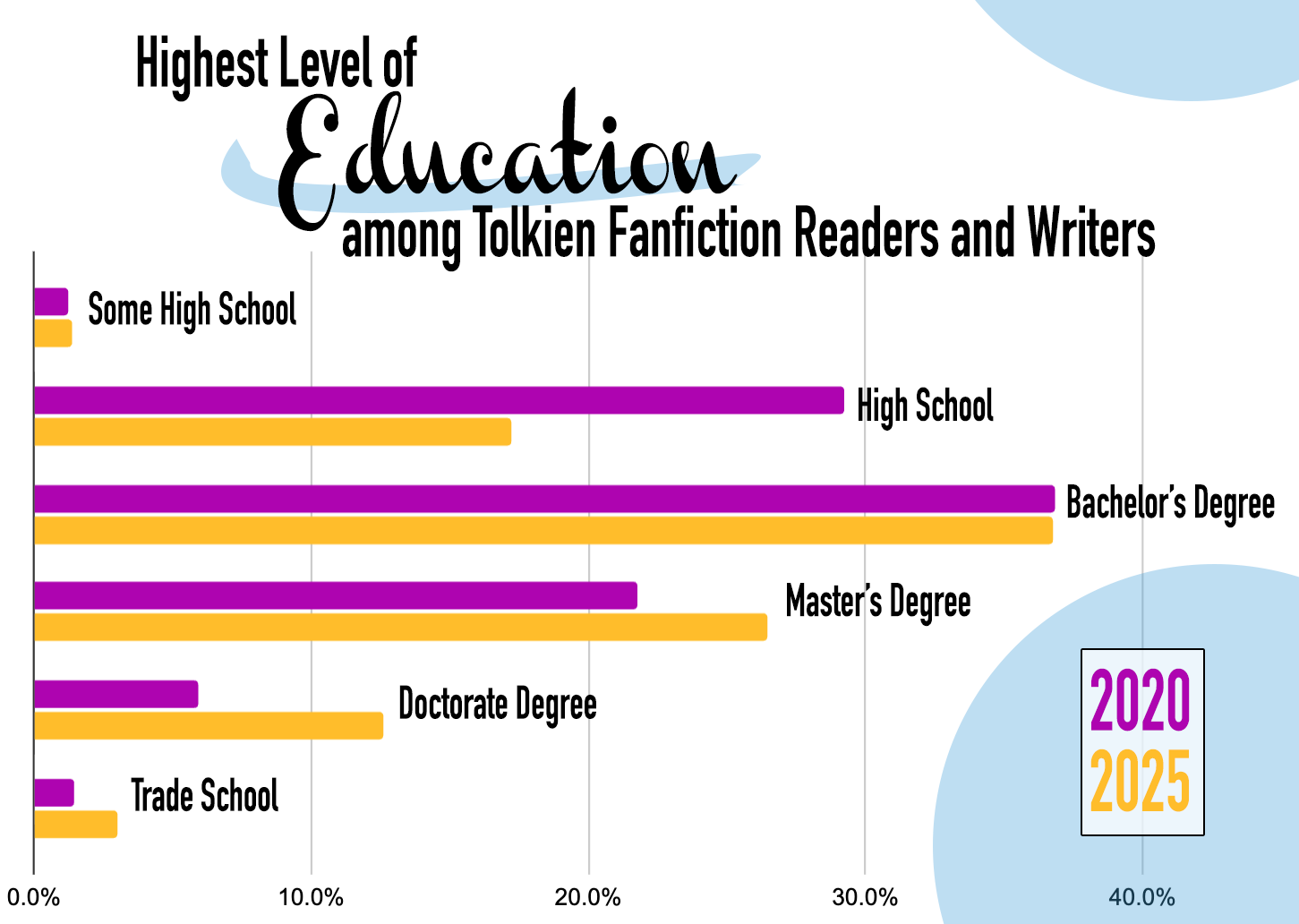
Likely, these data are a product of a fandom that is growing older, as discussed in Takeaway #2, where I observed that you can almost see the influx of young Hobbit fans moving through the graph. The same is likely evident here as well. In 2020, 70% of participants who chose "High School" as their highest level of education so far were twenty-two years old or younger, i.e., possibly still undergraduates. In 2025, only 44% of participants who chose "High School" were twenty-two years old or younger, indicative of a reduced interest in Tolkien fanfiction among high school- and undergrad-aged fans.
The increases in advanced degrees can be explained similarly, as fans who were in high school or undergraduates during the last big wave of new, young fans: the Hobbit films. Some of those fans who have remained in the fandom have since progressed on to Master's and doctorate degrees.
Ultimately, the 2025 data show that 79% of participants have a degree or certification beyond high school. ("Trade School" is an option, though only 4% of participants chose that in 2025.)
According to 2024 data from the US Census Bureau, 39% of American adults over the age of twenty-five have a Bachelor's degree or higher. This shows that Tolkien fanfiction spaces tend to be highly educated—perhaps not a surprise for a book fandom4 with a canon as complex as Tolkien's. It is not that one requires an advanced education to understand that canon but more likely that people who have chosen to complete an advanced education find that kind of reading, thinking, and writing to be enjoyable.
On the flip side, in a fandom where high educational attainment is the norm, I am left to wonder who is being excluded. University education is often a mark of privilege and treated as a distinction demonstrating intelligence and a willingness to work hard—but living as I do in a rural poor community (as a professional with a Master's degree), I see all the time that it is not that simple. Some of my most capable students do not really have the choice to pursue education beyond high school. Class is a factor of identity that we do not talk about a lot in fandom, but I wonder to what extent the shared culture and experience of having attended university and the shared language of academia may exclude Tolkien fans who would otherwise happily join us to read and write stories.
Takeaway #6: Tolkien Fandom Is Neurodiverse
One of the demographic questions on the survey concerns marginalization based on a list of identities with the ability to add additional details in a free-response field. In the 2020 survey, seven people used that field to list neurodivergence … and as a teacher myself, the annoying thing teachers say to students about how if they have a question, five other people do too is true. So if seven people wrote it down, at least thirty-five thought about it. So, on the 2025 survey, we added "neurodiversity" as an option on this item.
Well, more than thirty-five people were thinking about it. In fact, 48% of participants chose neurodiversity as a marginalized group to which they belong. Likely, this means that more than half of Tolkien fanfiction readers and writers are neurodivergent, since it is entirely possible that participants identify as neurodivergent without seeing that status as marginalizing.
Conclusion
According to the demographic data, the average reader or writer of Tolkien-based fanfiction is a thirty-something university-educated white woman from a Western nation. There's a good chance that she will be neurodivergent and a good chance that she is nonreligious.
Demographic data is intriguing because the description above of the average Tolkien fanfiction reader/writer in some ways parallels the history of the fandom—and the wider world. It crossed my mind, for example, as I struggled to find longitudinal data documenting an increase in nonbinary folks outside of fandom, that the Tolkien Fanfiction Survey might have captured a societal trend that wasn't yet being documented. It also captured a key shift in the fandom, away from an acceptance (even tacitly) of homophobia and transphobia and toward a more diverse Middle-earth and fandom.
The people missing from the data likewise reflect the fandom's history. Men have never been well-represented in fanfiction communities because those communities were largely formed by women and nonbinary folks, seeking a type of creativity and community not found in mainstream (read: male-dominated) spaces. Women-run fanfiction communities are more than five decades old. The lack of BIPOC fans and fans without a university education speaks to historical challenges that the fandom has yet to overcome in creating communities free of racism, colorism, and classism.
The age data likewise also marks a historical moment, the significance of which has yet to fully unfold. For the first time in three Tolkien Fanfiction Surveys, young fans are not joining the fandom in large numbers. The Rings of Power show so far, unlike the Hobbit and Lord of the Rings film trilogies, has yet to attract new, young fans to write and read fanfiction about Tolkien's world. Does this spell a winding down of the fandom, which has dominated the fanfiction world since the early 2000s, as other popular fic fandoms have come and gone? Or is it merely a lull, similar to that between the film trilogies, that will be reinvigorated by later seasons of the show or a yet-unknown media adaptation?
In the months to come, this column will look at survey data and what it shows of how the fandom has changed—and not—sometimes in light of its demographics.
Notes
- Participants who self-described as transgender were included in the numbers for their identified gender, as either women or men.
- The 2015 survey was also the only year where the Institutional Review Board (IRB) allowed us to collect data from minors. In past years, I included data from the under-18s; this year, in order to create consistency between the three surveys, I removed the under-18 data from the 2015 set. Therefore, if you are comparing this year's numbers to past discussions of demographics, this will produce a noticeable change in the youngest group of fans for 2015.
- Letter 142 To Robert Murray, S.J. Of course, when Tolkien's audience is less religiously inclined, he was apt to opine on things like his view that the Arthurian cycle was weakened by being "involved in, and explicitly contain[ing] the Christian religion" (Letter 131 To Milton Waldman). He also stayed mum to Father Murray about the status of The Silmarillion as a Catholic text.
- Tolkien-based fanfiction can, of course, be written about the films, the Rings of Power show, and any number of media projects based on Tolkien's world—and is. However, three iterations of the survey now show that, while the films especially remain sources writers draw from when creating fanfiction, the media-only fanfiction writer is almost nonexistent. Less than 1% of participants in 2015 and 2020 used only the films for their fanfiction, and in 2025, not a single participant used only media sources. I discuss how Tolkien-inspired media has bolstered a book-based fandom in my article Becoming Bookverse: Jackson's Films as an Initiation Point for Tolkien's Book Fandom.


As always, a fascinating and…
As always, a fascinating and scholarly piece of research. I am not surprised by your findings as the fandom has 'slowed down' so considerably since the films have become 'classic' and ignited that wonderful interest in Tolkien. But it is still testament to the greatness of the works that so many are STILL so invested in his works, and still find the space in his incredible world for their own expression and freedom. I remain an optimist and proudly liberal that our fandom started so much of the openness about sexuality. Now we have to do the same for race- your points about this are fascinating, even with the diversity in the otherwise truly horrible RoP, this hasn't really brought more diversity of people to Tolkien. I'd be interested to know what influence the films had on this- PJ's films were still 'lily-white' in spite of Gondor being so far south, and we can't really get over the fact that Harad, the Easterlings, the Southrons are not white and side with Sauron. The ambiguity you find in fanfic is much more nuanced and diverse.
This has given me much to think about -thank you.
Very interesting and thought…
Very interesting and thought-provoking as always, Dawn!
About the impact of ROP: We know that there usually is a bit of tension when fans brought in by a new adaptation join the fandom. There was tension in the case of the two Jackson trilogies, to different degrees. In the case of ROP fans, it seems to me the disagreement has occasionally been bitter, very regrettably.. So I wonder whether that group might be slower to join the mainstream fandom now and how well your survey reached them, given you also record a lower number of participants overall.
Tangentially, I was interested to see the Innumerable Stars mods mention that War of the Rohirrim now has more than 100 fanworks on AO3! It is hardly a major wave, I suppose, but it is nice to see.
About the racism angle: not at all to downplay the shortcomings of those of us Tolkien fans who hang out in fanfiction spaces, which are certainly something that very much needs more thought and care. But I think there is an additional initial hurdle: the involvement of Tolkien fans (using that word despite my reluctance to have anything in common with them) with the alt right may (largely) be happening elsewhere than in fanfiction spaces, but I believe it has reached public awareness and is likely to influence perceptions before anyone even thinks of joining, probably?
You have been busy!
Absolutely fascinating as always -- and the comparative aspect is so amazing!
I was intrigued by the shift in nonreligious fans (just dropping a link here to Tom Emanuel's dissertation which is a major study of that very group: The Tale We've Fallen Into : J. R. R. Tolkien's The Lord of the Rings and the Post-Christian Quest for Meaning).
And from what I read about religion and the US at least, the growth in nones/nonreligious/atheist/etc. (LOTS of complicated categories/distinctions) is also happening in the culture at large: Ryan Burge's blog is a great resource).
Thank you for posting (have added to my bibliography!).
Fantastic and so very interesting....
....and most parts of my experience feel "seen". Although at some point (perhaps the next survey), you may need an 80+ category for when the 1950s cohort moves upwards!