
"The Rings of Power" Is a Ripple (So Far) by Dawn Walls-Thumma
Posted on ; updated on
This article is part of the newsletter column Cultus Dispatches.
The world of internet Tolkien fanfiction has been shaped, perhaps more than any single factor, by the coexistence of a large and long-running book fandom and fan activity generated by multiple high-profile media productions: the Lord of the Rings film trilogy (2001-2003), the Hobbit film trilogy (2012-2015), and the Rings of Power television series (2022-present). As I analyzed two rounds of Tolkien Fanfiction Survey data, the impacts of the two film trilogies was a key point of interest for me as a researcher. Part of the reason for this interest was my relationship to the Lord of the Rings (LotR) films as a fan: I am a film-first fan, brought to the books by my interest in the film trilogy. My fandom origin story—as my research has shown—is very typical of a film-first fanfiction author. Enthralled by the world, character, and storyline of the films, I picked up the LotR books, then The Hobbit, and then sealed the deal by delving into Tolkien's posthumous works, beginning with The Silmarillion.
At the same time, these film releases generate fans into fandom communities that already exist, sometimes for years or even decades, and this can create tension and conflict among the people with established ways of interacting with each other and the texts and newcomers with different interests and understandings of the norms. For example, in the communities I frequented as a new fan, I remember well the disdain toward authors whose interests tended toward the films and not the acceptable mode of using fanfiction to expand and comment on the books. For instance, the disregard of the popular Legomance and Tenth Walker genre came, in part, from the sense that those authors were more interested in imagining attractive actors than Middle-earth (with a hearty helping of sexism as well given that the fans writing these stories were mostly young women). I was a veteran fan by the time the Hobbit films came out, so that time around, I tended to hear more the perspectives of fellow veterans: concern over platform shifts and other big changes that they felt powerless to control and the sense that years of research and discussion had been arrested in order to bring new fans up to speed. In short, these generational1 clashes can be stressful and unpleasant for both sides.
Not surprisingly, then, once word got out about the Rings of Power television series, there was anxiety around its forthcoming release. How would it change the fandom? How would it change the stories we write about Tolkien's world? Once I got my hands on the 2025 Tolkien Fanfiction Survey data earlier this year—the first of the surveys to occur after the show's release and to include items about the show—the impact of The Rings of Power was one of the biggest questions looming in my mind.
The Tolkien Fanfiction Survey originated in 2015 as a personal project of mine. In 2020 and again in 2025, I collaborated with Maria K. Alberto to continue collecting data to see how the fandom has changed over time. Anyone eighteen or older who writes or reads Tolkien-based fanfiction was invited to participate, and we had 907 participants in 2015, 746 in 2020, and 436 in 2025. The survey collected demographic information, then presented a series of statements about the participant's attitudes, beliefs, and behaviors related to writing and reading Tolkien-based fanfiction. Most survey items offered five choices of response: Strongly Agree, Agree, Disagree, Strongly Disagree, and No Opinion/Not Sure. Participants could skip any item they preferred not to answer. In discussing the survey data, when I say that participants "agree," I mean that they selected Agree or Strongly Agree (and vice versa when I state that they "disagree.") If I am referring to the number of participants who chose a specific response, I will clearly indicate that.
The Impact of the Films
To say that the LotR and Hobbit film trilogies have shaped the Tolkien fanfiction fandom is an understatement. I could write a book on the many ways the films have influenced fanfiction, but I'll limit myself today to an impact that is relatively easy to measure with survey data: entry of new authors into the Tolkienfic fandom. Both films drummed up interest in writing fanfiction about Tolkien's world (at which point, those authors largely became bookverse writers), creating a large and enduring influx of new authors.
The graphs below show the number of authors who began writing each year for the three surveys. While the films showed modest impact while they were still being released, the years immediately following the release of the final films show a large bump in the number of authors who joined the fandom—and this bump endures. Even in the 2025 data, the influx of authors who joined after the LotR trilogy left theaters stands out. A similar bump in 2015 endures in the 2025 survey data.
There also appears to be a bump prior to film releases. 2010 has long been a mystery to me, but with three surveys worth of data now, it matches a similar bump in 2000, suggesting that publicity around the films may rekindle interest in Tolkien that nudges fans to seek out and create their own fanfiction.
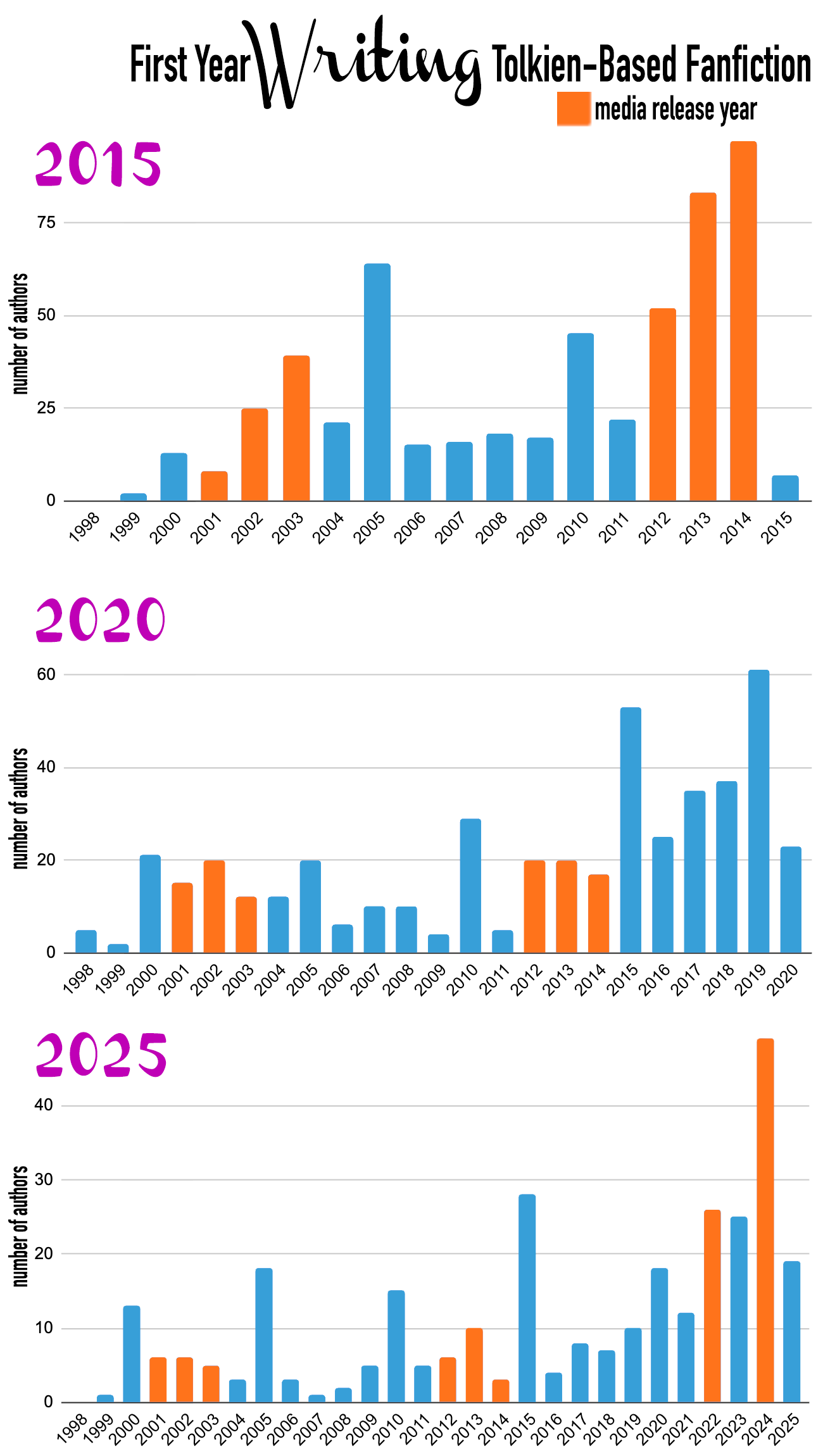
You may also notice in the data that there are more authors who began writing in the years immediately preceding the year the survey was given. In the three years preceding the survey year (and excluding the survey year itself), for the 2015, 2020, and 2025 surveys, 42%, 28%, and 32% of authors started writing within the three previous years, respectively. This makes sense, as people may pick up Tolkien fanfiction-writing for a few years but then lose interest for varying reasons. For the years preceding and following film releases, however, those fans stick around, their presence felt in the data even decades later.
… and the Impact of The Rings of Power
Because the three years preceding a survey release always contain a significant percentage of authors, it is impossible to judge the impact of the Rings of Power on the fanfiction world from these data alone. In the 2030 survey, we will get a better sense of whether 2020 remains a bump year and whether the show produced an enduring influx of new fanfiction authors. But for now, we have to turn to other survey items to get a picture of how the show is impacting the fandom.
So far, the fanfiction wing of the Tolkien fandom just isn't experiencing much impact or influence from the show. In fact, based on survey data, I'd say that many fanfiction writers aren't paying attention to the show at all.
There are several survey items aimed measuring the various ways that fanfiction writers and readers engage with The Rings of Power and fanworks based on it. Each item reveals a different way that authors and readers use the show in their fanworks. Authors are presented with four different Rings of Power-related survey items:
- What sources do you base your fanfiction on? Check all that apply. This item includes a list of sources and a space for participants to add additional sources and reveals the lowest level of engagement with the show: authors who simply use elements of the show in their fanworks, likely along with other sources. 16% of authors selected the show as a source. Not a single author wrote only using The Rings of Power, but this confirms what the previous surveys showed: that media-only authors are rare, with less than 1% of authors in the 2015 and 2020 surveys using only media sources, and no authors using only media sources in 2025.
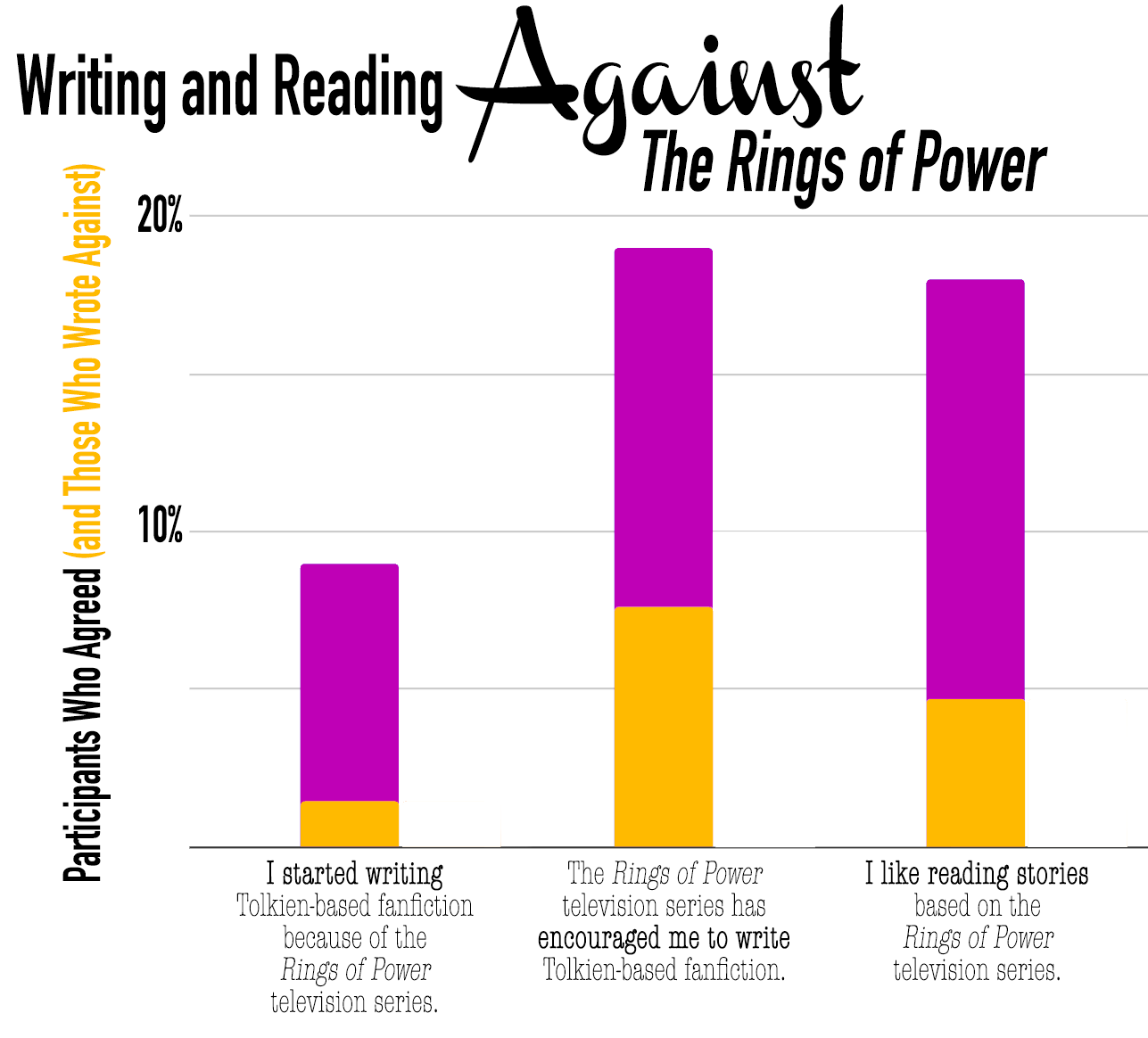
- The Rings of Power television series has encouraged me to write Tolkien-based fanfiction. This survey item counts authors for whom the show plays a more central role in their fanfiction: It is not merely a source but a reason for writing. 19% of authors agreed with this statement.
- I started writing Tolkien-based fanfiction because of the Rings of Power television series. This item steps up the engagement with the show another notch, bringing forth the authors who would not be participating in the fanfiction fandom at all if not for the show. 9% of authors agreed with this statement.
- Writing fanfiction helps me to correct what I view as mistakes in the Rings of Power television series. Finally, this item takes a totally different approach (and explains why more authors have been encouraged by the show to write than authors who use the show as a source). It measures the number of authors using fanfiction to "read against" the show, i.e., viewing it critically and presenting a different perspective using their fanfiction. 19% of authors agreed with this statement.
For readers, there are two survey items related to the show:
- I like reading stories based on the Rings of Power television series. Roughly the same percentage of readers enjoy Rings of Power-based stories as enjoy writing them: 18% of readers agreed with this statement.
- I like reading stories that correct or criticize the Rings of Power television series. For the reader equivalent of the "reading against" item, 23% agreed.
The survey item for authors about using fanfiction to correct mistakes included as one of the response options, "I have not seen The Rings of Power." 39% of authors chose this item. To compare, in a related item, only 2% of authors chose "I have not seen Peter Jackson's movies."
Comparatively speaking, then, The Rings of Power is a ripple so far. The emphasis there is important. As of this writing, Season 3 will be released in a few months, and the show is supposed to extend for five seasons, so we are close to the halfway mark, making it possible that the remaining three seasons will generate fan energy more on order of what the film trilogies did. Author entry years show that more writers enter the fandom in the year or two immediately following the conclusion of a film trilogy, and it is likely that The Rings of Power may follow a similar pattern.
Writing Against The Rings of Power
Writing against a text means reading it critically and challenging its assumptions in writing. As discussed in the section above, the survey specifically assessed authors' and readers' engagement with fanfiction that "wrote against" The Rings of Power at least some of the time by criticizing it and correcting its shortcomings as perceived by the fan. 19% of authors agreed that they wrote this way, and 23% of readers enjoyed these kinds of stories.
In considering the impact of The Rings of Power, though, what proportion of authors who either started writing or who were encouraged to write because of the show do so out of a desire to critique the show? If most authors and readers engaging with The Rings of Power are interested in writing against it, this paints a different picture than if those same authors and readers find the world presented in the show an unmitigated inspiration.
Authors who started writing because of the show are least likely to write against it. Among authors who stated they were encouraged to write based on the show and readers who enjoy Rings of Power stories, the numbers are higher, with 40% and 24%, respectively, of authors who agreed with those statements writing against the show. The graph below visualizes these numbers.
I was interested in how this compares to authors and readers who engage with the Hobbit films. Like The Rings of Power, the Hobbit films were subject to fan critique and negativity during and immediately after their release. At the same time, they prompted the second largest wave of new fanfiction writers in the fandom's history.
A couple of caveats should be borne in mind when comparing the two groups of fans. First, the Hobbit films are now a decade in the past while the Rings of Power series is in active production, i.e., we no longer have access to fans' raw perspectives on the films. Those perspectives have been tempered by a decade in which the films have not been central to the fandom. The fandom has also likely lost those fans whose primary engagement was due to the films and who did not shift into the book fandom. Secondly, while there is a survey item that states, "Writing fanfiction helps me to correct what I view as mistakes in Peter Jackson' movies," there is none specific to the Hobbit films.
Among authors who agreed that "I started writing Tolkien-based fanfiction because of Peter Jackson's Hobbit movies," 62% agreed that they wrote against the films at least some of the time (i.e., they also agreed with the statement about using their stories to correct the movies). Among authors who agreed that "Peter Jackson's Hobbit movies have encouraged me to write Tolkien-based fanfiction," 55% acknowledged writing against the Jackson films. This is the opposite of the Rings of Power data, where authors who started writing because of the show were unlikely to write against the show, and those who were simply "encouraged" to write because of the show were more likely to write against it.
These numbers are also much higher than the data for Rings of Power authors. Again, the Hobbit films are much more likely to have been seen by survey participants (and other fans with whom they engage), and the decade that has passed since the films left theaters has left a lot of time to engage with the films using fanfiction. The low numbers for authors writing against The Rings of Power, however, again underscores a general lack of interest in the show from fanfiction writers: It's nothing that rouses them to offer alternative visions of what the showrunners present (in many cases because the writer hasn't seen the show).
The Rings of Power Authors
The Rings of Power has been a ripple (so far), but it is still a presence that shapes the fandom, and Tolkien fanwriters do engage with it. While their numbers are not as commanding as those engaging with the two film trilogies, those fans still deserve recognition and study!
Demographically, fans who started writing because of the Rings of Power show (i.e., agreed with the survey item "I started writing Tolkien-based fanfiction because of the Rings of Power television series" look almost exactly like the typical survey participant. Fans who begin writing because of a media adaptation of Tolkien are often assumed to be young (with the negative stereotypes of youthful overexurberance, impulsivity, and obliviousness to social norms often dogging these fans' entry into fandom spaces). And in the 2015 survey, fans who used the Hobbit films as a source were slightly younger than participants overall, at a median age of 24 years compared to 25 years. This is not true of Rings of Power writers, who are slightly older than the average participant. Authors who used the Rings of Power show as a source were a median age of 36 years (compared to 33 years for participants overall). Those who started writing fanfiction because of the show2 were a median age of 35 years.
Rings of Power authors were 70% women (compared to 68% for participants overall) and 22% nonbinary (compared to 24% for participants overall). They were 14% Black, Indigenous, and People of Color (BIPOC), just slightly higher than the 11% of BIPOC participants in the survey overall. 82% had a post-high school degree (compared to 79% overall—but as I pointed out in my Six Demographic Takeaways last month, age and education appear to be correlated, so the slightly older Rings of Power demographic likely explains why this group is also more likely to have a degree past high school).
The most notable difference between Rings of Power authors and survey participants overall concerns religion. As last month's column discussed, 53% of fans were nonreligious,3 and 26% indicated some form of Christianity (whether religious belief or cultural practice) in their response. Authors who started writing because of The Rings of Power are significantly less religious than participants overall: 70% were nonreligious and only 12% were Christian.4
I was curious if a lack of religiosity typifies media-first fans more generally, so I also looked at the number of nonreligious fans among those who started writing because of the Lord of the Rings and Hobbit films. Those authors were about as likely to be nonreligious as participants overall: 53% of authors who started writing because of the Lord of the Rings films and 55% of authors who started writing because of the Hobbit films were nonreligious.
What is it about The Rings of Power, then, that attracts nonreligious fans? Is it the show itself? Is it the platform, which may not be available (or as available) in regions of the world with high levels of religiosity? Or is it the less intriguing explanation that only twenty-nine survey participants started writing because of the Rings of Power—a small sample size that is more easily distorted by the addition of a few nonreligious fans?
Conclusion
Having been part of the Tolkien fanfiction fandom immediately after the LotR and during the Hobbit film releases, there is no point where I would have used the word "ripple" to describe their impact. Both created a tsunami, not only flooding the fandom with new authors and readers but shaping how writers depicted and engaged with Middle-earth.
So what is the difference with The Rings of Power? Why has the show not had much impact on the fanfiction fandom so far? It is possible that the format—a television show versus a film trilogy—makes engagement less likely. It certainly requires more effort to engage. Instead of committing a few hours to see a film once per year, fans interested in The Rings of Power must subscribe to Amazon Prime and tune in regularly to see new episodes. With no episode runtime under an hour, each season requires a time commitment roughly the same as watching one of the film trilogies in its entirety. Combined, these factors may discourage fans with a casual interest from seeing the show.
Amazon, the company behind the show, also generates negative perceptions from fans in a way that the many commercial interests associated with the films did not. New Line Cinema, for example, was not regularly in headlines over its negative impact on human rights, labor rights, small businesses, and the environment. Warner Bros. is not a monopolizing omnipresence in the Western world. (As a case in point, MGM, one of the studios that produced The Hobbit, has since been gobbled up by Amazon.) Likewise, while this is an area deserving of more research, my perception is that fans have tended to view the showrunners with negativity or at least skepticism, where much of the conversation about Peter Jackson, Fran Walsh, Phillippa Boyens, and their team focused on the filmmakers' status as fans and the care they took to remain true to Tolkien's vision of his world.
Rings of Power fans may also not be fully integrated into the broader Tolkien fanfiction fandom, in part because of the negativity towards the show, Amazon, and the showrunners, meaning they may be a subset of the Tolkien fanfiction fandom that the survey missed. As I've discussed these data informally with other fans, this point nearly always comes up: that Rings of Power fans tend to keep their heads down in general fandom spaces because, while media adaptations of Tolkien and their fans have always been criticized by bookverse fans, the criticisms of the show feel more existential than complaining about the Elves at Helms Deep or the addition of Tauriel. Unfortunately, justifiable critiques of Amazon can too easily turn on fans whose choice to stream The Rings of Power is not enabling Amazon's harms.5
Finally, it's possible that the Tolkien fanfiction fandom is finally and simply saturated by media adaptations of Middle-earth. The Fellowship of the Ring film was released almost twenty-five years ago, and the years since have seen not only the two trilogies but several influential games and smaller media productions—with more on the horizon. Tolkien fanfiction writers, at this point, may not be able to generate the collective enthusiasm over these productions that they once did.
Of course, it's essential to bear in mind that the show isn't even halfway over, and a new season continues to be released every other year, we won't know how the ending of the show impacts the fandom until the 2035 survey.
However, one thing I have learned from three iterations of this survey is that they reflect a moment. In this moment, the show is not exerting a heavy influence. It is not even being noticed at all by about 40% of fanfiction writers. It is not producing an influx of new readers and authors. That could change—there are three seasons and probably five years left for it to do so. But for now, Rings of Power is still just a ripple.
Notes
- When I refer to generations here, I am not using the word in its traditional sense of age bands defined by historical events and that tend to share certain broad traits. Rather, fandom generations are those defined by fandom events and who sometimes engage with fandom in different ways from the fans who came before them. For instance, fans brought in by the Hobbit films helped to shift the Tolkien fanfiction fandom—a community reluctant to undertake platform shifts in the past—onto Tumblr.
- In the 2015 survey, we had not yet added the survey item about fans who began writing because of the Hobbit films; hence these data are not available to offer a comparison. Instead, I've used the sources authors identified in the surveys to compare by age.
- Meaning they indicated that they were atheist, agnostic, nonreligious, or used a synonym like N/A or none. Participants who identified as "spiritual but not religious" were counted separately.
- As a sidenote, while working with the demographic data, I had noticed an uptick between 2020 and 2025 in the number of participants who indicated that they were members of the Church of Jesus Christ of Latter Day Saints (LDS). This is a very small minority of participants (less than 1% in both surveys), but the number of LDS participants doubled in 2025, and I wondered if it was due to the fact that the Rings of Power showrunners are themselves LDS. However, none of the LDS participants in the 2025 survey used the Rings of Power as a source.
- I still like how we phrase it in the SWG's policy on The Rings of Power: "[We] recognize that participation in any capitalist system requires selecting from an imperfect slate of choices. Unfortunately, we all make purchase decisions that generate a negative impact on our fellow humans and the environment." I.e., people in glass houses and all that.


Interesting!
Just as a data point, I'm old, so my baseline is the books, but as a dedicated "subcreator" my tendency is to be inclusive (in a cherry-picking way) of other versions. Since I'm working in pre- and post-War of the Rings timeframes, content from the LOTR films isn't really relevant, but I am very deliberately pulling in ideas from ROP - could not resist giving Adar a backstory (and a future), and the prospect of Mr. Aramayo as Elros for S3 has completely up-ended my idea of him (Elros, that is!). I had always thought of Elros as somewhat similar to Sean Bean's Boromir, but that pic lightbulbed me into the realization that a scrappy James Dean-style rebel-to-king arc is actually just as "human", and pulls some of my plotlines together very nicely.
So there ya go:)
There are currently 5,262…
There are currently 5,262 fanworks tagged for ROP on AO3, although it is not easy to see how many engaged authors that represents, at this point. They range all the way from a quick spoof to extensive sagas (while a couple may have just thrown the tag in for good measure alongside others).
And as you say, the show hasn't been running all that long and still has some seasons to run!
Super neat stuff! I like the…
Super neat stuff! I like the exploration of how media received negatively by many viewers/critics (like the Hobbit films) can still spark a lot of creativity. I also went back to read the column about film-first fans entering the bookverse as fanwork creators, and that gave me a lot of food for thought too!
I guess I technically have RoP to thank for getting into Tolkien fanworks, in a roundabout way — I saw it was coming out and went “I’d better finish reading the Silmarillion first to make an informed opinion of the show” … and proceeded to fall head over heels for the Silm and forget about RoP altogether.
As ever, interesting insights....
....and as for whether the amount of fanfic for the Rings of Power show increases over the coming three seasons, I think it really could go either way.