New Challenge: Stars
Create a fanwork using star-themed prompts presented in a bingo board format.

SWG News
Character of the Month: Marach
There are few details in the texts about Marach, but he is noteworthy for his allegiances and his descendants, who would become pivotal to the history of Middle-earth and the eventual defeat of Morgoth and Sauron.
New Challenge: Allusive
Literature and art constantly refer back to each other using allusions, and this month's prompts are inspired by allusions to literature, myth, art, and history.
Cultus Dispatches: "The Rings of Power" Is a Ripple (So Far)
Tolkien Fanfiction Survey data for 2025 shows that "The Rings of Power" TV series has not had the same impact on the fandom as the film trilogies did ... so far.
New & Updated Fanworks
[Artwork] Lindórië looks to the future by Anérea
silhouette portrait of Lindórië, grandmother of Tar-Palantir
[Writing] From That Rubble by StarSpray
Fëanor shrugged, studying the contents of his wine glass. “Something must be done about that house. It will fall down eventually.”
“It does not follow that it must be you that tears it down single-handedly. Are you sure you do not want help?”
“It’s not as though I…
[Writing] A Thousand Winds that Blow by StarSpray
When uneasy dreams bring him back into Beleriand, Daeron finds a pair of twins who have lost their home, and an enemy who has lost himself. The Shadow's reach is growing ever longer, and if they are to survive, they must do it together.
[Writing] An Alluring Offer by octopus_fool
Tata is offered a solution to a grave problem, at a very low price...
[Writing] The Mirror Crack'd by AdmirableMonster
Rescued from a brutal Angband hunt, an ex-thrall with a strange and powerful artifact embedded in his spine is brought to Himring, for it is one of the only places in Beleriand which welcomes such folk. Though he has no memories of his life before, Anniavas slowly becomes accustomed to his new…
[Writing] most days I don't recognize me by annarobots
Of course, she knew that in the Blessed Land, true harm was unlikely to come to him. The Valar watched over them all, and the lesser spirits were everywhere. It was a great hound of Oromë who had found him happily splashing in the creek, in fact. But anyone could drown in mere…
[Series] Eat, Pray, Love by AdmirableMonster
The Darkest Timeline AU for my Steampunk Númenor series.
In which the Mouth of Sauron is originally a Númenorean chemister rescued from Ar-Pharazôn's intimate attentions by Sauron himself.
Current Challenge
Stars
Construct a fanwork using star-themed prompts in a bingo card format. Read more ...
Random Challenge
Companies, Clubs, and Cliques
Create a fanwork that explores a group of characters--formal or informal--that Tolkien didn't identify or describe in his own writings. Read more ...
New in References
Speak Friend and Enter: Trends in Fandom Entry Year by Dawn Walls-Thumma
Across three surveys and ten years, the Tolkien Fanfiction Survey has document when authors began writing. These data reveal trends in how film promotions, the films themselves, the books, and other historical contexts have influenced not only who writes but how long they stay.
There are few details in the texts about Marach, but he is noteworthy for his allegiances and his descendants, who would become pivotal to the history of Middle-earth and the eventual defeat of Morgoth and Sauron.
Featured Themed Collection
Beyond the Silmarillion
[Artwork] A Memento of Faery by Grundy
TRSB26 art 144 - an artifact brought back from Faerie by a Starbearer.
[Writing] Down the Long Years by Isilme_among_the_stars
Bilbo, the strange old hobbit with the wandering feet, senses something special in young Frodo the first time he sees the lad; as they become close, they find in each other a cameraderie not well understood by other hobbits. Five poignant moments between Bilbo and Frodo Baggins over the course…
Around the World and Web
Silm Smut Week 2026
Silm Smut Week is a Tumblr event celebrating sexually explicit fanworks.
LotR Week 2026
A week-long event for The Lord of the Rings
Finwëan Ladies Week 2026
Finwëan Ladies Week will run from September 21-27, 2026!
Fingon x Finrod x Maedhros Day 2026
A day to celebrate the relationship of the three eldest princes.
Sindar Week 2026
A Tolkien event week for the Sindar, the Grey-Elves, from the Years of the Trees to the Third Age.
Fandom Voices: Impact of the Films by Dawn Felagund
Posted on ; updated on
| | |
Fandom Voices: Impact of the Films
With Amazon's Rings of Power series on the horizon, many Tolkien fans wonder—or worry—how the new show will impact the fandom communities they are a part of. This is not the Tolkien fandom's first experience with major media adaptations, however—far from it! With two blockbuster trilogies part of its history within the past two decades, the fandom has ample experience to draw on in considering how The Rings of Power will (and won't) change the fandom.
In March, we published an article that analyzed how the films affected initiation into the fanfiction community, using data from the Tolkien Fanfiction Survey. This month, we take a different approach, asking fans who were part of the fandom before the two trilogy releases to share their experiences of the changes they saw in the fandom following each trilogy release. The survey was open to everyone—in fact, it's still open, so if you want to share your experience or memories of how the films impacted the fandom, you can do so here, and we will periodically update our response collection with new responses.
In this first section, we'll share some of the trends we noticed in the responses we've received so far, with minimal commentary, followed by the complete collection of responses.
The Lord of the Rings Film Trilogy
The debut of the Lord of the Rings (LotR) film trilogy might be the single most impactful event in the fandom's history to date. The films ushered in thousands of new fans, turned a niche community into an online megafandom, and shifted fandom cultures in important ways.
Fandom Population Boom
Many respondents noted that the films brought an onslaught of new fans into the online fandom. Elwin Fortuna was the founder and a moderator of the tolkien_slash mailing list and Least Expected fanworks archive, both which pre-dated the films. They recall:
The release of The Fellowship of the Ring meant that, within days, our small mailing list saw hundreds of people joining. Fanfic and fanart exploded in numbers. I also noticed many new mailing lists and some new archives being created, some that lasted for years, others that disappeared fairly quickly. … This all happened within the space of a few months post December 2001.
TheXPhial, who was a participant on Tolkien forums—particularly The Barrow Downs—prior to the films, recalls a similar experience:
When the movies started coming out, membership at the forum and in the chat room really ballooned. It was like a massive influx of new faces and voices. Mostly they were younger than the original population of the forum, and new threads and whole new sections were added to discuss the movies. We got a lot of younger women who were brought in through crushes on Legolas. I mean, all the main characters had fangirls, but by far most of them were there for Legolas. The younger, newer fans were eager to prove their cred. Most of them started reading the books and the appendices.
Another respondent also noticed how new fans rose to the challenge of a fandom that prided itself on its encyclopedic and detailed knowledge of Tolkien and related fields, like medieval studies:
What I liked was the "after", once everyone had watched the films and grumbled about all that was left out, when lots of people, new to Tolkien fandom, began writing and talking about such obscure nuances as why Orlando Bloom had a slight Welsh accent, and if it was because Welsh archers were the best in medieval times ...
Lyra, active before the films on www.herr-der-ringe-film.de and www.elbenwald.de, also recalls pre-film fandom and the boom that followed the 2001 release of Fellowship of the Ring:
[Before the films,] there was also a lot of shared love for the books, the occasional fanfic (though never called fanfic!) or fanart, RPGs, as well as some muted hope for the movies. Regional or even nationwide offline meet-ups were an important fixture, with attendance ranging from under ten to about thirty people, while the forums had a membership in the low triple digits. You generally knew the other active users at least by name.
This changed drastically after the movies premiered, although I don't remember the exact timeframe in which user numbers rose! But there was a huge influx of new fans, bringing with them bright-eyed excitement and discussions ranging from "Why don't the Ringwraiths just ford the river?" to "Isn't Legolas the sexiest?"
A New (and Easier) Entry Point for Fans
What TheXPhial noticed about "newer fans … eager to prove their cred" was observed by others, who saw one of the major impacts of the films as providing a new entry point for fans, who maybe wouldn't have committed to the books otherwise but, through the films, found themselves transported to Middle-earth, with no wish to return.
Daniel Stride sees the films as reversing how fans encountered the books and adaptations made from them. "Prior to December 2001, the standard entry point into the fandom was via the books," he writes. "Adaptations (Bakshi and Rankin-Bass) did exist, but generally speaking, one read the books and only then checked out adaptations. Since Jackson, I would suggest that most people see the movies first, and then follow up the books later."
Multiple respondents noted that the films made Tolkien's work accessible to more people, moving it from "nerd culture" to "popular culture." John observed that the films "opened the whole world of Arda to a new set of people who would have been reluctant to get into the written trilogy ... which, it has to be admitted, can be pretty dense. These are not beach-read materials. The trilogy demands your attention."
Megan Abrahamson writes, "I could finally get my IRL [in real life] friends interested in reading the book!" while Rebecca notes how Tolkien became more mainstream with the films: "The movies made the fandom bigger and more mainstream. Before the movies, when I would tell someone I was a Tolkien fan, I would wait half a beat to see if I needed to explain what that was. I don't need to do that any more."
PhoenixRisesOnceMore observes that veteran fans often supported new film fans who wanted to read the books: "I mainly remember an environment of almost 'Tolkien mentorship' in which older fans introduced younger fans who had mainly (or solely) experienced the films to the wider Legendarium."
Even among existing fans, the films impacted not just their fandom participation but their reading of the books. Neverwhere notes that she started reading fanfic because of the films but also felt a new passion for the books. "I liked the books before," she writes, "but the films really helped me *love* them."
John also identifies the films as an opportunity to connect one's fannish and nonfannish social worlds: "I had been a fan of the novels since I was a child, long before the movies were made. So when friends who were never into the books saw the movies and were enthralled, it gave me the opportunity to say, 'See? THIS is why I love the books. Now you see what I see.'"
Friendships and Social Connections
Several respondents recall that the films allowed them to connect with the many new fans brought online by the films. (Two respondents even noted that they met their spouses in post-film online Tolkien fandom!) One participant recalls the dual movement of fans online and the popularity caused by the films as opening more opportunities to connect with other fans:
I was a solitary fan before the films after having started reading Tolkien in the mid 1970's. I desperately wanted to participate in the Tolkien Society moots, but never had the money to travel to them, and I did not live in an area where people were active. I ran across rumors of a possible film of The Lord of the Rings in early 1998, then discovered TheOneRing.com and TheOneRing.net in 1999 and was very pleased indeed to be able to interact with fellow fans online. Thankfully, the films brought fellow Tolkien fans out of the woodwork, even in my geographic neck of the woods, and I was finally able to join other folks to share our love of the Professor's works. I have the films to thank for that and I am grateful.
Spiced Wine makes a similar observation:
I started reading Tolkien in the '80s and, apart from a few people and friends, had no-one to discuss the books with. … [B]ecause of the internet people could suddenly discuss Tolkien almost in real time across the world. After being a quiet fan for so long, I was both intoxicated and a bit overwhelmed.
Responses among fans around before the films sometimes expressed this tension: gratitude for increased opportunities to connect but also a feeling of being overwhelmed. Bunn, who was active in pre-internet fandom via Middle-earth Roleplaying and fanzines, writes of the films:
To be honest, the whole thing got a bit over the top. What had been a book fandom full of nerdy enthusiasts became a megafandom filled with pretty much everyone, and that was a bit much. I was pleased so many people were having fun, but I'd already been moving away from that phase of my life, and all the RPF [real-person fiction] and loud arguments, drama and shipping maybe gave me a bit of an extra push in that direction.
The Tolkien fandom that burgeoned after the films had a life-changing impact on many of the fans who were a part of that experience. One respondent writes:
I only read LotR for the first time when I got it for Christmas in 2000. I was thirteen at the time and bullied in pretty much all of my social circles, so offline it was an amazing means of escapism. I actually made one of my best friends when she said she was a fan of The Hobbit and reading LotR.
I looked for a fan community online and made my "home" at herr-der-ringe-film.de, as well as an eight-person rapid forum. … Generally it was a very welcoming place though; got me interested in linguistics; helped me study abroad; sparked a lifelong passion for roleplaying, reading, writing and drawing; changed my musical taste forever; and ultimately introduced me to my best friends, one of which I'm lucky enough to have married. I'm extremely glad for that very online, very LotR-heavy time in my life. I wouldn't be the same without it.
Ithiliana likewise sees the films as a personal turning point:
I'd drifted away from Tolkien as an angry young feminist. Jackson's films brought me back to Tolkien *and* to fandom (LiveJournal) because I was recruited by friends at an academic conference to join LJ. Though I was protesting I would never write fanfiction, I started writing my first RPS [real person slash] on the flight back from the conference and soon started writing FPS [fictional person slash] as well. So my experience is that the films (and the internet) had a fantastic effect on my fandom experience, and the fandom communities available to me. It was life-changing.
Conflicts
Of course, throwing together thousands of strangers from around the world, with varying levels of experience with Tolkien and online communications, some of whom loved the new films and others of whom loathed them, was not going to always be an avenue of roses. Fandom (as all social activities) is at least partly defined by tensions and conflicts among its members. Pre-film fans had their conflicts too, but some respondents observed that those conflicts changed as the release of the films approached and especially once the films were in theaters. TheXPhial offered one perspective:
Before the movies, most of the disagreements were over classic Tolkien questions like, do Balrogs have wings, and do Hobbits have pointed ears. After the movies, the questions and debates shifted somewhat. They were much more about changes that had been made to the story. Many people were annoyed that some characters, like Merry, got short shrift in the movies, or were changed to the point of not being recognizable. Other people were worried about changes to Arwen's storyline.
Arwen's character and role was mentioned by multiple respondents. Daniel Stride specifically observed that the arguments over Arwen "bore more than a bit of resemblance to current furore about the upcoming Rings of Power series, and often the same sort of pseudo-political arguments ('Political Correctness!') were getting wheeled out."
Conflicts transcended the filmmakers' choices, however. With more people in the fandom, bringing a more diverse range of interests, fandom groups sometimes sought to limit what was and was not permissible within their spaces. Elwin Fortuna, remembering the meteoric rise of fandom groups, notes that "[t]here were also 'anti' mailing lists as well, and archives were founded that didn't allow slash." Lyra also remembers gatekeeping, tied to a variety of motives:
There was quite a bit of gatekeeping, partly born from the frustration of having to explain "basics'' repeatedly because many new users weren't just new to the fandom, they were also new to forum culture and didn't bother to see if perhaps the thread they felt like opening already existed, and partly from people just liking to feel superior for having been there before LotR became cool and mainstream.
Another participant remembers a similar sense of superiority among some of the fans who knew Tolkien from before the films and comments about "how none of the new fans had any reading ability at all."
Fan Cultures
Conflicts were sometimes instigated by changes in the fan cultures that the new fans brought. "Before the films the fandom was much more concentrated and concerned with academia," writes OnTheTrail. TheXPhial remembers a similar shift on the Barrow Downs: "The biggest change to the chat room was that the age of most chatters shifted younger. We had a lot more teenagers and young adults than before. The chats became sillier, and less formal, which most people tolerated or enjoyed."
These demographic shifts were one of the most lasting legacies of the films. Several respondents noted that fandom skewed younger and welcomed more women. "There was a great sense that LotR fandom wasn't the sole purview of the fanboys," says Elwin Fortuna, "but now belonged to the fangirls as well."
The definition of canon also shifted after the films. "All of a sudden there were fans everywhere," writes one respondent, "some of whom took PJ's films as canon." Bunn recalls that, after the films, fans became more interested in texts other than The Hobbit and LotR, which resulted in the fandom compartmentalizing as it had not done before:
Though Tolkien was already a big name, most people who had read him had only read LotR or The Hobbit, and stories from The Silmarillion or Unfinished Tales felt really obscure, a sort of shared secret among people who were real enthusiasts. But I don't think we really had separate parts of the fandom then, I don't think the term 'Silmarillion fans' would have resonated. There was just Tolkien fandom, and some people were deeper into it than others.
Fanworks
The fanworks being produced changed as well. Elwin Fortuna traces several new forms and genres of fanwork to the post-film era, including real-person fiction (RPF) and fanvids. Some of this was driven by platform changes: "I think the rise in popularity of LiveJournal was also a huge factor in LotR fandom. As LJ became more and more the home of fandom, hundreds of communities sprang up, and in turn icons and photomanips became very popular."
The films also exerted an influence on the look and style of fanworks being produced. This was not without conflict. Rebecca recalls:
I remember a few people on rec.org.sca (or maybe it was alt.tolkien) getting very, very, very upset because anyone who came into the fandom through the movies would have their image of the characters set by the movies, instead of developing their own. They never articulated to my satisfaction why that was a bad thing.
"Characterizations in fanfiction were altered," remembers another respondent. "Fanart especially went from extremely diverse renderings of the characters to almost universal representation of them with the actors' faces." Daniel Stride uses Legolas as an example of the one of the more lasting film-driven changes: "Certainly, the notion of Legolas being blond-haired was very much a Jackson-driven thing—plenty of people before Jackson saw him as blond on account of his father, but we have now reached the point where it is genuinely rare to see a dark-haired Legolas in fan representation."
Fanfiction gained new genres. As Daniel Stride also recalls:
It might also be anecdotal, but I think one other impact the Jackson movies had on the fandom was in the fanfiction trends. So-called Tenth Walker fics were always popular, but the movies sparked an upsurge in Legomance fics (romances involving Legolas), due to the fascination that young women had with Orlando Bloom's performance as Legolas.
But writing styles also became more diverse. "People started writing fanfic in their own styles," writes Elwin Fortuna, "rather than even attempting to create pastiches of Tolkien's."
And it wasn't just fanfiction and fanart. The imagery and style of the LotR films pervade other areas of fandom as well. Speaking of cosplay, in addition to fanart, Lyra writes:
Before, costumes (as they were sometimes worn at meet-ups or depicted in fanart) had been inspired by various medieval fantasy sources, from "Mittelaltermarkt" (German RenFaire) aesthetics to Prince Valiant. Now, the movie costumes influenced the picture everybody had of Middle-earth.
If one trend pervades the recollections of fans who remember the fandom when the LotR films arrived, it is of not just expansion but diversification: more and more diverse fans, more places to connect with other fans, more and more diverse fanworks, more discussions, more debates, more ways of approaching Tolkien. Then, a decade later, the fandom would do it all again, this time for the Hobbit trilogy.
The Hobbit Film Trilogy
Unlike the LotR trilogy, the Hobbit films arrived amid an existing online fandom. While this trilogy generated its share of innovations, fans who were present in the fandom when the Hobbit films opened recall less impact on the fandom and more in the form of shifting the culture in subtle ways rather than creating parts of the fandom from whole cloth, as the LotR films helped to do.
Impact on Fandom … or Not?
Respondents differed on the impact the Hobbit films had on the Tolkien fandom. Many people responded that the Hobbit trilogy had little to no impact on the fandom. TRiG writes that
as far as I can tell the Hobbit films sank with barely a trace. I presume that Tauriel fanfic exists, but I have not yet come across it. … Interestingly, the Jackson LotR films are acknowledged, even in book-focused spaces—ACOUP's blog posts on war tactics, for example, or /r/tolkienfans on Reddit—but the Hobbit films are mostly ignored.
Others noted that the impact was demographic, bringing in more and younger fans into the fandom. "I think that the Hobbit films brought a new wave of fans and a younger generation of fans in particular into the fandom," says one participant.
Other respondents, however, saw the films as highly impactful. "The Hobbit is a turning point in my opinion," writes OnTheTrail. "I think the community split somewhat and defenders of The Hobbit started to become aggressive in their defence of the movies." Rishika Aggarwal makes the case that the Hobbit fanfiction fandom owes its existence to the films:
The movies completely changed the way the events of The Hobbit and the characters were seen by the fandom. The biggest impact was undoubtedly on the characters of Bilbo and Thorin, who were immediately shipped together in a relationship. When sorted by kudos, for example, the top Tolkein-related fics on Archive of Our Own are generally related to the events of The Hobbit (or a fictionalised version of the time right after the events of the book/movies) and either feature Bilbo/Thorin as the main pairing or as a background pairing. Additionally, nearly all were written after the release of the first movie, and most after the release of the entire trilogy, which is why I'd argue the online fanfic fandom as it exists today can trace its existence to the Hobbit movies.
Elwin Fortuna offers a humorous anecdote that supports the idea that the Hobbit fanfic fandom originated with the films: "I recall pulling a little trick with one of my fanfics, written years earlier, which had a little Hobbit-based content in it. I simply listed it in The Hobbit category on AO3 shortly before the first movie came out and then watched the kudos roll in!"
So were the films turning points for the fandom or did they sink without a trace? The difference in responses seems linked, at least in part, to the fan communities to which respondents belonged. Bunn notes that a lot of the significant activity around the films occurred outside of many existing fan communities: "My impression is that Hobbit movie fandom mostly does its own thing in slightly separate space, so it felt less overwhelming than the arrival of LotR movie fandom did." Spiced Wine observes the same: "It didn’t seem to impact the fandom as much as LotR did, or that was my impression. At that time my fandom home was the fandom-specific Faerie Archive and not so much AO3 (where there might have been more reaction fic-wise)." Lyra likewise notes that the division of the fandom by source text—a change that Bunn ascribes to the post-LotR boom in the fandom (see the section on the LotR films above)—played a role: "In my corner of the fandom, the Hobbit films didn't have a significant impact. However, as my preferred fannish haunt is the Silmarillion fandom, that may simply be because there's next to no overlap between my bubble and The Hobbit (either book or movies)."
A New Entry Point
As shown in the LotR section above, multiple respondents observed that the LotR film trilogy made Tolkien accessible in a way that the books alone had not been able to do. While the increase in fandom participation speaks to the Hobbit films playing a similar role, remarkably few respondents explicitly identified the Hobbit films as easing entry into Tolkien's books. Of course, the relative difficulty (and commitment) of LotR versus The Hobbit likely plays a role here. In fact, one participant identified existing familiarity with the book as a reason why the films didn't have the same impact: "I don't think the Hobbit films impacted the fandom as much as the LotR films did. Most of the people I knew who watched the films had already read the book."
Similarly, Lyra saw the Hobbit film fandom as assimilating more quickly with the existing online fandom: "I had the impression that the Hobbit (movies)-only fandom quieted down a lot quicker than the LotR movies fandom. People were either sucked into the larger Tolkien fandom, or moved on to different pastures."
Controversies and Conflicts
As in the early days of the LotR films (and observable now as the hype about The Rings of Power heats up), the arrival of the Hobbit films provoked controversy and consternation from existing fans. Many respondents noted their dislike of the films, with several acknowledging that they didn't finish the trilogy due to disappointment with the earlier films. However, Bunn also offers an observation questioning whether memories of fan reactions to the films always match their actual reactions:
I remember a disapproving feeling of 'how very uncanonical and awful these movies are' floating around, particularly in the terrible reviews for the last movie—but checking back on my LJ comments at the time, many of my very-long-term Tolkien-enthusiast friends seemed to have loved them, as I did myself.
Daniel Stride observes that the nature of fans' objections to the Hobbit trilogy differed from objections to the LotR films:
Whereas the earlier trilogy had split the community along Purist/Revisionist lines—essentially the question being whether the priority was to create stand-alone art or remain faithful to Tolkien's text—The Hobbit movies saw far less emphasis on fandom Purism (except possibly over Tauriel), and much more criticism over perceived narrative bloat. People reacted poorly to them because they were seen as bad movies, rather than as poor adaptations of Tolkien.
Jacob J. points out several elements of the Hobbit films that earned fans' early ire, as well as aspects of the films that others looked forward to:
The fandom was divided. Many were enthusiastic about the cast (particularly Freeman, Armitage, and Pace) and returning to Middle-earth. However, others were frustrated by deviations from the source material, the choice to do a trilogy of films, the reliance on CGI, and the cartoonishness of the action compared to Jackson’s LotR films. I remember personally enjoying each film (while acknowledging flaws) but seeing many fans vocally disappointed on forums such as TheOneRing.net.
Not all misgivings concerned the narrative and filmmaking choices of Jackson's team, however. "Legolas was blond; Tauriel was canon; Elves are vegetarian," writes one participant, suggesting that she saw Jackson's more controversial changes become canonical to some fans. Another respondent recalls:
There was some controversy about Tauriel as an original female character from the outset (welcomed by some, but rejected by others), which intensified when the love triangle was revealed. I seem to remember some early fanworks of Tauriel. There was widespread criticism of some features of the trilogy from the canon point of view, especially the portrayal of some canon characters (Radagast, for instance).
But the conflict generated by the new trilogy wasn't without its benefits either. John writes that "there are some fan-made edits of The Hobbit which makes the series FAR better than what Jackson was forced to release. And on a positive side, I think it engaged a lot of fan creativity on what they would have done to make the films better." And PhoenixRisesOnceMore saw Hobbit film fans using other fans' negativity to fuel their own love for the films:
I also got the sense that there was a contingent of fans who very much loved The Hobbit films who were energized by the fact that the films veered as much from the source material as they did in terms of adding scenes and expanding characters etc. I also got the sense that some of this love for the films was framed or perhaps engendered partly as a reaction to those who felt the opposite about the films, be those fans who loved the books but didn’t like any of the films or fans who liked both the books and the LotR films but hated The Hobbit films.
Gatekeeping and Inclusivity
One effect of the LotR films, described above, was in opening the fandom to women fans. Several respondents remember that the fandom boom that followed the Hobbit films likewise had the effect of welcoming more diverse fans and fanworks to the fandom. "Everybody was cool with teh gays all of a sudden," recalls one participant. Elwin Fortuna makes a similar observation:
By 2012, fandom was a lot more shameless about kink than it had been in 2001, so a lot more kinky fanfic was written early on for the Hobbit movies than there had been for the LotR movies. As well, much more was written about gender, including changes to stated gender or writing specifically transgender fic, and also a lot more emphasis on queerness and queer community in Middle-earth.
Another respondent credits the Hobbit films with "more representations of Dwarves, especially Dwarven ladies."
Rishika Aggarwal also describes Tauriel—a character multiple respondents identified as controversial—as playing a pivotal role in making the Hobbit films appeal to women. In what she calls "the curious case of Tauriel," Rishika writes:
While there have been numerous debates regarding the creation and inclusion of the character into the Tolkien canon, it's undoubtedly true that she caught the interest of a major chunk of the fandom. The Lord of the Rings books had a canonical female presence (Éowyn, Galadriel, Arwen) that The Hobbit did not. By adding the character of Tauriel and making her more than a passive romantic interest, I'd argue that Jackson caught the interest of a section of fans that would otherwise have paid little attention to the Hobbit film series. Indeed, she remains a popular supporting character to add to Hobbit and LotR-adjacent fanfics, and rarely in a way that is critical of the development of her character.
One respondent specifically recalls that the gatekeeping that some recall as a hallmark of the early LotR fandom online was much-diminished post-Hobbit trilogy, ushering in a new level of openness to diverse interpretations across the fandom:
It may have been the spaces I frequented, but I also noticed a greater desire to openly discuss and create transformative works that were challenging or subversive of cishet or amatonormative readings of the texts, and Eurocentric readings of the texts too. It's not so much that these fans originated those ideas (they definitely didn't) but I started to see them normalised as part of fandom discussion across spaces (not confined to one community). It didn't feel like the LotR online fandom where there seemed to be a clear divide between people who loved diverse readings and discussions versus people who were gatekeepers and/or prejudiced. The Hobbit fandom almost had a homogeneity of sorts that allowed a crosspollination of fandom culture between spaces that I hadn't really seen in other corners of online Tolkien fandom.
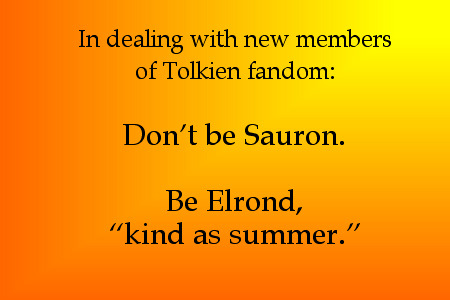
But existing Tolkien fans didn't necessarily welcome those brought to the fandom by the film with open arms. Independence1776 writes:
[My predominant memory] is of going into the #Hobbit tag on Tumblr the day the first movie was released and reading back twenty pages to find the first post that *wasn’t* negative toward new fans. It was literally twenty pages of “new/movie fans suck.” I ended up making a little “Be like Elrond, kind as summer” banner to push against that mindset, though it didn’t get all that much traction.
And just as online LotR fan spaces sometimes struggled with how film fans who didn't always understand their community norms, a respondent identifies tagging norms as an issue that sometimes created tension between existing and new fans: "There sometimes seemed to be a bit of disagreement about how many references to any book source a Hobbit movieverse fic needed to contain, proportionally, before some non-movie fans were happy to see it tagged for that source on AO3 …."
Fan Cultures
In the section above, several participants identified a major cultural shift as a growing openness to interpretations and fanworks about women, LGBTQ+ characters, and characters of color. Another cultural change involved platform shifts. Writing of her return to fandom after the Hobbit films, PhoenixRisesOnceMore observes that the
online fandom landscape had changed *immensely* in that time. Social media sites had overtaken message boards as the primary way of interacting with fans. AO3 existed. Many of the smaller fanwork archives from the late '90s and early '00s were gone. The sheer diversity of fan representations of Tolkien’s world had *greatly* increased.
The consolidation of participation onto fewer and larger platforms also brought Tolkien fans in closer contact with other fandoms. Independence1776 writes that the Hobbit films
had a lasting impact because they (along with the general fandom shift to Tumblr) brought Tolkien fandom closer in culture/contact with general Western media fandom and that changed how many people interacted with fandom and the canon, both movie and book. There started becoming more of an assumption that everyone was multifandom and conversant with the norms of non-Tolkien fandom without realizing that Tolkien fandom has long had its own subculture, especially because a lot of the newer fans seemed to be or outright were dismissive of long-time fans and our experiences. This also marked the shift away from Tolkien-specific fic archives to AO3 dominating.
Another respondent also saw cultural changes originating with platform shifts:
I think that the Hobbit films brought a new wave of fans and a younger generation of fans in particular into the fandom. The generational difference meant that fandom activities also took place on new spaces like Twitter, and took on the cultural norms of these spaces too. "Stan Twitter" just has a different energy from LiveJournal or Tumblr or the various old forums.
An interesting side note about the responses concerning the Hobbit films: No respondent mentioned that the Hobbit trilogy helped them connect with other fans or make new friends. In light of the responses by fans who recall the LotR trilogy—some of whom met their spouses or had other life-changing experiences due to the Tolkien fandom—the Hobbit trilogy seems far less impactful on people already participating in fandom when it was released, possibly because much of the fandom's infrastructure was already in place and fandom in general had become much more normalized.
Fanworks
Participants in the fandom prior to the LotR films recall that a major effect of the films was to homogenize how people viewed and visually represented the characters (see the section on the LotR films above). Respondents observed an even more drastic effect of the Hobbit films: They brought characters and groups that had been largely ignored for over a decade into the limelight and altered how fans perceived them. One respondent writes, "Again, fanart became very standardized," but many participants noted the radical shifts in perception of Hobbit characters and the popularity of the Bagginshield ship. Rebecca observes, succinctly: "Dwarves became sexy." Elwin Fortuna sees a similar phenomenon in how Bilbo was perceived and written:
Bilbo had previously been seen as the uncle or as someone older and thus less sexy prior to the Hobbit movies. They changed how he was perceived too, and he began to get a lot more explicit content, especially with the rise of Bilbo/Thorin, which is a Hobbit movie ship from whole cloth, specifically sparked by the hug they share at the end of the first Hobbit movie.
The Bagginshield ship, in particular, was a monumental outcome of the Hobbit films. "The burgeoning of Bagginshield fics was predictable," recalls one respondent, "but the numbers, quickly growing on AO3, nevertheless took previous fans by surprise."
Nor were these the only characters and ships to receive more attention post-Hobbit film. "Certainly the rash of Kili fanfiction (a throwback to the Legomances of an earlier era) was entirely a product of these movies," writes Daniel Stride. Other participants identified Legolas/Gimli—a LotR ship—as receiving a boost due to the attention paid to Legolas's character and Dwarves in general in the Hobbit films. "Legolas/Gimli, despite arguably having incredibly shippy content in the book, wasn't written very much," says Elwin Fortuna. "The Hobbit movies changed that, and changed the way that fandom perceived Dwarves." Rishika Aggarwal traces some of this interest to the Hobbit films' focus on Legolas, noting that "while Legolas is not part of the original book, giving him a greater depth of character through his inclusion in the Hobbit movies has been largely appreciated by the fanfic fandom."
Putting It All Together
If two film trilogies show anything, it is that adaptations of Tolkien will generate interest in the Tolkien fandom. But the responses of fans present before the LotR films compared with fans who were around before the Hobbit films show that this interest doesn't necessarily take a predictable shape and other factors come into play.
The film trilogies did shape what some fans saw as canon, but this was not their biggest effect. Both trilogies generated a good deal of inventiveness in fan communities and especially in terms of fanworks. Both also opened the boundaries of who felt welcome to identify as a Tolkien fan.
The Hobbit trilogy, however, was on the whole less impactful. Where online LotR fandom arose alongside the films, fans drawn into the fandom by the Hobbit films found existing fan communities that they joined (or didn't). In other words, where some of the aforementioned inventiveness for the LotR films involved building online fan communities by LotR film fans, the Hobbit films did not have the same effect. Likewise, the Rings of Power series will emerge into a fandom already constructed, already with many of its norms in place, and even more mature and set in its ways than the fandom the Hobbit films found a decade earlier.
Table of Contents | Leave a Comment

