New Challenge: Stars
Create a fanwork using star-themed prompts presented in a bingo board format.

SWG News
Character of the Month: Marach
There are few details in the texts about Marach, but he is noteworthy for his allegiances and his descendants, who would become pivotal to the history of Middle-earth and the eventual defeat of Morgoth and Sauron.
New Challenge: Allusive
Literature and art constantly refer back to each other using allusions, and this month's prompts are inspired by allusions to literature, myth, art, and history.
Cultus Dispatches: "The Rings of Power" Is a Ripple (So Far)
Tolkien Fanfiction Survey data for 2025 shows that "The Rings of Power" TV series has not had the same impact on the fandom as the film trilogies did ... so far.
New & Updated Fanworks
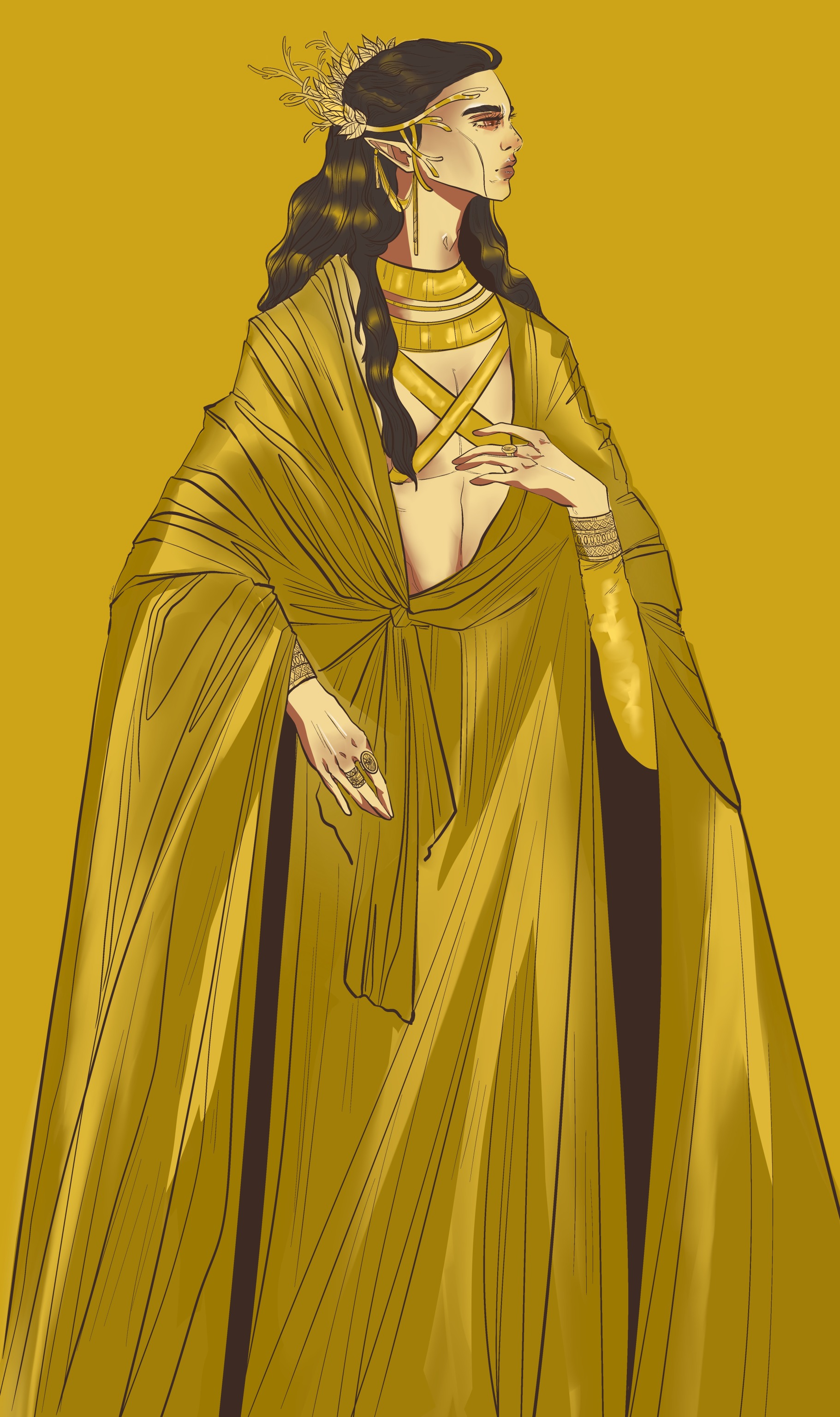
[Artwork] Lindórië looks to the future by Anérea
silhouette portrait of Lindórië, grandmother of Tar-Palantir
[Writing] From That Rubble by StarSpray
Fëanor shrugged, studying the contents of his wine glass. “Something must be done about that house. It will fall down eventually.”
“It does not follow that it must be you that tears it down single-handedly. Are you sure you do not want help?”
“It’s not as though I…
[Writing] A Thousand Winds that Blow by StarSpray
When uneasy dreams bring him back into Beleriand, Daeron finds a pair of twins who have lost their home, and an enemy who has lost himself. The Shadow's reach is growing ever longer, and if they are to survive, they must do it together.
[Writing] An Alluring Offer by octopus_fool
Tata is offered a solution to a grave problem, at a very low price...
[Writing] The Mirror Crack'd by AdmirableMonster
Rescued from a brutal Angband hunt, an ex-thrall with a strange and powerful artifact embedded in his spine is brought to Himring, for it is one of the only places in Beleriand which welcomes such folk. Though he has no memories of his life before, Anniavas slowly becomes accustomed to his new…
[Writing] most days I don't recognize me by annarobots
Of course, she knew that in the Blessed Land, true harm was unlikely to come to him. The Valar watched over them all, and the lesser spirits were everywhere. It was a great hound of Oromë who had found him happily splashing in the creek, in fact. But anyone could drown in mere…
[Series] Eat, Pray, Love by AdmirableMonster
The Darkest Timeline AU for my Steampunk Númenor series.
In which the Mouth of Sauron is originally a Númenorean chemister rescued from Ar-Pharazôn's intimate attentions by Sauron himself.
Current Challenge
Stars
Construct a fanwork using star-themed prompts in a bingo card format. Read more ...
Random Challenge
Manwë's Mailbag
This challenge has two parts—making postcards which will be used as prompts, and using postcard prompts to create a fanwork—and will run slightly longer than usual. Read more ...
New in References
Speak Friend and Enter: Trends in Fandom Entry Year by Dawn Walls-Thumma
Across three surveys and ten years, the Tolkien Fanfiction Survey has document when authors began writing. These data reveal trends in how film promotions, the films themselves, the books, and other historical contexts have influenced not only who writes but how long they stay.
There are few details in the texts about Marach, but he is noteworthy for his allegiances and his descendants, who would become pivotal to the history of Middle-earth and the eventual defeat of Morgoth and Sauron.
Featured Themed Collection
Beyond the Silmarillion
[Artwork] A Memento of Faery by Grundy
TRSB26 art 144 - an artifact brought back from Faerie by a Starbearer.
[Writing] Down the Long Years by Isilme_among_the_stars
Bilbo, the strange old hobbit with the wandering feet, senses something special in young Frodo the first time he sees the lad; as they become close, they find in each other a cameraderie not well understood by other hobbits. Five poignant moments between Bilbo and Frodo Baggins over the course…
Around the World and Web
Silm Smut Week 2026
Silm Smut Week is a Tumblr event celebrating sexually explicit fanworks.
LotR Week 2026
A week-long event for The Lord of the Rings
Finwëan Ladies Week 2026
Finwëan Ladies Week will run from September 21-27, 2026!
Fingon x Finrod x Maedhros Day 2026
A day to celebrate the relationship of the three eldest princes.
Sindar Week 2026
A Tolkien event week for the Sindar, the Grey-Elves, from the Years of the Trees to the Third Age.
Fandom Voices: Filmverse Fans by Dawn Walls-Thumma
Posted on ; updated on
| | |
Fandom Voices: Filmverse Fans
In May, we asked people who were part of the Tolkien fandom before the films how they believed the films shaped the fandom. Their responses can be summed up, in the words of one anonymous respondent, as "there were fans everywhere."
In our Fandom Voices project, we open questions to anyone who wants to share their experiences. This month, we tackle the matter of the films again but from a different perspective: that of those suddenly omnipresent fans, brought to the fandom by the films. We asked fans who joined the Tolkien fandom entirely or in part because of the Peter Jackson film trilogies to share their experiences joining the Tolkien fandom as a film fan or while the films were in theaters. Participants could respond about the Lord of the Rings (LotR) movies, the Hobbit movies, or both. If you missed the question when it was first posted, don't despair: the response form is still open, and we will continue to add new responses as they come in.
In this first section, we'll share some of the trends we noticed in the responses we've received so far, with minimal commentary, followed by the complete collection of responses.
"I Discovered the Books"
I have written in the past about how the films first brought Tolkien fans to theaters, then to the books. Many respondents claimed that seeing the films encouraged them to pick up the books.
In some cases, the drive to read the books was so strong that fans overcame significant challenges in order to access them. One respondent wrote that, after seeing the films, "In fifth grade (around age 10), I decided I wanted to read the books, so I got a boxed set. It probably took me three years to fully read and understand them for the first time." Another describes feeling compelled to be familiar with the books before seeing the films and speeding through them in record time: "It was in that period of my life when I refused to watch an adaptation without having read the book first, so I sped through the trilogy in something like a week." This response is interesting, too, because we often think of fans progressing from the films to the books, in that order. In this case, anticipation of the films—and wanting to experience them with a fuller understanding of the legendarium—led to reading the books.
Fans identified many reasons for turning to the books after the films. Of course, wanting more of the world they first entered when viewing the films is a major reason. "I loved the story," says one fan about her experience watching the LotR films, "so I sought out the books and devoured those too." Another respondent recalls how powerful the first viewing of the Fellowship of the Ring film was for her: "My parents made us go to see the first LotR movie. When I got out of the cinema, I just had to buy the books immediately."
The Hobbit films also inspired (or renewed) an interest in Tolkien's books. Starlightwalking writes:
I was a teen when the Hobbit movies were released, and I have fond memories of going to see them in theaters with my dad. I'd read the LotR books and the Hobbit book before that. Newly interested in Middle-earth, I jumped back into the books eagerly, and began to research more about the cultures of my favorite characters (the Dwarves and the Silvan Elves), which led me to a pairing very related to my previous interests [in Kili/Tauriel]: Legolas/Gimli.
In some cases, even a piece of that world could inspire a film viewer to turn to the books. "I watched the first Hobbit movie and didn’t like it much," one respondent admits, "but I was interested in Dol Guldur and looked it up online. From there I read lots of lore and turned to The Silmarillion. I became active in fandom for the first time after reading The Silmarillion." Likewise, negative perceptions of the films pushed fans to engage with the books. Writing about the Hobbit films, one respondent states: "I joined [the fandom] again because I hated [the Hobbit films] and wanted some vindication. This was how I ended up drifting towards The Silmarillion."
Other fans who watched the films and found the fandom experienced social pressure to read the books. "I wanted to write fanfic to contribute to [Tolkien fandom on Tumblr], but I felt like I didn’t know the world/characters well enough and decided I should read the books," Ari wrote. L. Chan uses the term imposter syndrome to describe the feeling of being a film-only fan in a fandom that tends to be heavily bookverse: "As I got more involved in the fandom, I began to feel a sort of imposter syndrome having not read the books, so I hastily read through all of the Lord of the Rings books, then The Hobbit, and then The Silmarillion." Another respondent writes that "communities were more open to new fans that were willing to read the books as opposed to fans strictly of the films, and I think it’s still the same nowadays."
Along the same lines, having read the books conferred a status on fans whose friends were only familiar with the films. One respondent remembers, "I was the only one of our fan group who not only read the books but also looked at some of the appendices, so I was the resident Tolkien expert until we got a friend who read The Silmarillion about five years later."
"I Discovered Fandom"
The section above hints at the role the films played in nudging fans toward the Tolkien fandom hand-in-hand with their discovery of the books. Fans often reported that the films were all or part of the reason that they found the Tolkien fandom.
In some cases, respondents enjoyed the books long before the films came along, but the films encouraged them to look for content online, leading them to become involved in the fandom. "When I was thirteen," says L. Chan, "my dad showed my sister and me the Lord of the Rings trilogy films. I was enamored by the sword fighting and grand high fantasy of it all. Once we were done, I went on the internet looking for all the content I could find of it."
In other cases, the discovery was accidental. Keiliss writes,"I'd loved the books since my early teens but had no idea fandom existed till I went looking for pictures of Elrond from the movies and accidentally found the Vanilla Elf site and drowned in fiction. Never looked back." Another respondent notes that the films reignited an interest in Tolkien that ended with finding and joining the fanfiction community: "The connection is quite a loose one. I had already been a Tolkien nerd before. But I had pursued that interest in a comparatively solitary fashion, apart from the occasional conversation. The films revived my interest after a short hiatus, and shortly after that, I discovered the existence of fanfiction online as a reader."
Respondents identified many ways that the fandom impacted them positively. Creating fanworks was, of course, a big one. "The communities I joined were mostly also new/film fans," writes likethenight. "There was a huge flurry of fic, particularly, and most of it was set in, or at least inspired by, the movieverse." Sam credits fandom with his interest in writing meta: "I think fandom is really what got me into the meta analysis of Tolkien's work and comparative analysis of the books versus the films."
Nor were these experiences conducted entirely online. Several participants described in-person experiences. Writing of her first time seeing the LotR films, Juliana recalls a mix of online and in-person participation: "Brazil had a decent Tolkien community even back then, with local groups which met in person, some published magazines, and online forums." Another respondent, a child at the time of the release of the LotR films, remembers that "my friends and I would find message boards to learn Sindarin, bake lambas, and dress up together playing in the woods."
The films also influenced fans' perceptions of how the texts should be read and canon interpreted, often causing fans to embrace more liberal interpretations. Sometimes, this bumped up against the prevailing bookverse culture, causing filmverse fans to feel unwelcome. One respondent notes, "Overall I haven't felt very eager to join the Tolkien fandom proper because it seems to me from some probing to be very over-serious and full of people who want to get into big academic debates as opposed to having a more light-hearted attitude to canon that I perhaps picked up due to my film-first exposure." Shadow observes that parts of the Tolkien fandom felt unfriendly after the release of the Hobbit films: "During that time the majority of the most active writers were all purists and Mary Sue hate was at a high as well, which made it a pretty bad place to be for a new writer. Especially one who wanted to write about OCs [original characters]. It got better though." They go on to recall an exodus of many of the existing, vocally conservative fans, "which meant the fandom there felt a lot safer and happier overall."
Especially among Hobbit film fans, several respondents report that the Hobbit segment of the fandom was friendly, open, and fun—an impression that didn't match their perception of many existing Tolkien fan communities. Juliana writes that the Tolkien fandom post-Hobbit was "fine" but, "I could tell I was coming into a community with a lot of baggage and established disputes on how to read the source material." Another respondent notes that the sheer number of new fans created a sense of safety in numbers: "I felt welcome because there was a big surge of new fans." Others found a fandom that welcomed newcomers and the energy they brought with them. "There was a huge influx of new fans on Tumblr during the release of The Hobbit," writes one participant. "It was fun, it was fast-paced, it was a combination of new fans and established Tolkien enthusiasts, and it was friendly."
Starlightwalking details the long-term impact of animosity towards the films—and their fans. "Even nowadays, when I see Tolkien fans dunking on the Hobbit movies, I can't help but feel defensive of them," they write:
Yes, they have many flaws, but also I love them. Seeing people who are genuinely distraught about how they "ruined" the story or the fandom is hurtful, because I would not be here without them! They are very important to me! And though I am primarily a Silm fan these days, I will always love and appreciate the Hobbit movies, and my experiences of being part of the Hobbit-movie-fan-to-Silm-fan pipeline will always shape my views on new fans coming from other media sources, and thus those adaptations themselves. Maybe the new Amazon series will be horrendous. But you won't see me out here being needlessly cruel about it.
As implied above, film-first fans often see the films as shepherding in a more friendly fandom. In some cases, exposure to the films led fans to become more open to different ideas about Tolkien's world.1 For example, Caitlin writes, "I knew of fandom before the films came out but I had only read the books at that point, the films gave me the realisation that other views were justifiable and enjoyable." Sam makes a similar observation when, speaking of the Hobbit films and the controversy around Tauriel in particular, he says, "I came out of it with a positive outlook rather than a defeatist one because I could enjoy the books and films separately." Whether urging fans toward new books to read or new perspectives to consider, one of the overall impacts of the films is to broaden and deepen engagement with the legendarium. On the eve of the release of Amazon's Rings of Power series, starlightwalking uses this to guide their own engagement with fans brought in by the show: "I want to take the good things out of this, and that includes the new fans who will undoubtedly make this fandom a better place in the long run, because anyone who loves Tolkien enough to remain dedicated to his works will add something to our fan communities."
"I Made Lifelong Friends"
After joining the fandom, filmverse fans often reported forming enduring friendships with the people they met there. These friendships are often strong and even life-changing. Firstamazon writes, "I have fond memories from all the chatting, the endless discussions of whether Balrogs did or did not have wings, if Sam was more a hero than Frodo, if Gollum or Fëanor were truly evil, etc. It was in this forum that I also met one of my best friends to this day." In some cases, these friendships extended into real life. Lady_Elwing offers an example: "I started to read and write fanfics on Fanfiction.net and made friends in the French-speaking part of the fandom. We made a forum to share things … . I'm still friends with my forum friends. We had a real life meetup in Paris and since then we meet regularly."
These friendships often had a lasting personal impact. JoT writes: "I found the Hobbit trilogy during a particularly harrowing time, and the fandom basically served as a haven. I came across works by some amazing authors, who were kind and incredible. Their works sustained me and kept me going and I'll forever be grateful to them for writing such stories."
The influx of new fans that came with the films also created a community ripe for growing friendships. "There were a lot of other new writers like me," Shadow recalls, "who had just found this space and were starting out and that was lovely because we were learning together."
Parting Thoughts
The experiences reported by fans who began participating in the Tolkien fandom because of the films aren't easily categorized. Some found a fandom that they perceived as vibrant and welcoming. Others stumbled upon communities that felt stiff and unfriendly. Fans report communities that embraced the films, detested them, and everywhere in between. However, some clear trends emerge. First, as I have written before, the films drive viewers to read the books. While many respondents created or consumed filmverse fanworks, the filmverse-only fanworks creator is a unicorn; most fans pick up the books. Next, the films led other fans to discover the fandom, again through diverse means. Finally, the films inspired friendships: online, offline, or a mix of both but often described as life-changing. Regardless, for these fans, the films initiated a process that usually began with a deeper exploration of the legendarium and ended up with new community and social connections.
Works Cited
- The idea that movieverse fanfiction would "give permission" to bookverse fans to be more liberal in straying from the canon was put forth in 2004 by Amy Sturgis in "'Make Mine Movieverse': How the Tolkien Fan Fiction Community Learned to Stop Worrying and Love Peter Jackson" in Tolkien on Film: Essays on Peter Jackson’s The Lord of the Rings, ed. Janet Brennan Croft (Altadena, CA: Mythopoeic Press, 2004), 283-305.
Table of Contents | Leave a Comment

