Interview with Anérea and Shadow by Anérea, daughterofshadows
Posted on ; updated on
This article is part of the newsletter column Mereth Aderthad.
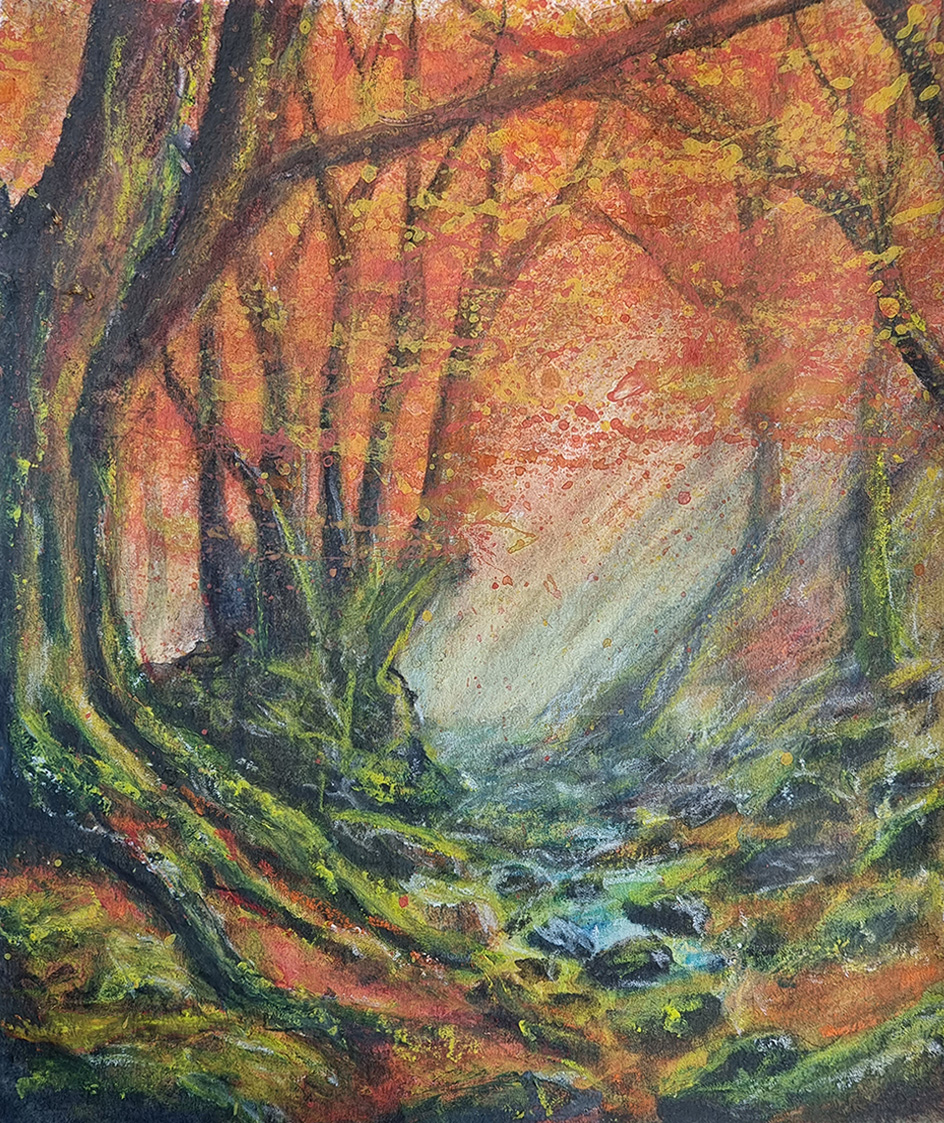
Anérea and Shadow are the featured artist and featured writer, respectively, for Zhie's Mereth Aderthad 2025 presentation, "How To Make a Star From a Tree: The Science of Telperion and Laurelin." They sat down together to chat about their work on Zhie's presentation and on Mereth Aderthad more broadly, as both are involved as volunteers for the event, and Shadow has also written a story for Maglor's presentation "Gil-galad was an Elven King: Kingship and Personhood in the last High King of the Noldor." They spoke about the appeal of light in Tolkien's world, about achieving freedom from perfectionism and imposter syndrome, and the special role that fanworks and fan communities play in so many of our lives.
You can listen to the audio here with a transcript following.
Shadow: Hi, everybody. This is another one in our series of interviews for Mereth Aderthad. Today, Anérea and I will be talking about our works for Zhie's presentation, "How To Make a Star From a Tree: The Science of Telperion and Laurelin", and just chat about what we've been up to in terms of fanwork creations for that presentation and also about everything else that comes to mind.
Anérea: So I think we can start with your Tolkien history, Shadow; I wanted to know what it is about his work that excites you.
Shadow: I mean, most of all, it's the vast amount of space that you have in his world.
The people who know me will know that I am mostly a world builder in terms of writing, and even though Tolkien has done so much in exploring the cultures he created, there's also still a lot of open space where we can create our own things and that is something that definitely excites me a lot.
And it's like, I've been given all these toys and now I have an entire playground to build on and build all my little sandcastles where I can put my silly little creatures in and make them go on adventures in this wonderful, wonderful, wonderful world. And I think that is one of the most important parts that excites me as a creator in Tolkien's world.
As just a reader, it's definitely the hopefulness. It's a story that I come back to every time when I'm feeling down because Tolkien has done such a great job of making sure that you always find something that cheers you up even when it's in the middle of the darkest chapters. There's always this little spark of light that you can find and can cling to, and I think that's really, really beautiful.
Anérea: That's so cool. You're absolutely right. I hadn't thought about the hope aspect; despite it being so tragic, there is always this spark of hope, as you say.
Shadow: Yeah. It's really fun. How about you?
What do you think is the key aspect that you like about working in Tolkien's work, or just about Tolkien in general?
Anérea: I was thinking about it and I can't actually say what exactly it is about his work that draws me to Tolkien, just a certain je ne sais quoi, about it. I've had a lifelong attraction to fantasy from when I could first start reading. My early readings of The Silmarillion had a lot more magic between the lines than I find in it now. I think my reading of it was more like the Book of Lost Tales stuff: it had a feeling of that magic and whimsy and the sort of otherworldliness. For me, I love that escape to the other-worldness, despite the irony that Middle-earth is our Earth. There's just these other possibilities that are not possible in our reality. Combined with the sense of realness in Tolkien's legendarium, it just really draws me in. So there isn't really a part that's more of a favorite and I don't have any particularly favorite characters. I keep jumping around with different characters, but I think it's really the magic and the possibility. And just escaping … escaping into this world which feels so real.
In terms of the fandom and reading other people's interpretations, there's such a wide scope of interpretations and explorations of the many gaps that Tolkien has very generously left us. I feel like The Silmarillion is looking at events from the vantage point of the Eagles or of Vingilot: just very, very distant and not very detailed. Whereas reading fanfic is like swooping right down to ground level and getting up close and intimate. And that's what I absolutely love about the fanworks. And then for me, whether it's writing or creating art, it's just exploring all those little bits, those sort of one-liners which actually open up those huge vistas, that for me is where the magic is.
Shadow: Yeah. You're talking about, like, how it's our world, but still there is this magic left and I think it's the same type of magic that when you go outside you see in the glittering of a lake, of water in the lakes or in the birdsong when you're in the middle of the forest and just listening to what the birds are telling you. I think that's the magic that is still “left” in this world from the world Tolkien imagined was the predecessor of what we have now. I think that's like, the magic is still here. It's just way more hidden, but it's really fun to dive in where it was still vibrant and very present.
Anérea: I really like that there is this sort of realism to that magic. And I think in our modern world we've become so focused purely on science and things that we can explain, whereas there's so much stuff that we can't explain, that we can't measure, and I think that's where magic lies. So there actually is a lot of possibility.
I've been thinking about how one of the things which is really different in the legendarium is light. And I guess that sort of comes back to Zhie's presentation because Light is a very tangible substance in Middle-earth and quite different to what we get here from the sun. And one of the lines that I absolutely love is in The Book of Lost Tales, where the light is described as shimmering streams that would sometimes fall to the ground as a sparkling rain and gather in pools in the ground. And then the Valar gathered that light and took it to Valinor and dug these holes and filled the holes with this liquid light, which then fed the Trees. I just love this whole concept of light being this thing that you can touch that, you can actually run this liquid light through your hands, rather than it being something which is illuminated by a different lightsource. (And just as I said that, the sun has come over the top of the mountain, and I'm finally in the sunlight here!)
Shadow: Light obviously is a fascinating part of Tolkien's work, and I loved seeing that you had picked up this presentation because I adore what you do with light in your paintings. It's definitely, like, one of my absolute favorite parts of your art and one of the reasons why I love the two prints that I have standing in my bookshelves just looking very, very glowy despite the fact that they are both scenes at night. And I was wondering whether this fascination with light was one of the reasons why you decided to pick up Zhie's presentation of all the presentations for Mereth Aderthad.
Anérea: They were just all so interesting, but Zhie’s immediately leaped out at me, and I was like, oh my gosh, I can't believe this! I am picking this one! I want to paint this! And actually synchronicity was at play too because I happened to be working on a fanwork illustrating the progression of Arda's various light sources through the ages, when the abstracts were shared with us. So it was just right on point there.
So, it's interesting what you said about the light in my art as well. In a “previous life” I was a photographer and I've always loved playing with light. I mean, with photography that's actually what you're photographing. You're not really photographing the objects. You don't capture the objects, but you capture the light that's reflecting off them. So when I started painting, I realized that photography had influenced and informed my painting.
I've seen really gorgeous and inspiring artworks of the Two Trees, and in so many different styles. Some are stylized, some are very realistic, and everything in between, but what I really wanted to convey for Zhie's presentation (because as Zhie said, it's all about the light more than the Trees) was a sense of the Trees being the illuminating lightsource, so more the light of the Trees rather than the Trees themselves. Which was actually very interesting because there's no references for something like a tree that is a lightsource in itself. Bioluminescent fungi are about the closest I can come, or deep sea animals which have light. So trying to figure out how the leaves would sort of glow and everything, has actually been quite a challenge, but a fun one.
Shadow: I can imagine. It's interesting that you mentioned the different light sources that existed in Arda because that's kind of what I ended up basing my my story around, tracing the story of light in Arda and also how it comes into conflict with darkness and yet still manages to be, the survivor, the “winner” in quotation marks of this conflict. That the darkness tries again and again to destroy and capture the light, but the light says no. And it finds new ways to exist, and that's very much a part of what I try to convey with this story, to go through the different ages and to see how one light source was replaced by another, was replaced by another. And the essence of it still hearkens back to the very first ones, the Lamps that existed at the very beginning of Arda, and capture this determination of the light to continue on even even in the dark in the darkest times.
Anérea: Yes, I find that such an amazing aspect of this light. If you actually read through the whole lot, it is all the same light from the very, very beginning. And, I find it absolutely fascinating because in The Book of Lost Tales, there's this mention of the shimmering streams of light that were drifting through the air. And before that, Vada had hung some stars, but it never actually mentions what she makes stars from. And then going back before that, Eru places the flame imperishable at the heart of Arda, but there's no mention anywhere of where these shimmering streams of light come from. But from there that light is gathered and it's made into the Lamps, and then the Lamps are destroyed. And then even in The Silmarillion, they gather some of the light and it goes into the trees as well. And then, obviously, the trees turn into the sun and the moon. So it's just amazing that it's as you say, the stuff is just so resilient, it cannot be destroyed. It's really like pure energy, but it's such a tangible, tactile energy, which I just find absolutely magic.
Shadow: Yeah. Absolutely. And I think it's also fascinating it's in the nature of so many other stories in our world as well because light has been such a fascinating aspect of human existence that we've been telling stories about the stars, the moon, the sun for millennia now, and there's still more to say about them. And I think that's also one of the fascinating aspects, both in the universe of Tolkien and in our world, that even though it's such a strange concept by itself, there is so much to say about it.
Anérea: Absolutely. And as you said, it's a strange concept, but I really like what you say about that: the persistence of it, the indestructibility of it, which is really like pure energy, which cannot be created or destroyed. And it seems it's the same with this light. No matter how hard Morgoth tried, or Ungoliant or whomever, it just could not be destroyed.
Shadow: Absolutely. Although the constructs that were sort of the framework, or the support for them were destroyed, the light itself continues. It's also interesting because, I don't know whether Zhie will actually talk about this aspect, but it's the same with how stars die in our universe. The lights, the energy that they have given off doesn't disappear. It's just that the carrier changes because, obviously, at some point in time, a star will run out of fuel and then die. But that doesn't mean that all the energy it gave off before just disappears. So I'm very curious to see what Zhie will be talking about in this presentation.
Anérea: Ja, me too! I've read Zhie’s paper that this is almost a sequel to, about how the Silmarils were made. And that was really fascinating, so I'm really interested to see what conclusions Zhie comes up with for this. Very excited too.
I know that you're into astrophysics, so it really didn't surprise me at all that you chose Zhie's work to write for. And, just what you're saying here about the stars, even when they go supernova, there's this light that just continues through the universe to wherever it goes to.
Suddenly you've given me an image which sort of is half blending our real world with Tolkien's world: somewhere at the edge of the universe are these, like, pools of light from all these stars that have just been traveling through the universe, and then it ends up in this magical world where this light is, like, gathered. I just suddenly had this funny image.
Shadow: I think that that would be really interesting. It's also because, obviously, we still see light from stars that have died long ago, just because they are so far away that the light has been traveling still even though the star has gone out. And I just suddenly have this image of some place, like, in a neighboring galaxy that is still seeing the light of the Lamps even after all this time because they're so far away that they haven't haven't gone out yet. But that is definitely one of those that I should include in the sci-fi universe and not in this story for this presentation. It's a fascinating thought to think about.
Anérea: Yes, I think that's one of the magical things about Tolkien's work is how it just spontaneously spawns all these crazy ideas, that are just absolutely fantastic to think about, and they're such original ideas. I mean, here's a bunch that we just never thought of before. All of a sudden, well, for me, I've got a very visual mind, so I have all these images in my head now.
Shadow: Yeah. I mean, I can't say that I've got a very visual mind. I'm more of a text thinker, but I rarely spend a day in my life when I don't suddenly have a new fanfic idea that I could explore if only my days had more than twenty-four hours.
Anérea: Oh gosh, yes! That irritation of having to actually go to bed and sleep and not be creative during that time.
So, I was wondering what your process looks like. So, when you have these ideas, do you plan out a ficlet or do you just sort of let it pick you up and carry you along, or something else?
Shadow: I'm definitely more of a pantser. I rarely plan out what I want to happen. It's one of the reasons why I mostly write drabbles and short stories. The only thing that I will put in a modicum of effort to actually know where the story goes is for my long fic for events like TRSB because I know that I need some substance that I can cling to if I want to get 5,000 words out of the story. Otherwise, I'll just, like I pick up the thought and I'll put it down on a page and I see where it wants to go and then I just follow it along and try to type fast enough that I won't lose sight of it. And that's how most of my stories come to be and it works perfectly for the majority of stories I write, because for me, writing is definitely more of an outlet, something that I want to do when I need a break from my university work and stuff where I need to think far more about the process and make sure that it's, like, logically organized and all that stuff. And writing is just like, yeah. Let's find out where I'm going to go today. Today is a time for adventure, and then I see where I end up. And that's how most of my stories come to be. I think it's also very visible in my stories that I'm often just like, let's find out. I don't know where we're going to end up, but I'm excited to get there.
Anérea: I love your stories. And I must say, it's not evident from the reader's side whether you plan or not because for me, it's just this experience, and I just step into this world that you have created, whether it's just a small drabble or something a little bit longer. And, ja, and just sort of go with it. I just love your ideas because a lot of them are very different, novel ideas like your underwater elves, which was delightful, and then your stories with your Ents as well.
Shadow: It's a lot of fun. And I must admit for the world-building, at least I try to keep some sort of consistency so I don't contradict myself because, I mean, we have a high example to live up to in terms of internal consistency for some of the story. So I try to at least not contradict myself with the world-building. But other than that, I'm very much an adventurer. I’m an adventurer when writing my stories, and I rarely have a map with me.
Anérea: Oh, I love that. You make the map as you go along.
Shadow: Yes. Absolutely. I'm more of a cartographer of a new area. I paint the lines and the borders and the mountains while I wander through the terrain.
Anérea: Yes. And that's one of the things that I really love that draws me to Tolkien's work: the borders. It's not boxed in and there's just so many gaps and so many edges and so many possibilities. I absolutely love that.
Shadow: Yeah. It's fascinating. It's always a fun adventure when you go and find a new area to explore. Even during the times when it drives you absolutely mad because Tolkien clearly did not think through the logical implications of how he could achieve the thing he was trying to do—looking at you, Gondolin!
Anérea: Ja, it exists with its own little space-time fabric there!
Shadow: Yes. Absolutely. And I'm like, please give me something, anything. At least, like, put some trees in this valley. You want me to build a city there? But we love him for it. Even when it drives me mad, it is a story that I don't think I will ever abandon completely. I've wandered through many fandoms since I joined since I found Tolkien in 2014, but it's the one place I always come back to.
Anérea: I really enjoy this fandom. I'm actually pretty much monofandom. I discovered fandom through Tolkien, and I haven't wandered far from it, I haven't even wandered far from the SWG itself. It's just such a nice little cozy corner, and there's just so much fantastic writing and art and stuff that's just being created that there's more than enough for me here.
Shadow: Absolutely. I think the Silmarillion Writers’ Guild is a wonderful place to be in the Tolkien fandom. And I think it's also part of the reason why I keep coming back to it just because I love the community so much, and I love spending time with the friends I've made here and enjoy the things they create, the things we create together, and it’s definitely my fandom home. There's no better way to describe it.
Anérea: I also think of it as my fandom home for sure. And it's just really nice having the challenges as a little extra bit of motivation to create art, because … I have an interesting relationship with creating art. I've shifted from digital – I spent thirty years working with Photoshop as a professional graphic designer and photographer. So, I was very used to that tool, but then I just wanted to get away from digital stuff. I wasn't feeling well sitting for more than an hour or so at a computer, so I started painting with watercolors and ink. And I've gone from knowing my tool, knowing how to do stuff in my sleep without even thinking, to not actually knowing how the medium works and how to achieve what I want. So it's been so interesting learning, but it's really nice having actual projects to learn on. I'm quite an intuitive artist, I have a bit of a chaotic let's-see-where-this-goes approach, but having an actual project to work on and learn through is good, because I find that I just learn better while I'm actually doing things. And there's no stress with having the challenges. It's not for a client. There isn't a really tight deadline or whatever. And it doesn't really matter if I make a mistake or whatever. And so that's really helped with my design or my painting process and getting used to the materials and then finally making something. I mean, I'm still learning. And I have a lot of respect for watercolor artists now! I laughingly say there's five stages of creation, which start with excitement and inspiration when you first see the project brief. It's like, Oh my gosh, this is an awesome project!, and my brain starts brimming with ideas. And then the next stage is self doubt, and I go, Oh, shit. I don't know how to paint this. I can't do it. I'm such a fraud. I can't do this! And then it's the bargaining and excuse making, and I'll spend a few days or a few weeks coming up with excuses not to do it. And then just when I finally get up the courage to tell the person, whomever I've offered to do something for, that I can't do it, I realize that it's actually harder for me to tell them that I can't do it and let them down than it is to just sit down and say, “Okay, let me see if I can do it.” That stage is determination. And then the final stage is like the sort of total obsessed absorption with a lot of, Oh my gosh. This actually looks cool. I like what I've done. Oh, I've actually done this! So my creative process is totally chaotic with a lot of unnecessary insecurity-driven stress, which fortunately is getting less and less. What I love about doing fandom stuff is it doesn't have the stress of being paid for something, where the stress levels go up for me because then it's … I think with creative stuff, it's not so much like it's right or wrong, a design or an artwork or whatever is correct or incorrect, it's more “have I interpreted this person's aesthetic preferences correctly? And so with the fandom stuff, it's nice because I can just do it and share it, and I think that actually also helps with my own creativity. I don't feel constrained. And, so my painting is looser and actually better that way.
Shadow: Yeah. No. I totally get that self doubt in between. It's why, if it's not something that I'm writing for somebody else, I usually do not bother with finding another person to beta read my stories. I just go and post them immediately because I know if I start thinking too long about it, I will just hide it away in a corner, and it won't see the light of day for another year or two. So I just go. “Be free. And I hope that when I look back on you in two years' time, I will still think I did a good job.” And that is kind of where I measure my progress as a writer. I'm pleased to say that I have now reached this stage in my life where I can look back at my older works and be like, yeah. Actually, I still like that. Sure. I've improved since then, but it's not terrible. It's nothing I'm ashamed of seeing in my work collection. Because personally, I do not delete stuff. No matter how much I hate it, I do not delete things. There are still some of my very first attempts at fanfiction floating around on the internet because I am of the opinion that back when I wrote it, it was the best I could do at that time, and it deserves to be cherished for that. Even if my current self thinks it's a bit cringe, I know that my teenage self was like, yes, I'm doing a good job with that, and I appreciate that. It was written at a time where I still had a lot to learn about writing itself and about language itself. But I still think that for the fact that it was written by fourteen-year-old me, I still did a good job, and I'm okay with that. And that's why I wouldn't delete it. It's proof of how much I've grown as a creator since then. And there's no point in hiding your past attempts because we're all learning. Even, like, the writers I look up to, that I admire, where I'm like, “Oh my god. You are so cool. How can you do that? I love the way you play with words and create these beautiful, beautiful stories!” I know that they have also started at some point, and it's okay. There's nothing wrong with those cringy attempts because they're still a part of me. I still love those stories. I think the idea would need a bit of work if I would want to do it again, but it was worth it. It was worth writing it, and I think it's worth staying out there to be read.
Anérea: I think that's such a great philosophy and attitude to have towards that stuff. It's interesting because I've had a look back at some of the early fanfic that I wrote, which is only from a few years ago. There's, I suppose, that insecurity, and I think, oh, this is not nearly good enough, and it's such a nice feeling reading this stuff years later and going, oh, wow, this is better than I thought or better than I remembered it!
So I really like that. But, you know, there was a photographer whose work I really admired. He was a top wedding photographer who traveled internationally and charged a fortune for his weddings. I went to a workshop he gave and we kept in touch after. When he came down to Cape Town to adopt his kid, he contacted me and said he's only here for a day and he wants photos of his family, and he wants me to do them. And I was like, “What!!? But you know all these photographers and you could choose anyone!” And he was like, yes, I really like the way you photograph. I was so nervous, but I took him to a forest where I really like the light and we did the photo session. I was so nervous the whole way through, but of course I didn't say anything because I'm used to just pretending that I know exactly what I'm doing and that I'm so confident and everything while I'm doing photoshoots because, obviously, you can't let people know that you're actually crapping yourself! But afterwards, I sort of felt, well, you know, he's also a photographer, so I said to him, "You know what? I was just so nervous doing all of this. I hope these photographs are okay and I hope you've enjoyed the experience as well, because I just feel like I don't know what I'm doing." And he said it was great and he's absolutely sure that the photographs would be too. I'm self-taught and I didn't know the term “imposter syndrome" at that stage but I realize that's exactly what I had. And he said to me, "You know what? After twenty five years of being a photographer, I still don't feel like I know what I'm doing, I still get nervous every time I take photographs, and my parents are still waiting for me to get a real job!" And I just realized, we're all the same! We all have these insecurities about our creations. And I think it's partly because— unlike if you're balancing accounts which are either correct or incorrect, it either balances or it doesn't—when you're doing something creative, whether it's writing or visual art or music, it's a matter of “is this going to appeal to my audience? Is this going to be appealing at all?” I think that's where the sort of insecurity comes in when we're creating, even our fanworks. But I must say, I'm absolutely blown away by all the fanworks and the different styles and the different ideas that get expressed in this fandom, I think it's just absolutely amazing.
(Sorry. I went off on quite a bit of a tangent there.)
Shadow: No. No. No. Don't worry. It was a fascinating tangent, and also, I think you are quite right with the imposter syndrome.
I think all of us do have that problem sometimes because at the end of the day, sharing creative works is very much about sharing a part of yourself, and you're putting yourself out there to be judged even if it is in the form of a painting, of a story or a song. It's always a question of: will people like you? Will they like what you did? Because there's a tiny bit of yourself in everything you create. And I think that's why I struggle so much with showing it. And that's why it's wonderful to have a community that cheers you on and doesn't doesn't get caught up in the mean thoughts in your brain and instead can just look at the thing you create and be like, yes, this is awesome! You did such a great job! And they cheer you on. And that's also, I think, a large part why you stick around in a community like the Silmarillion Writers’ Guild, because there's so many awesome people that are willing to go above and beyond to tell you that you're doing a good job and to beat back those thoughts that are hiding in all of our brains.
Anérea: Yes! I love the supportive nature of the SWG, and it's also taught me to be more forgiving because coming from a graphic design background, I'll say this: I worked with my first boss for two years before I started freelancing (but she's always remained my boss in my heart) and she was also German and that German precision was epitomized in her. So I actually had that as a grounding for my work: careful to ensure things like everything lining up perfectly, no errors, and stuff. Being very particular about those kinds of things has been very good in the graphic design field and proofreading other people's stuff. (I remember I offered to proofread a paper for Dawn when I'd been part of the SWG for a few months. When I beta’d her paper I made so many suggestions because I was used to doing that for my professional work. And I think she was quite overwhelmed at the number of suggestions I had made! I felt quite embarrassed!) And I think what I've learned is to actually be more forgiving of humans just being human, and just doing things and being sort of looser and a lot more supportive. So I've lost a lot of the kind of judgmental aspects that I've inherited from my family and become a lot more accepting. And then also, previously, I would really notice errors. Like, the errors would stand out. I suppose it's almost like when you have a blemish on your skin, you've got this lovely, beautiful, smooth patch of skin and then this tiny blemish. And everybody will just notice the blemish, but ignore the smooth patch of skin, for instance. And I think it's the same if you've got a typo or whatever it is in a fanwork. For me, it used to stand out because I had been trained to notice all the errors, but something that I've noticed happening with fandom and reading fanworks is that I'm having a look at the broader picture and any little imperfections are actually just nothing anymore. And it's actually changed how I see things in life as well. It's interesting because our language also is sometimes so accurate. For instance, if something is broken we'll say that thing “needs attention”. Whereas if something is working beautifully and it doesn't need fixing or anything, if it's functioning fine, we don't say it needs attention but really, that is where our attention should go because that's helping us to enjoy life more instead of just looking at all the things that are broken.
So, ja, I think that applies to fandom. (I've gone off on another tangent here!)
Shadow: It's one of the tangents that need to be said sometimes. And, you couldn't see me, but I was nodding along with you because I very much agree.
It's easy to get lost in trying to find the mistakes and forgetting to enjoy the bigger picture. I mean, for me, English isn’t my native language. So all the time while I was learning it in school, our teachers were very much focused on making sure that we were grammatically picture perfect with no deviations whatsoever. And that has made me very hyper-aware of my own shortcomings in the stories I write. And it remains one of my main concerns when posting that I've made some silly grammatical mistake where all native speakers are like, why would you do that? That is so dumb. But I've also noticed by doing all of these interviews that we all have these little quirks when we talk, and keeping these quirks alive in the editing process is part of what makes these interviews special and not just the same thing over and over again. The same way that Dawn has to correct every single one of my Gil-galad’s because I refuse to remember that the g is lowercase and not capitalized, which has been interesting especially when I was working on the interviews for Maglor's presentation, and Kai’s who is doing the art for Maglor's presentation. Because there's a lot of Gil-galad’s in those interviews.
(Note from Dawn: All of the galads had lowercase g's in this interview.)
And I think of all the twenty times or so that it got mentioned, I have done it right once, and every single other time, Dawn had to go through and correct the g's. But, it's one of those things where I'm like, yeah. It's okay. I don't need to worry about that. I know Dawn is not mad at me for it because we've talked about it, and one day, maybe, I will remember that the “galad” part is lowercase and not uppercase. I just think it looks far prettier when it's capitalized in both parts. But oh well. I do remember that type of fixation on mistakes. And it's nice.
It's so good that you have learned to also spend time to see the whole picture instead of just focusing on the little details. There's this saying that I've learned. It was mostly about crafting, but I think it can be applied to all creative works. And it's that the mistakes are how the evil spirits fall out of the work because they are drawn to perfection. And that making those silly little mistakes means that your work isn't inhabited by evil spirits that could ruin it. And I've stuck to that. Every time I now make a small mistake in my knitting or my crochet or even my writing, I'm like, it's okay. I can leave that in. It's how to make sure that there are only good spirits in my work.
Anérea: Oh, I love that. Absolutely love that. And ja, perfectionism can pretty much be evil spirits for sure. I definitely struggle with that. When I was working digitally it was great because there's undo and in Photoshop there's layers. So if you want to try something different without affecting the work that you've already done, you can just create another layer and then you can either use it or not. But now, painting with watercolor, it's like if I've made the mark, I've made the mark! And then sometimes I'll think, oh, I think I can improve it a little bit. And then I try and often I can never get it back even as good as it had been. But I'm actually finding that's one part of the magic of painting without having this “perfectionist tool”. And, actually, that's where the creativity happens. It's from mistakes. And there's those happy accidents. There's some that are very much less than happy accidents, but throughout, if we have a look at language, like how language has changed; we wouldn't have The Silmarillion if it weren't for those sorts of changes. What at the time might have been a mistake, became part of history. So, ja, I think it's actually creativity, and I just love that it's getting the evil spirits out. That's a good one, I'm going to remember that.
Speaking about Gil-galad, you also wrote another ficlet for Maglor's presentation, about kingship and personhood in the last High King of the Noldor. I was wondering what aspects of his proposal grabbed you to write for that as well.
Shadow: I mean, the story for Gil-galad was the one I picked up first, because for one, Maglor and I, we are co-moderators for Scribbles and Drabbles, so we generally talk quite often. And during the proposal time we were chatting about our ideas, for what we could do, and I was immediately excited because Gil-galad is such a fascinating character to me. And a lot of what Maglor is exploring in his presentation is about how everything we know about Gil-galad is linked to that kingship and not to who he was as a person. That is part of what intrigues me a lot in terms of writing about him because I like to explore those bits and pieces where he's not just a king. He's also a human, well, Elven, being with thoughts and feelings and ideas. And that is what I ended up exploring in the story as well. It's very much a story about the transformation from, what how I described it in the story from Ereinion to Gil-galad, from the man to the king and having to leave behind those aspects of humanity to become a, it's not not really a martyr, but it's similar in in flavor that he had to sacrifice his humanity to become the king the Noldor needed at the time. And, I mean, he was more or less immediately thrust into a war, but he managed to do something with that. In Middle-earth, he was the longest reigning king of the Noldor. And it's so fascinating to see that he achieved things and led his people into an age of peace and then obviously war again. But in between, they had a very long period of stability, and I think that exploring how that works and what he had to sacrifice for it is something that fascinates me about Gil-galad. And also the fact that he's unmarried. We all know that I am obsessed with characters that I can turn into aromantic characters, and Gil-galad is one of them. So that is another reason why I love him very much.
Anérea: I actually hadn't connected him with the aromantic, but he is, totally. And that's such great thoughts about him. I'm really looking forward to Maglor’s presentation as well. I mean, I've been fortunate because I'm doing the design of the zine so I've been able to have a preview of the fanworks. And I must say, what an amazing collection of fanworks for Mereth Aderthad! I'm quite blown away by the quality. So, now I've been able to look at the fanworks, I'm really looking forward to seeing the presentations and connecting with people over that weekend.
Shadow: And I think on that note, that might be a good point to wrap up. What are you most looking forward to during Mereth Aderthad? I assume you will be attending online, just like me, because the trip to the US is a bit far. And so it's a good alternative. What are you most looking forward to over the weekend?
Anérea: It's really it's really the presentations. I'm very curious. The abstracts have whetted my appetite, and they all are so interesting. And, again, it comes to all these individual people. We've got the same work that we're all referencing, and yet there are as many ideas and interpretations as there are people who are reading that work. And so that's what I'm really looking forward to, all these new ideas. The sort of crossover between fandom and scholarship, I think, is great. And also just connecting with people online. And yourself?
Shadow: Same. I mean, we've been working on this for more than half a year now, and it's gonna be so exciting to see the fruits of our labor, so to speak. And having had the chance to speak with so many people during the interviews about their presentations, their creative works, I am so excited to see everything in its entirety.
And I think it's gonna be a fun weekend hanging out, meeting some people that you've otherwise only seen on or chatted to on Discord to celebrate this community and celebrate twenty years. Twenty years is a long time. It's so amazing that the Silmarillion Writers’ guild has gotten this far and that we now get a chance to celebrate it. I mean, twenty years ago, I was, like, what, four or five. So at that point in time, fanfiction, fandom, or Tolkien wasn't even on my mind, but I'm so glad that I'm here now, and I get the chance to join in the celebrations and have fun with all the people that have become so important to me about over the last four years.
Anérea: Yes, I'm really looking forward to the connection as well and meeting people that I've only met in type. I mean, it would be absolutely fantastic if we could just fly over with the Eagles or something, but, the second best is being online!
Wow. Oh, it's been great chatting with you this morning!
Shadow: I was about to say the same. Thank you so, so much that we found the time to talk about this. It was absolutely lovely. And I hope our listeners slash readers have also enjoyed our chitchat!
Anérea: Well, as they say, when you create, you should create for yourself. If you enjoy it, that's the most important thing. And I've really enjoyed chatting with you. It's been great to have this opportunity and to go off on very many tangents!
Shadow: We knew that's what was going to happen! It always happens in vocally recorded interviews. There's just so much more opportunity to go off on tangents than there is in Discord when you're typing out.
Anérea: Absolutely. And, and, no room for that perfectionism!
Shadow: No. No room for perfectionism.
Anérea: Well, it comes out perfect in the end without the perfectionism. However it comes out.
Shadow: Exactly. Yeah. It will. It is good enough with what we've done and everything else is just bonus.
Anérea: Oh, fantastic. Cool. Thank you!
Shadow: Thank you as well!


A great chat-interview!
Anérea and daughterofshadows are so engaging as they talk about Tolkien, their past works and the light-inspired writing and art they have done for Mereth Aderthad. Fantastic!
♡
Thank you Wisteria, I'm so pleased you found all our nattering engaging! ♡
this was DELIGHTFUL to read!…
this was DELIGHTFUL to read! so encouraging and hopeful and so interesting too (I'm so glad I'm not the only one who constantly mis-capitalizes Gil-galad!). and as I'm ALWAYS struggling with perfectionism it's really really helpful to see other people talking about it so casually (I looked back at my interview recently and was like OH GOD why is my grammar so messy in that interview -- btw native speaker here so I don't think you need to worry about that...--and this was a nice little reminder that the imperfections are part of what makes the piece itself.) <33333
♡
Thanks Azh! I'm delighted you found our chat interesting, and somewhat reassuring around perfectionism. (Reading the transcript made me realise how, um .... (I'm digging around for a non-judgemental term here!)... full of extraneous terms like sort of and you know (cringe!) and how disjointed my speach gets as my brain throws more things it wants to say than I have mouths to say them at any one point in time. But then my humour kicked in when I realised how perfectionist I was getting about it! It's a process. 😆)