
Interview with Idrils Scribe by Shadow by Idrils Scribe, daughterofshadows
Posted on ; updated on
This article is part of the newsletter column Mereth Aderthad.
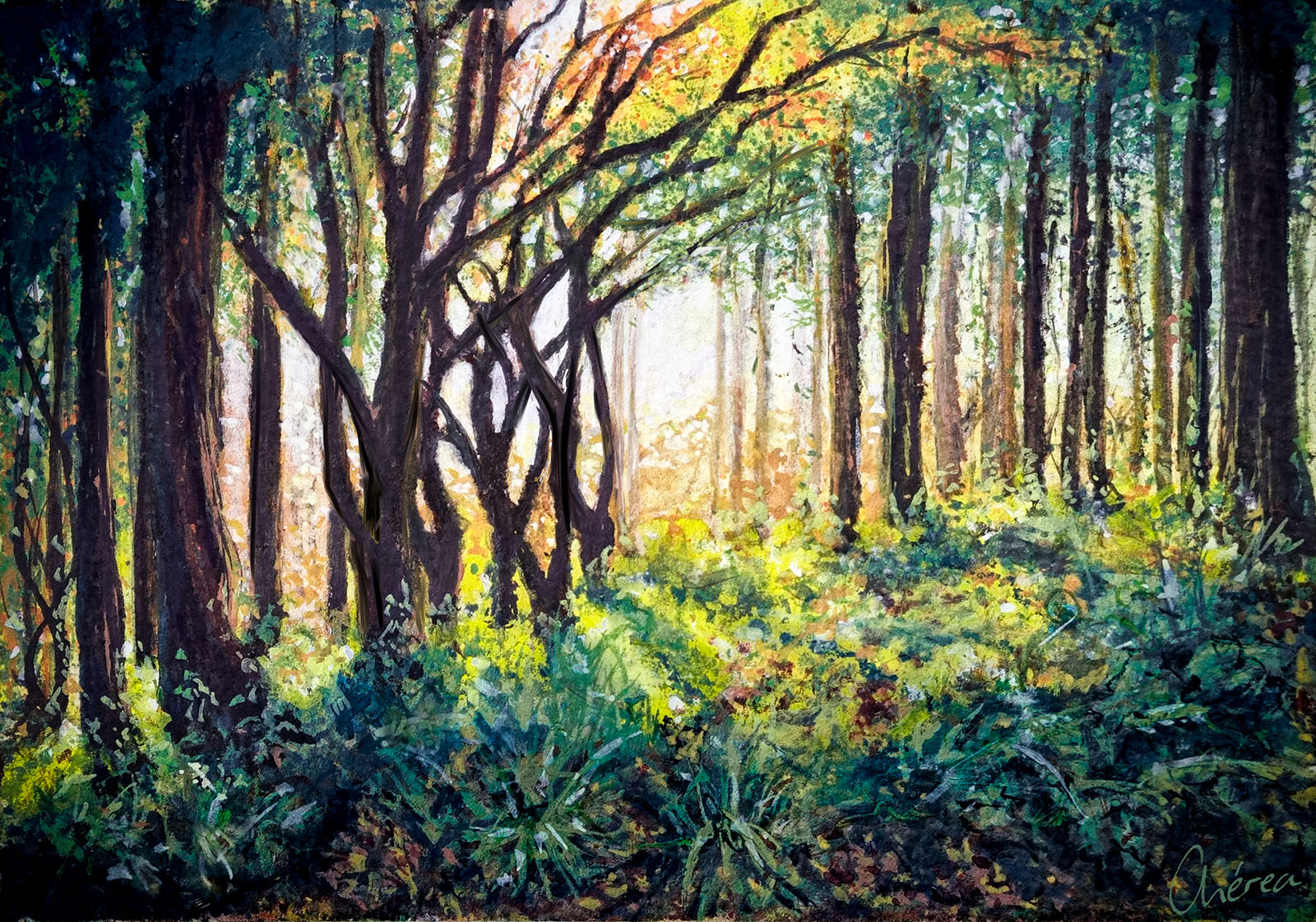
As an author whose work tends to focus on the Sindar, Idril's Scribe is a natural fit as the featured author for Stella Getreuer-Kostrouch's Mereth Aderthad 2025 presentation, "Cherished antagonist, despised protagonist - a defence of Elu Thingol." Shadow spoke with Idril about her story for the event, about the disproportionate criticism Thingol tends to receive in the fandom, the endless layers of the legendarium, and the arc of fandom history that makes inclusive communities essential for creators to thrive.
Shadow: Hi, Idril! Thank you so much for joining me to talk about the story you're writing for Mereth Aderthad. You've chosen to write for Stella's presentation, “Cherished Antagonist, Despised Protagonist - A Defense of Elu Thingol”. What made you pick that presentation in particular?
Idril’s Scribe: Stella and I share a fascination with those Elves who remained in Middle-earth, and Doriath in particular.
Tolkien’s love for trees and forests deeply resonates with me. Europe doesn’t have much forest left, but I had the good fortune to grow up surrounded by one of the remaining ones. As a child I spent many days playing in the woods and exploring in all seasons. It left me with a deep and abiding love for forests. What place in the legendarium could suit me better than Doriath, a forest realm?
Later, when I discovered fanfiction, I grew even more intrigued by Doriath and its ruling family because they appear so rarely. Such a wealth of stories deal with the Elves of Valinor, and the Finwëans in particular.
Middle-earth before the return of the Noldor lies in darkness, literally and figuratively. During the Noontide of Valinor so much worth writing about happened in Middle-earth: Doriath was founded, its dynasty begun, the Dwarves came over the Blue Mountains, built their great cities and made alliances with the Elves, entire wars were fought; but there are few stories about any of it. The First Battle of Beleriand is no less epic and tragic than any of the ones that followed, but so little fanfic even mentions it.
Even during the First Age the people of Doriath are mostly seen through Noldorin eyes. I like to imagine what their world was like. How did their culture differ from that of the Amanyar? What did the arrival of the Noldor look like through their eyes? What did they make of their returned cousins?
The fandom has produced some fantastic stories that deal with those questions, but nowhere near as many as the ones that are set in Valinor. I'd like to contribute something there, however small.
Shadow: Oh, yeah. Absolutely. For me personally, Doriath has never been quite as intriguing as the Falathrim around Círdan, but I'm very, very excited, not just for Stella's presentation, but also for the story you're writing because Thingol is such a fascinating character. It's just that there are so many characters that he's never been quite on the forefront of my mind. So I'm really excited to learn more about him and to explore him a bit more.
Idril’s Scribe: Definitely! He and all his court. As I researched this story, I made a list of all the named characters in Doriath. I was amazed by how many there actually were.
Shadow: I know! It's quite interesting. Every time I reread "Beren and Lúthien", I'm like, oh, yes. True. You also exist.
Idril’s Scribe: Absolutely. Of course Valinor has more named characters, but Doriath doesn't do that badly. Not everyone could make an appearance in "Neither Speak Nor Answer", but I got a great deal of inspiration for future stories. I will definitely revisit Doriath.
Shadow: That sounds incredibly exciting. Do you maybe want to give us, like, a sneak peek of what is going to happen in your story? What were you especially thinking about when you were writing it?
Idril’s Scribe: The Silmarillion gives us a factual description of what Elu Thingol did, but very little about why he did it.
He gets quite a bit of criticism from the fandom. His treatment of Beren, demanding a Silmaril as Lúthien’s bride-price, his refusal to take part in the Nirnaeth Arnoediad, the conflict with the Dwarves that cost him his life … but also the Quenya ban. All contentious decisions.
As I was saying, we know what Thingol did, but we know so little about why he did it. He was ancient, an experienced ruler, and he had Melian the Wise for an advisor. What, then, was his reasoning?
I’m trying to peek inside his head, speculate what his intentions were, and hopefully provide an interesting perspective on one of the more controversial episodes.
Shadow: Yeah. That definitely sounds very, very intriguing and exciting. I was just thinking while you were talking, that yes, we get the rather unlucky start with Melian, but after that, he did a fairly good job keeping his people safe.
Even with Morgoth and being more or less on his own with just his people. I feel like that is also an area that is really underappreciated. He did a lot of things that maybe from an outsider's perspective looked like they were “bad” decisions, but he also managed to achieve quite a bit.
Like, Doriath was, for all intents and purposes, a fairly safe place in an otherwise very dangerous time. That's definitely something that is so interesting to see and also keep in mind when we're dealing with Thingol.
Idril’s Scribe: I think Thingol often gets a bad rap because the Noldor in general and the Fëanorians in particular are so popular.
Characters who oppose them are automatically cast in the part of the villain, even if that role doesn’t fit. Elu Thingol gets that a lot. From a different perspective, he really didn't do that badly. Morgoth would have conquered Beleriand much, much earlier if Thingol hadn’t stood in his way. He kept his land and his people safe for a very long time, in very difficult circumstances, but he did make mistakes, mostly out of hubris (a familiar theme in the Silmarillion!), and in the end they caused his downfall.
Shadow: Absolutely, I totally agree.
I also think that this fallibility of characters is something that makes Tolkien very, very special and also worth the reread every time. You always discover something new. Are there other aspects of Tolkien that keep you coming back to his works over and over again?
Idril’s Scribe:
Part of the attraction of the L.R.[Lord of the Rings] is, I think, due to the glimpses of a large history in the background: an attraction like that of viewing far off an unvisited island, or seeing the towers of a distant city gleaming in a sunlit mist. To go there is to destroy the magic, unless new unattainable vistas are again revealed. Also many of the older legends are purely 'mythological', and nearly all are grim and tragic: a long account of the disasters that destroyed the beauty of the Ancient World.1
This longing, the curiosity that can never be wholly satisfied, the sense that something beautiful and magical has been forever lost and can now only be known through imperfect memory … It struck me so powerfully when I first read The Lord of the Rings as a twelve-year-old, and hasn’t left me since.
Another thing that sets Tolkien’s legendarium apart from other fantasy universes is, as you say, the depth of his characters and the wealth of details that all fit together. The legendarium is more than the sum of its parts. It’s lovingly crafted, and it all makes sense.
You can tell that Tolkien had a profound understanding of mythology and history, and that’s what makes the world so rich and realistic. He wrote so much, and once he passed away Christopher gave us even more. There is always something new and interesting to find. For me that makes it the greatest "secondary world" ever created.
Shadow: Yeah, it's definitely one of the fascinating parts that you just keep peeling back layers and layers of history and somehow there's still more under it to find, more unattainable vistas. That quote is a really good summary of that fascination there.
Idril’s Scribe: I don't know whether I’d have liked J.R.R. Tolkien if I'd ever met him in- person (though I certainly hope so!), but I do think we share the same tastes. He liked stars and trees and music—three of my favorite things!
Shadow: Absolutely. Now, Mereth Aderthad, the event that we are doing all of these interviews for, is going to be a celebration of the community we have in this fandom and the long history of the Silmarillion Writers’ Guild itself. You will be joining us for the event, I believe. Is that correct?
Idril’s Scribe: Sadly, I can’t make it to the United States physically, but I will be virtually present.
Shadow: Yeah, same. I will also be on Zoom for it. What are you most looking forward to with regards to the event?
Idril’s Scribe: To see and hear people whose work I've only read. I admire so many writers in this fandom. Many of them will also be taking part and contributing, so I'm looking forward to hearing and seeing them perform their work.
I’m a huge fan of the Silmarillion Writers' Guild itself, as a community, so my greatest respect and admiration is for Dawn. She built this community and generously invested so much of her time and effort in it. I find it such a great place to be. The support you get as a writer, the friendly atmosphere, the people. It's fantastic and I'm so enthusiastic about this opportunity to celebrate it.
Shadow: Yes, me too. I can't wait. It's been such a wonderful place to find four years ago for me now, and I'm so glad we are going to get this chance to celebrate twenty years of this community.
Idril’s Scribe: I vividly remember my first experience with the SWG. I've been in the fandom since the first Lord of the Rings movie came out way back in 2001. Back then I didn't have the confidence to write, but I read voraciously. It took me seventeen years, but in 2017 I managed the first chapters of what would become my first story, Under Strange Stars. Little did I know that Under Strange Stars would spawn an entire universe in which I’m still writing today.
Back then it was just three short chapters. Glorfindel had just arrived in Harad in search of Elrohir. When I read the whole thing through I thought, “I need this to be better.” I had never written fiction before in my life and I had no idea what I was doing.
I knew and loved Dawn’s work (seriously, go and read Another Man’s Cage!) and I was a bit of a fangirl.
So I gathered my courage and emailed Dawn. She didn't know me at all. I was just an internet rando, but she was so kind and generous. Her warm welcome gave me a taste for writing. That was eight years ago, and I'm still writing and enjoying it. I have her to thank for that.
Shadow: Yeah, I can totally see that. Dawn is such a wonderful person to work with. And I also adore her work. So I totally understand the fangirling part. And I'm so glad that you found somebody that was willing to support you and walk you through those baby steps as a fanfiction writer.
We've all been there at one point, and we've all struggled with those very first steps. So it's always lovely when you have somebody to hold your hand along the way.
Idril’s Scribe: Absolutely. You have to do the writing part yourself, but the community you come into is so important.
All I knew was the fanfiction culture from the early 2000s, when people were very critical and harsh about each other's stories. When I first posted Under Strange Stars I was frightened of that, but it never happened because the culture at the Silmarillion Writers' Guild is so kind and friendly. I love that.
Shadow: Absolutely. I mean, I was born this side of the millennium, so I missed that crazy time. But when I joined the fandom in 2014, there was still quite a few people, especially with the Hobbit movies coming out, that were just as critical as I've heard from the stories that some of the other people tell. So I totally get that. I was also very glad when I found the Silmarillion Writers’ Guild.
It's been a much safer place for a lot of my, I don't want to call it experimental stories because it's not really, but for some of the stories that I know that I'm more worried about being badly received. I've been diving a lot into aromantic readings, obviously. And the thing with queer readings often is that if you do the “wrong” queer reading, people get very angry at you. And I'm still very scared of that. So I'm glad that I have a safe space to discuss those things. I totally understand where you're coming from, that you didn't want to be in the fandom at that time, it was a very scary place.
Idril’s Scribe: It was. We've come such a long way! I remember when the mere presence of LGBTQ characters or themes was simply taboo among huge swathes of the fandom. "Slash", they called it back then. Entire archives simply refused to accept those stories. So much has changed for the better in the past twenty years.
We need to keep working to make sure that we, as a community, are welcoming to all kinds of stories and all kinds of writers.
Shadow: Yes. Absolutely. I agree.
It's a continuous effort. Because if you don't try and work on it and continue to make sure your community is open, you'll just regress and go back to the old ways.
Idril’s Scribe: I agree. We don’t want the bad old times to come back.
Shadow: Well, thank you so very, very much for coming to chat with me. I hope you had an enjoyable time during this interview.
Idril’s Scribe: I definitely did!
Notes
- The Letters of J.R.R. Tolkien, "Letter 247 To Colonel Worskett."


An Idril's Scribe story....
....is always a treat, and adds another wonderful layer to the SWG's Mereth Aderthad to look forward to reading.
♡
Lovely interview, thank you!