
Marhwini by Secondborn
Posted on ; updated on
This article is part of the newsletter column Character of the Month.
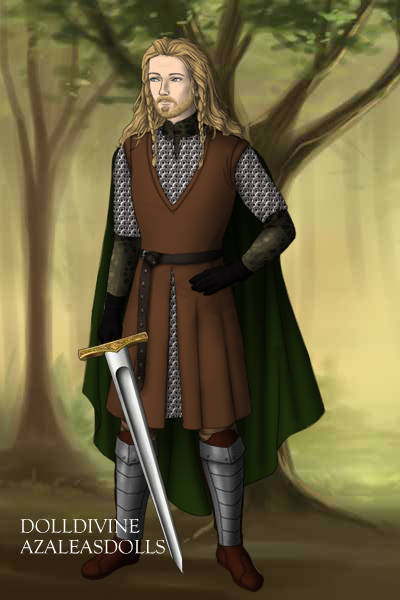
Because Tolkien’s legendarium is both so broad and so deep, it is possible—easy, even!—to trace the historical development of any particular group (Elves, Men, Dwarves, etc.) across a pretty vast swath of time and space. You can follow them through and between books to see how that group evolved and grew, moved and acted, achieved triumphs and committed missteps, and eventually found the paths that would lead them to the places where they are best known inside the main narratives. Although these historical waypoints on the road to the primary storylines are significantly less discussed than the major events of the big canon texts, they are no less important to the overall trajectory of the story and no less interesting to dive into!
Marhwini of the Éothéod is one such waypoint, a representative of a people who didn’t even exist, as such, during the First Age events of The Silmarillion and by the late Third Age of The Lord of the Rings (LotR) had evolved again into a related but markedly different group. Neither a man of Gondor nor of Rohan, Marhwini played a critical role in the history of both kingdoms and, in the process, carried some important messages from Tolkien about the nature of alliance and what it means to find and sustain common cause with others.
Marhwini the Historical Figure
Marhwini (“horse friend”) was the first lord of the people who became known as the Éothéod (“horse people”).1 They were descendants of one of the bands of Northmen who lived across Rhovanion in the early Third Age and would become, in turn, ancestors of the Rohirrim who occupied Rohan during the late Third Age and into the Fourth.
At the time of Marhwini’s childhood (we don’t know when he was born, but he was an adult already by T.A. 1856),2 the Northmen were still living much as their ancestors had but in reduced numbers. Once a great confederation of renowned horse breeders and riders who lived in and around Mirkwood, they had been decimated by the Great Plague that rocked Middle-earth in the mid-T.A. 1600s, losing as much as half their total population when the cold northern weather drove them into crowded homes and stables where the illness could spread unchecked.3 Their recovery from this trauma was slow, but underway during Marhwini’s era. They maintained what seems to be a semi-nomadic lifestyle, in which they spent much of their time in the plains with their horses but kept settled homes in the eaves of the forest.4 Marhwini’s particular band of Northmen no longer had a “king,” as they did before the Plague, but they had lords, and Marhwini’s father, Marhari, was their lord in the mid-T.A. 1800s.5
Despite their reduced circumstances relative to the past, the Northmen under Marhari still remained a force to be reckoned with, and they were loyal and active allies of Gondor. That alliance had first been forged by Marhari’s ancestor, Vidugavia, in the T.A. 1200s, and it was solidified when Vidugavia’s daughter married into the Gondorian royal family.6 That not only put Northmen heritage into the Gondorian royal house, where it would remain until the end of the line of kings in T.A. 2050, but it resulted in many Northmen emigrating to Gondor, where they ultimately carved out a lasting place for themselves in Gondorian society. So it is no surprise that Marhari’s Northmen still looked favorably on Gondor and were willing to frequently act as a “bulwark” against its enemies.7
It was in this position—as the front line defense of Gondor’s northern and eastern borders—that Marhwini came to his inheritance as lord in T.A. 1856. The Northmen were the first resistance to a wave of assaults by the Wainriders, a loose grouping of people from the East who were stirred by Sauron to invade Gondor.8 Being physically between the Wainriders and the target of their invasion, the Northmen bore the brunt of their first attacks, giving Gondor time to ready itself for war. Eventually, King Narmacil II brought an army to oppose the Wainriders, and Marhari’s people fought alongside them in what became known as the Battle of the Plains.9 The battle went poorly, however, and Narmacil was killed. Gondor’s forces withdrew to avoid further losses, and Marhari provided the rear guard to cover their retreat. When he, too, was killed, Marhwini found himself suddenly the new leader of his father’s people.
While the forces of Gondor were able to return to the safety of their own lands, the territory of Marhwini and the other Northmen of Rhovanion was totally overrun. Some lucky individuals escaped with the Gondorians and others fled to Dale, but many were trapped in Rhovanion and enslaved by the conquering Wainriders.10 Marhwini gathered as many refugees as he could and, together with fugitives who escaped through Mirkwood, settled these remnants on the far western side of the forest in the vales of the Anduin between the Carrock and the Gladden Fields.11 This surviving group became known as the Éothéod, with Marhwini as their lord, and for a time they lived quietly—so quietly that Gondor was not even aware of their continuing presence until nearly fifty years later.12
The event that brought the Éothéod back to Gondor’s notice was, once again, an impending assault from the Wainriders. Despite their displaced status, reduced numbers and low profile, Marhwini’s people evidently kept an active watch on events in Rhovanion and had a lot of key intelligence that they could share with allies. In T.A. 1899, Marhwini sent an early warning to King Calimehtar of Gondor that the Wainriders were preparing an invasion of Calenardhon (the part of Gondor that would eventually be ceded to Rohan hundreds of years later).13 Marhwini was also aware that a revolt was being prepared by the enslaved Northmen of Rhovanion and that the revolt could be timed to coincide with a military engagement against the Wainriders for maximum effect.14
Calimehtar made good use of Marhwini’s information and counsel, provoking the Wainriders far into Gondor and then flanking them with a surprise attack from previously hidden troops that rode together with Marhwini and his forces. The Éothéod helped push the battle in Gondor’s favor, and the Wainriders suffered enormous losses before turning to flee. Critically, though, the Gondorians did not pursue the routed Wainriders out of Gondor. Having secured his own borders, Calimehtar brought his army home (where they were said to have afterward enjoyed a respite from war), leaving it solely to Marhwini to force the retreating Wainriders out of occupied Rhovanion and bring support to the slave revolt there.15
The Éothéod made a valiant effort, “[harrying]” the retreating Wainriders and “[inflicting] great loss upon them” as they pursued them to Mirkwood, where they hoped to find the revolt in full force.16 Sadly, however, the rebellion in Rhovanion had failed to take hold. The rebels had little access to arms, and they met stiff and well-provisioned resistance from the women and older men the Wainriders had left behind when their army rode out. Despite some success in setting fire to homes, storehouses, and equipment, most of the rebels died in the fighting, and Marhwini’s arrival was both too late and insufficient to turn the tide of the rebellion or to force the remaining Wainrider army from Rhovanion.17 Marhwini “was obliged to retire again to his land beside the Anduin, and the Northmen of his race never again returned to their former homes,” living out the remainder of their days further north before eventually emigrating to Calenardhon to found Rohan.18
There is no further mention of Marhwini in the Middle-earth historical record, but his legacy continued on through his people. His son, Forthwini, once again provided Gondor with critical early warning of a renewed threat from the Wainriders and participated in the battles to help keep those invaders out of Gondor. (Gondor’s Prince Faramir even died in the arms of an Éothéod leader as part of that campaign, indicating just how closely the two forces were operating.)19 In later years, the Éothéod would fight alongside Eärnil II against the Witch-king,20 and under Eorl the Young, they rode to the aid of the steward Cirion when Gondor was being menaced by Easterlings.21 This led directly to the Oath of Eorl, the founding of Rohan, and many hundreds of years of additional alliance and support between the two peoples.
Marhwini the Person
There is no direct characterization of Marhwini in any of Tolkien’s writings. We know about some of his deeds, but we aren’t told anything about his personality, his thoughts, his motivations, or his desires. Still, some details can be inferred based on his behavior and choices, and, as with many of Tolkien’s stories involving the Rohirrim and their ancestors, the common threads surround issues of alliance, friendship, and loyalty.
One of the most striking elements of Marhwini’s story is his deep involvement with the Rhovanion slave revolt. It seems self-evident that he would be sympathetic to the plight of his enslaved brethren, having come from the same broader confederation of Northmen, but the fact that he acted on that sympathy is actually surprisingly rare in the legendarium. Though there are numerous references to enslaved or occupied communities—the Elves who were taken as thralls of Morgoth and the oppressed Hadorians who lived under the Easterlings in Dor-lómin after the Nirnaeth in The Silmarillion, and even the Hobbits who suffered under the occupation of Sharkey and his ruffians toward the end of the events of LotR—we rarely, if ever, see outside leaders and armies working together with enslaved communities to free them as the Éothéod did for the enslaved of Rhovanion. There are rescues, escapes, and resistance in those other communities, but they tend to be internally directed or the work of outside individuals or small groups. The liberation of the Northmen, by contrast, appears to have been a formal political and military objective of the Éothéod, a separate and distinct people, under Marhwini.
He is described as having “planned and assisted” the revolt, which we can see by virtue of the fact that he was privy to its details and had influence over its timing.22 In order to accomplish that, he must have been still actively engaging with and aiding the slaves even half a century after their initial enslavement—quite a feat, given how difficult it must have been to communicate effectively and in secret with captives in what was then enemy territory. The ultimate failure of the revolt and the loss of most of the rebels was a tragedy but not a reflection on Marhwini. He did all that he could, and much more than most, in choosing not to abandon them to their fate or to allow his focus to drift solely to the people who had successfully evaded captivity. He maintained his loyalty to those enslaved Northmen right up until their deaths. Their rebellion faced long odds,23 but Marhwini gave his enslaved allies as good a chance as could be hoped for by pulling the entirety of the Wainrider army away from their homes and then riding back as soon as he was able in order to try to reinforce their efforts.
Marhwini demonstrated similar loyalty in his adherence to Gondor as a key ally. The Northmen’s history with Gondor had been difficult at times in the past, with Gondor actually fighting an entire civil war in the T.A. 1400s over the question of what role Northmen should be allowed to play within Gondorian society.24 Even in Marhwini’s era, Gondor still had a tendency to view and treat their allies as a means to an end. Tolkien specifically tells us that Gondor took for granted the protection provided by the Northmen and the Éothéod to Gondor’s borders—protection that Gondor did not fully appreciate until they were deprived of it25—and though they accepted the counsel and arms of Marhwini against the invading Wainriders, Gondor did not go out of its way to help him achieve the Éothéod’s own goals of liberating Rhovanion from the Wainriders’ grasp or freeing the Northmen who were enslaved there.
Still, Marhwini could perceive that a strong and free Gondor was in the interests of the Éothéod, and he would have been aware of the large and active Northmen community that lived within Gondor. As such, the bonds of kinship between the two peoples were not just metaphorical but literal, and the Éothéod seem to have always approached Gondor first and foremost as friends. Marhwini freely gave the gift of valuable—and perhaps painfully acquired—military intelligence to Gondor’s leaders, and he laid down Éothéod lives to repel an invasion of Gondor’s borders. Moreover, he did all of that seemingly without the expectation that Gondor would repay his efforts with specific military support of his own objectives. Instead, he seemed motivated by a more general sense of common goals and values.
Interestingly, he saw no such common goals or values with the Wainriders, who had a culture that was arguably much more similar to that of the Éothéod than the Gondorians. Gondor was a vast and far-reaching empire with centralized control, extensive history, and traditions and practices rooted in the formal grandeur of Númenor. The Wainriders, by contrast, came from a “confederacy” of peoples, much like the Northmen, with different tribes or groupings loosely joined under a shared banner when needed.26 That would make them less rooted to a particular place or historical tradition, just as the Northmen have a much more malleable history. The Wainriders also seemed to share an appreciation for horsemanship, with their army oriented around chariots and horse-drawn carts27 while the Éothéod relied on mounted cavalry, and both societies had an acceptance of women in arms, with Rohan’s concept of shieldmaidens tracing to their Northmen ancestors and the women of the Wainrider camps being trained in arms such that they could fight off the slave revolt in the absence of their army.28 Both cultures are even explicitly depicted as singing in battle,29 perhaps reflecting a shared approach to the emotional facets of war or a common mindset about the task of warfare.
But these similarities could never overcome a fundamental and overriding difference, namely that the Wainriders took encouragement and direction from Sauron’s emissaries.30 That is something that the Éothéod never did and would never countenance. Their oldest Northmen ancestors may not have crossed into Beleriand to fight against Morgoth as the Gondorians’ ancestors did, but neither did the Éothéod submit to the shadow nor provide aid to those who did.31 No superficial cultural alignment between his people and the Wainriders could entice Marhwini to attempt negotiations or compromise with them, to say nothing of alliance, even when such concessions could have won back some of the Éothéod’s ancestral land or the freedom of some of their former countrymen. He clearly understood the difference in values between their peoples and was unwilling to sell out his own principles for short-term gain.
So What?
Marhwini is little more than a tangent in the broader legendarium, so why did Tolkien bother to spend any time on his story? And why should we bother to spend our own time thinking about him?
The simple answer is that Tolkien created Marhwini and the tale of his exploits for the same reason that he went to an almost absurd level of detail in all of his worldbuilding—because it made the Middle-earth of his invention feel that much more authentic and lived-in for there to be such extensive history and detail behind each and every element. But more than this, Marhwini has important things to tell us about Tolkien’s specific views on the nature and value of relationships among peoples.
Marhwini invites us to reconsider the standards by which we deem a relationship to be valuable and worthwhile. Within the very narrow bounds of his own experiences, Marhwini’s alliance with Gondor might be termed a failure. The Éothéod spent resources and lost lives on Gondor’s behalf while not achieving any of their own political or military goals in exchange. Yet Tolkien very specifically tells us that Marhwini’s sacrifices “had not been in vain.”32 Not only does the alliance lead to the short-term preservation of Gondor by saving it from the Wainriders, its “greatest effect” was in solidifying the relationship between the two lands that would see them repeatedly come to each other’s aid over the course of more than a thousand years.33 In other words, Tolkien wants us to see that a true partnership can’t be viewed only in a short-term, transactional sense. Failing to reap an immediate reward from an act of service to a friend does not invalidate either the act itself or the relationship that motivated it. The true benefit is in seeing good accomplished, no matter who received it, and building the sort of long-term trust and confidence that can stand through future challenges that haven’t even been anticipated yet.
In addition, Marhwini’s role in the development of the broader alliance between Gondor and those that would become the Rohirrim effectively illustrates that strong and impactful alliances don’t just form out of the ether. They take real time and work to build. Sometimes they are stronger and sometimes weaker, and occasionally they can even be a little one-sided. But truly enduring alliances are rooted in shared values and principles that can overcome temporary setbacks or challenges as long as all parties are invested in the relationship’s success and willing to work for it.
The stirring and emotional arrival of the Rohirrim at the Pelennor Fields to fight for Gondor in LotR is not some sort of deus ex machina, without logic or precedent. The groundwork for it was laid far in advance in painstaking detail across a broad swath of the in-universe historical record. Many people put their blood, sweat, and tears into the alliance, on both sides, and fought for it in both literal and metaphorical terms. As such, the victory over Mordor that day outside Minas Tirith belonged to Théoden and Imrahil and to Aragorn and Éomer, but it also belonged to Vidugavia and Romendacil II, Marhwini and Calimehtar, Eorl and Cirion and generations upon generations of Gondorian and Northmen/Éothéod/Rohirrim leaders who nurtured the alliance into existence and did the hard work of keeping it healthy and viable across many years and many challenging times.
Conclusion
Marhwini is a narrative waypoint in the most literal sense, sitting as he does at the functional midpoint between the first tentative forging of the Gondor-(proto)Rohan alliance in the T.A. 1200s and its transformation into its final, fully realized form at the founding of Rohan in T.A. 2510. But ignoring the waypoint to focus only on the start and end of a story is to miss some of its most interesting and thematically rich parts that are entertaining in their own right and inform our ultimate understanding of the start and end in new and unique ways. You cannot appreciate the full complexity and scope of the Gondor-Rohan relationship without first understanding the Éothéod, and there is no Éothéod without our guy, Marhwini, a smart and strategic political leader, a brave warrior, and most importantly, a loyal ally to the powerful and vulnerable alike.
Works Cited
- Unfinished Tales, “Cirion and Eorl and the Friendship of Gondor and Rohan.”
- T.A. 1856 is the date given for the Battle of the Plains in The Lord of the Rings, “Appendix B, The Tale of Years.” In Unfinished Tales, “Cirion and Eorl and the Friendship of Gondor and Rohan,” it is noted that during this battle Marhwini’s father, Marhari, was killed, leaving Marhwini as leader of their people. Presumably, that is a job that would only be entrusted to a full-grown adult.
- Unfinished Tales, “Cirion and Eorl and the Friendship of Gondor and Rohan.”
- Ibid.
- Ibid.
- The Lord of the Rings, “Appendix A, The Númenórean Kings.”
- Unfinished Tales, “Cirion and Eorl and the Friendship of Gondor and Rohan”: “They were in fact a bulwark of Gondor, keeping its northern and eastern frontiers from invasion.”
- The Lord of the Rings, “Appendix A, The Númenórean Kings.”
- Unfinished Tales, “Cirion and Eorl and the Friendship of Gondor and Rohan”: “The escape of the army of Gondor from total destruction was in part due to the courage and loyalty of the horsemen of the Northmen under Marhari (a descendant of Vidugavia ‘King of Rhovanion’) who acted as rearguard.”
- Ibid.
- Ibid.
- Ibid.
- The date of T.A. 1899 comes from The Lord of the Rings, “Appendix B, The Tale of Years.” The description of Marhwini’s warning comes from Unfinished Tales, “Cirion and Eorl and the Friendship of Gondor and Rohan.”
- Unfinished Tales, “Cirion and Eorl and the Friendship of Gondor and Rohan.”
- The description of the battle between Calimehtar, Marhwini, and the Wainriders in the entirety of this paragraph comes from Unfinished Tales, “Cirion and Eorl and the Friendship of Gondor and Rohan.”
- Ibid.
- Ibid.
- Ibid.
- Ibid.
- The Lord of the Rings, “Appendix A, The Númenórean Kings.”
- Unfinished Tales, “Cirion and Eorl and the Friendship of Gondor and Rohan.” (Among many others!)
- Ibid.
- As do most slave rebellions, historically, due to the extreme asymmetry of resources (especially weapons) between the two sides. Shout out to the Haitian Revolution, which beat the odds and successfully freed Saint-Domingue both from slavery and French colonial control.
- See the description of the Kinstrife in The Lord of the Rings, “Appendix A, The Númenórean Kings.”
- Unfinished Tales, “Cirion and Eorl and the Friendship of Gondor and Rohan.” (One might even say that by the blood of the Northmen and Éothéod were Gondor’s lands kept safe…)
- The Lord of the Rings, “Appendix A, The Númenórean Kings.”
- Ibid.
- For a description of women Wainriders in arms, see Unfinished Tales, “Cirion and Eorl and the Friendship of Gondor and Rohan:” “…women, who in that people were also trained in arms and fought fiercely in defence of their homes and their children.” For Rohirrim referencing the shieldmaiden tradition and their own women in arms, see Éowyn’s description of herself in The Lord of the Rings: The Return of the King, “The Steward and the King,” or The Lord of the Rings, “Appendix A, The House of Eorl”: “Many fair and valiant women … named in the songs of Rohan that remember the North.”
- For the Wainriders, see Unfinished Tales, “Ciroin and Eorl and the Friendship of Gondor and Rohan.” For the Rohirrim, see The Lord of the Rings: The Return of the King, “The Ride of the Rohirrim.”
- The Lord of the Rings, “Appendix A, The Númenórean Kings” and Unfinished Tales, “Cirion and Eorl and the Friendship of Gondor and Rohan.”
- Unfinished Tales, “Cirion and Eorl and the Friendship of Gondor and Rohan”: The Northmen’s oldest ancestors share kinship with the house of Hador but never came over the mountains into Beleriand and, thus, aren’t considered Edain.
- Ibid.
- Ibid.


Fascinating to focus on....
....a character I read about but didn't really notice. I'm convinced of Marhwini's importance now!
Thank you so much! He’s easy…
Thank you so much! He’s easy to miss, given how little he appears in the text, but it makes me so happy to hear that he means more to you now! <3
Excellent bio! Marhwini…
Excellent bio!
Marhwini really deserves the attention, especially as his importance is not so obvious until you give it a closer look.
And you make your points well!
That’s so kind of you to say…
That’s so kind of you to say! Thanks for reading it and sharing an interest in him! I’m glad to find other Marhwini appreciators! <3
I can't believe how long I…
I can't believe how long I've taken to read and comment on this! It's so interesting, beautifully written and with such attention to detail. I love all the information about the Rohirrim and their ancestors we find in UT and the Appendices, and you've brought it all together so well, with this focus on Marhwini.
I especially love the penultimate paragraph, about the arrival of the Rohirrim at the Pelennor Fields. And, further back, I'm fascinated by your positive mention of Prince Faramir of Gondor (my beloved Firiel's brother) fighting with the Eotheod - as it's presented to us in UT as him having abandoned his post as regent in Minas Tirith, and thus leaving Gondor kingless, I'd be so interested to hear more of your take on that!
Oh my, thank you! I’m so…
Oh my, thank you! I’m so happy to know other people who appreciate Marhwini for the very cool guy he is and the super interesting place he occupies in ME history! ♥️
As for Prince Faramir, the way his story is such an interesting echo (or I guess a forerunner, chronologically) to the narrative of his namesake’s future wife is FASCINATING to me. I guess I am perhaps a little Rohirrim-pilled, and since I can’t see Éowyn’s choice to sneak out of Rohan in disguise to fight with her people as anything but positive, I have a tendency to view Prince Faramir through that same lens! I’ve also got Théoden’s views on royal succession though (“if Éomer and I both die, choose another leader however you want!”), so that makes it all go down a little easier for me. How do you feel about Faramir’s choices???
Thank you so much for…
Thank you so much for replying! I love your thoughts, and I'd love to discuss this further (but I don't want to clog up your comments too much, or detract from Marhwini!). Briefly though - I really want to think kindly of Prince Faramir (and I recently read something which suggested he'd previously spent time with the Eotheod and was in love with one of them, which gave me pause for thought). BUT, because I care so much about Firiel, I can't help taking what I suspect would have been her view, far away in Arthedain making the best of a political marriage and grieving the loss of at least four family members - that he'd disobeyed orders and shirked his duty and thrown his life away and left Gondor without a king...my heart breaks for her. (However...something inspired Denethor and Finduilas to name their second son after him - I'd love to know what that was!)
That makes perfect sense as…
That makes perfect sense as the viewpoint of a family member who loved him and desperately wanted SOMEONE in the family to have survived to carry on both as a leader and a last link for Firiel to her homeland. No one likes to be left behind (including, apparently, Faramir), and I can absolutely sympathize with that view! I’d never heard the theory that Faramir was in love with a member of the Éothéod—intriguing! It certainly shades his choices differently and adds another layer of parallel between this Faramir and his much later namesake!