
The Aromantic in Tolkien by daughterofshadows
Posted on ; updated on
This paper was previously presented at Mereth Aderthad 2025 on 19 July 2025.
Video
Transcript
Despite the fact that Tolkien lived long before the term aromantic was first coined and became popular, there are many characters in his works whose experiences reflect those of aromantic people today.
In this presentation, I want to take a closer look at three of them and look into how we can reframe them to explore concepts like identity, love and family from an aromantic perspective.
But before we get into the nitty-gritty of my presentation, let's first talk about what aromanticism actually is.
The term aromantic refers to a romantic orientation characterised by a lack of romantic attraction or desire to engage in romantic relationships. As is the case with any label under the queer umbrella, there are many forms this can take, but this lack is the key link between all of them.
Some of the quotes and arguments I present to you today have also been used to argue for other queer identities, including asexuality, and this versatility is part of what I want to talk about today.
There are some obvious links between aromanticism and asexuality, of course, but it is important to note that the two are separate identities and not all asexuals identify as aromantic or vice versa. That is why this presentation focuses exclusively on the aromantic side of things.
My thoughts reflect my own experiences as an aromantic person first and foremost, but I hope they will leave you with some ideas to explore in the future.
Some other important terms that might pop up:
Amatonormativity refers to the idea that a romantic relationship is a desire everyone experiences and strives for and that this relationship is the be all, end all of relationships, while heteronormativity suggests that this romantic relationship should necessarily be between a man and woman.
Partnering/non-partnering refers to aros who do or do not wish to engage in relationships of any kind.
Now with that out of the way, let’s take our beloved blorbos and look at them from a new angle.
Aredhel
We’ll start off with Aredhel, the white lady of the Noldor, daughter of Fingolfin, and a character that felt strongly aromantic to me even before I had the words to properly describe those feelings.
She is a fairly popular character to read and write as aromantic, and a lot of that is due to this quote from the published Silmarillion:
"She was younger in the years of the Eldar than her brothers; and when she was grown to full stature and beauty she was tall and strong, and loved much to ride and hunt in the forests. There she was often in the company of the sons of Fëanor, her kin; but to none was her heart's love given." (The Silmarillion, J.R.R. Tolkien, edited by Christopher Tolkien)
"To none was her heart's love given"
Now, that is a sentence that probably resonates with a lot of aromantic people. It certainly resonates with me.
From the beginning, Aredhel is presented to us as an independent woman.
She chafes under the restrictions living in Gondolin places on her.
Though it is perhaps a stretch to compare the rules of Gondolin to the expectations hetero- and amatonormativity often place on us today, her experiences feel familiar, nonetheless.
As a non-partnering aro, I see the way societal and familial expectations try to push me into unwanted relationships reflected in Eöl’s and Aredhel’s marriage, but equally, you can explore how relationships between aromantic and allo-romantic characters can work out with this couple if you prefer a more positive reading of Eöl.
To me, Aredhel's appeal as an aromantic character also comes from the fact that she is a woman, and the narrative importance of many female characters in the legendarium and elsewhere remains tied to romantic relationships. Flipping that on its head and breaking away from the romantic ties opens up a whole new world of possibilities and I encourage you to explore that the next time you think about Aredhel.
For now, let’s skip forward a few thousand years in the legendarium and to a different book to meet two other very aro-coded characters.
Bilbo & Boromir
Hobbits place great value on family and genealogy, as is evident from the family trees we can find in the Lord of the Rings.
And yet, when we meet our main character in the Hobbit, we find an established bachelor, who has no desire to comply with the societal expectations of the Shire.
Gandalf says this about him in the Unfinished Tales, The Quest of Erebor: "[...] I guessed that he wanted to remain 'unattached' for some reason deep down which he did not understand himself - or would not acknowledge, for it alarmed him."
Now, Gandalf might be talking about Bilbo's desire for adventure here, but I posit that there can be another reason for Bilbo's alarm.
He lives in an inherently amatonormative society that expects him to fall in love, marry and have children. He is from a well-to-do family, after all, and throughout the books we see other hobbits comment on his bachelorhood.
Experiencing a lack of interest in romance in a society that places such high value on it can be frightening.
It can be difficult to figure out where your own place is in it.
Bilbo chooses not to submit to the societal pressure of finding a wife and having biological children. Instead he decides to subvert expectations by adopting Frodo, his cousin, as his heir.
He disrupts the dynastic system of the Shire, choosing adopted family ties over closer blood ties.
To me this disruption is one of the most interesting ways to explore aromantic characters in settings like Tolkien's works, as the dynasties in his stories are such an important part of the narrative.
We have Aragorn, for example, the heir of Isildur, who can trace his line across generations and millennia or Gil-galad, whose nebulous parentage remains a point of fascination in the fandom.
The Hobbits themselves keep meticulous track of their genealogy.
In fact, dynasties are such an essential part of the story that Tolkien decided to include some of their family trees in his books, and so any character that disrupts the status quo offers the possibility of inherently queer readings.
A different character who presents himself in a very similar light to Bilbo Baggins is Boromir, son of Denethor.
I initially grew interested in Boromir's aromantic potential because he seemed rather old to be unmarried for a man of his position. He is Denethor's preferred heir and he has been fighting at the frontlines for a very long time. A dangerous place that seems to suggest that ensuring he has produced an heir would be more important to Boromir or at least Denethor than it apparently is.
I ended up combing through birth and death dates for the Line of Stewards (as marriage dates are unavailable) to confirm whether Boromir's marital status and childlessness is as much of an outlier as it appeared to me. I will not reproduce that research in full here, but anyone interested can find it on my SWG account (https://www.silmarillionwritersguild.org/node/8233)
The most important results for this exercise are the following:
Boromir is somewhat, but not significantly older than the average steward is when his heir is born. As can be seen in the graph, war and peace have little traceable influence on that age, which perhaps says more about Tolkien's methods of determining these ages than it says anything about the stewards themselves.
In Appendix A, we read that Boromir is "a man after the sort of King Eärnur”, a king who famously died unmarried and without an heir, because he took little interest in such matters. In the line of stewards we find Dior and Ecthelion I in similar positions. They die aged 107 and 98 respectively, old enough to suggest that there was time to have children, should they have desired them. Instead, they are succeeded by a nephew and cousin respectively, and we once again circle back to the disruption of dynasties. Perhaps any of these men were an inspiration to Boromir, validating his own potential disinterest in marriage and family. It is certainly an intriguing possibility, and one that opens much room for further exploration through both scholarship and fanfiction.
Conclusion
There is a lot more to unpack here, a lot more aromantic characters that I could have talked about, but I will leave you with these three for now.
I also hope I’m leaving you with a bit more awareness of aromanticism in general, and the potential for aromantic Tolkien characters in particular. And who knows, maybe the next time you sit down to write, you can try writing a drabble about an aro character, try to see the world from a different angle.
Q&A
Moderator
Okay. So, do we have any in the … We do, we have 3 questions in the online Q&A. So first, Mira would like to know, what do you think about Aredhel's marriage to Eol in the context of her aromanticism? So what do you think about Aredhel's marriage to Eol in the context of her aromanticism?
Shadow
It's interesting, because like, as I said, I'm personally not partnering, so I don't have any desire for partners. But since I have talked about this with other aromantic people, and I think it depends a lot on how you see the relationship. If you go, like, if you… if you are willing to accept that it wasn't, like, it wasn't completely forced that Aredhel chose out of her own free will. And I think that it's really interesting, because Eol and Aredhel, like you can absolutely explore how relationships between aromantic people with other non-aromantic people can work, because not all aromantics don't want relationships. Like, some of them still have partners in some way, shape, or form. And I personally also do not headcanon Aredhel as asexual. So I can … I usually … the way I usually approach it is that I decide to go, okay, Aredhel idoes enjoy having sex with Eol, but there is no … for her, there is no romance inside this relationship. But it's also equally possible that you that you say that Eol is very much going along the lines of corrective attempts to … unaromanticize her. I don't want to, like, trigger anybody, so I'm gonna keep this brief, but there's definitely also very … there can also definitely also be mirrors in, terms of corrective measures against queer people if you want to explore that through that relationship. I think both are very possible. It depends entirely on how much you like Eol, I guess.
Moderator
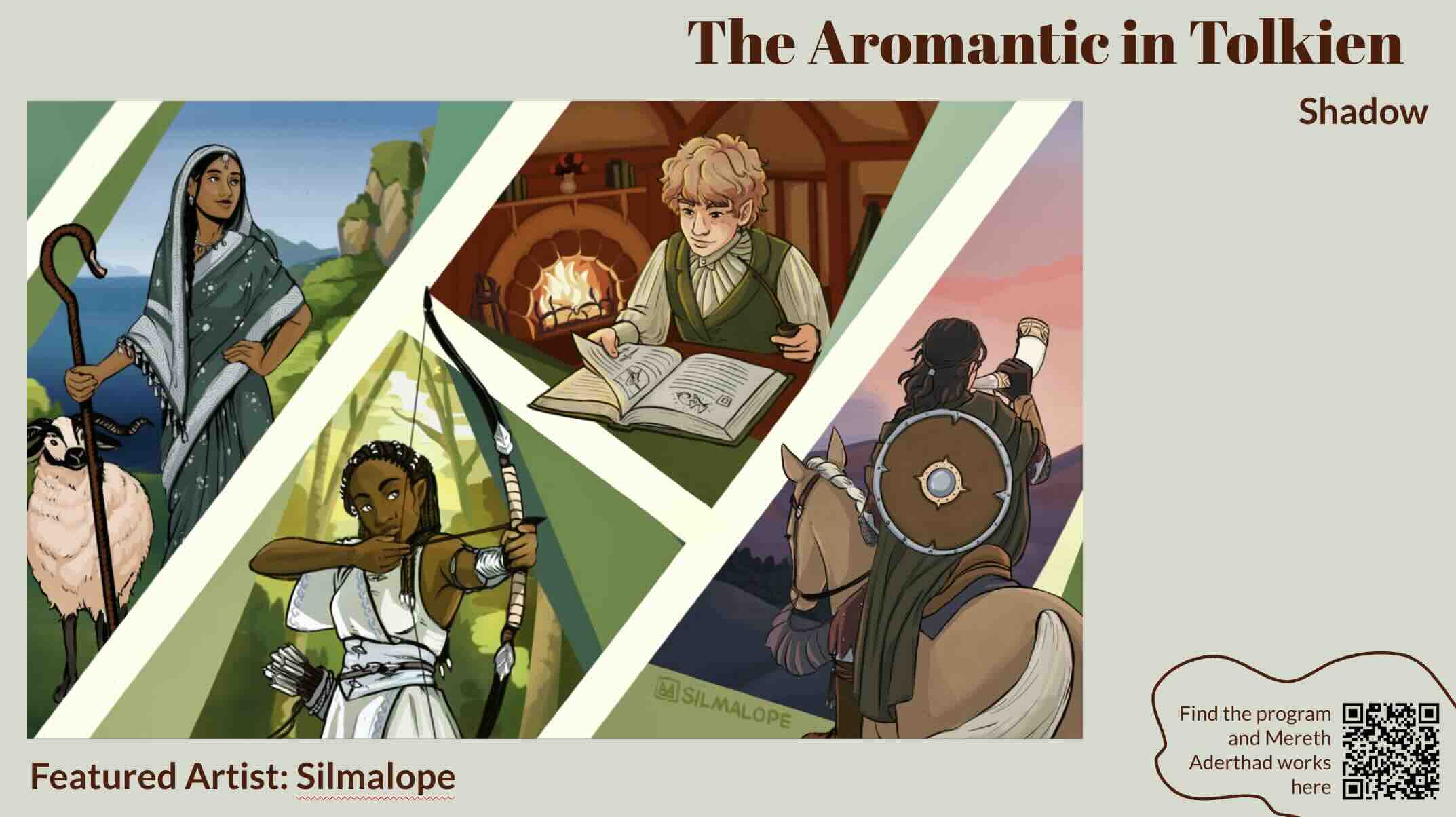
Okay, and we probably have time for maybe one or two more, maybe … is there anyone in-person who had a question for Shadow, or chrissystriped? Or Silmalope, Sin is here as well, the artist, the featured artist, so we have … they can answer questions also. Yes, Acha?
Acha
Just to point out that my fanwork, that it was inspired by the talk is on the last page of our zine.
Moderator
Okay, yes, there is a poem on the last page of the zine. It was intentionally put there because it is, like, an amazing ending piece, and it is by Quente, aka Acha, so definitely check that out.
Shadow
It's really good.
Dawn
It is… I, like, melted it like a… like a puddle when we … when we got … when I got that one in. I think it was, like, the first one that came in, too. I was like, way to set the bar, like, really high for the rest of us. We have another question online. Got another online question. All right. Sesame would like to know, do you think Tolkien deliberately wrote them as aro-slash-whatever the understanding of aromanticism was in 1930, or was it more of his personal influences unconsciously leaking through, as in characters based on real-life people who might have been queer or neurodivergent? Okay, so that was sesame's question, Shadow, just in case you couldn't hear Lisa. I'm not sure how well the mic is picking up.
Shadow
No, I could, I could hear that, no problem.
Moderator
Okay, awesome.
Shadow
I'm not sure, because, like, on the one side, I … Tolkien's real life is not something that I have investigated it particularly much, like I have no idea what people he might have been friends with. But I can totally … I could … I can totally see that that might be … might have been the inspiration, because there is so much … there is … there are so many characters that are in, like established relationships in his books that they start … the ones that aren't stand out. It's really interesting, so I could I can totally see that they might have been inspired by somebody that he knew that she had these feelings, either because of aromanticism or because of neurodivergence. I think that's entirely possible. But I can't really give you a definitive answer on that. I'm not familiar enough with his life to say that.
Moderator
All right, we actually have a minute, so I think we can get to the last one, too. Someone asked, this is … I_did_not_mean_to: Shadow, can you talk more about the importance of the mentorship of these aromantic characters, thinking of Cirdan?
Shadow
Of course, I think the mentorship is such an interesting part of these aromantic characters, because we've basically … we don't actually have, like, really any that don't still have, the aromantic characters in popular culture right now are often, like, presented as, like, cold, unfeeling, more robotic-like. But in Tolkien's works, all of them have relationships that are important to their character of some sort, and many of them find "parenthood," in quotation marks, by looking, by adopting, by mentoring other people, and I think that is a way for Tolkien to still stick to his desire to present familial relationships in his works while still maintaining the romantic independence of these characters, and I adore that, because all of them have their own legacies that are very, very much part of their characters without forcing them to have children, and I just think that's really neat. I love my found-family tropes, and I love it when my aromantic characters still, like, get the chance to show emotions and be emotionally attached to somebody without forcing them into romantic relationships.


I did think of Bilbo as…
I did think of Bilbo as aromantic. Otherwise, Boromir flew under my radar (I unconsciously explained the lack of marriage by the geographic position of Gondor. Who'd want to marry when living with Sauron next door? Who'd have sufficient mental energy to marry when their feisty neighbour went at war whenever they wanted? It made great sense in my mind. True that I'm not allo, that does skew my reasoning), and Aredhel was an interrogation mark. She always seemed to me a free spirit who wouldn't fare well in a typical nuclear, monogamous arrangement.
What are your thoughts on Findis and Lalwen? Little is known of them, but I could see them being arospec. Perhaps that's projection.