
Twilight, Child Of: Comparisons Between Tinúviel, Lómion, and Undómiel by JazTheBard
Posted on ; updated on
This paper was presented at Mereth Aderthad 2025 on 19 July 2025.
Video
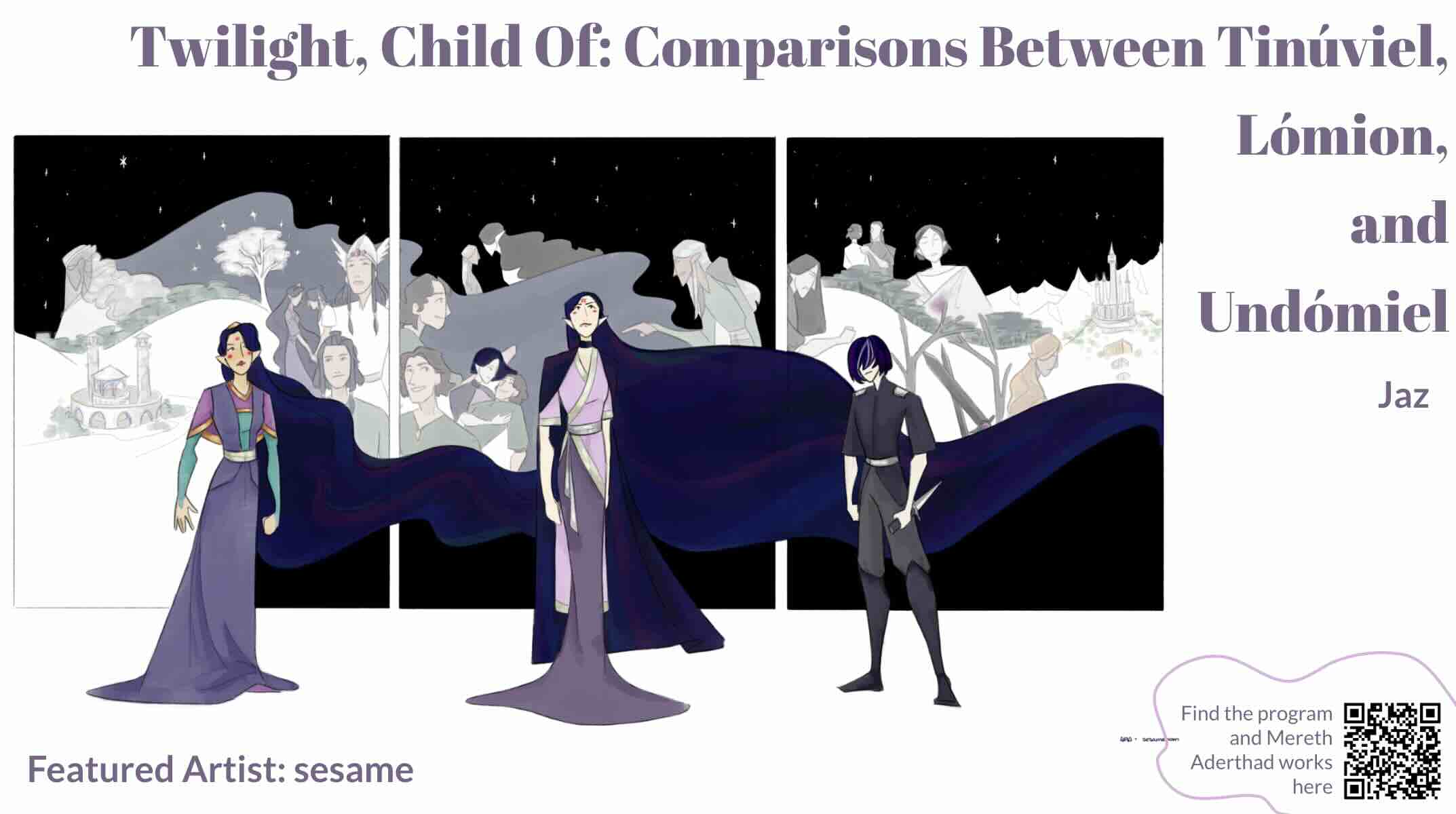
Transcript
So, hi everyone, welcome to my Red String Conspiracy Board that I turned into a presentation. This is "Twilight comma, Child Of: Comparisons between Tinuviel, Lomion, and Undomiel." It is really hard to stop myself from saying OND for some reason when I do this.
So, intro, let's get this out of the way. Luthien, Arwen, and Maeglin all have the same etymology of "twilight plus child" in their secondary names. While the parallels between Luthien and Arwen are explicit in Lord of the Rings, in fact, every time Arwen appears for, like, one sentence, it's like, "Luthien, Luthien, Luthien! Did we mention she looks like Luthien?" But Maeglin's position as an antagonist kind of sees him left out of all of this, although he's not really mentioned in Lord of the Rings. So, I mean, there's also that. Info here is taken from Silm, Fall of Gondolin, Lays of Beleriand, which was Histories of Middle-earth III, Lord of the Rings, and also Elfdict.com, because I'm not digging through Vinyar Tengwar.
Okay, let's just get this out of the way. We have to say it. Tinuviel, twilight plus daughter, meaning nightingale. Lomion is night plus son, but in the text it is translated as "child of twilight." And Undomiel is twilight plus star in the given definitions, but it looks like Undome plus E-L, which is twilight plus daughter. Same thing for Tindomiel.
Physical appearance. I color-coded this! Because it … I couldn't figure out a better way to do it. So, here, a lot of these are from Lays of Beleriand and also Lord of the Rings. We have a couple categories. The yellow-orange is about eyes. Luthien and Arwen have eyes, though, that light up stars in them. Maeglin's eyes are also called out as bright and keen, but the starlight is not mentioned. And Arwen and Maeglin in particular, have piercing eyes. They pierce people's hearts.
Hair. They all have dark hair for Luthien and Maeglin. This is compared to shadows. This is also compared to, like, snaring and tangling for Luthien, this is "her hair within its cloudy web did snare," and for Maeglin, it's "his hair was as the strands of night that are tangled in Taur Fuin.
They're also all extremely pale. Side note, this is not true in The Fall of Gondolin, in early drafts, this was not true, Maeglin did have a different skin tone, but in the published Silmarillion, he's pale as heck, because he's never seen the sun.
And Arwen has a special color coding for … she looks like Luthien! Did we mention she looks like Luthien? Because that's just Luthien 2.0 right there.
For family background, I found it easier to just color code the things that aren't the same. So, first of all, they all have a very multicultural background, whether this is multiple species, multiple cultures, or both for Arwen. Thingol and Elrond both give quests to their daughter's suitors. Eol's dead, so he can't do that. One imagines he would because he's that kind of person, but no. Luthien and Maeglin both have controlling fathers who either threaten to lock them up or do so. No one ever tells Arwen what to do. Elrond might be giving Aragorn quests, but he's not telling Arwen what she can and cannot do, as she can go wherever she wants.
We also have parents who meet in Nan Elmoth, featuring enchantment that, you know, it might be a little bit dubious consent, sort of, it depends on your interpretation, but it's a little weird, especially for Aredhel and Eol. And then also, Arwen keeps winning. Her parents met in Rivendell and only got married a couple thousand years later, so that's, like, fine.
And all of them lose their moms in some way, shape, or form. Luthien, this doesn't … it's not really a huge moment for her, because she's already sort of moved out and moved on, uh, but Melian does leave Middle-earth when Thingol dies. Aredhel obviously dies that it's real traumatic for everybody, and Celebrian has her whole torture thing, and has to sail west, because … Yikes.
Culture and choice. We've talked about the multicultural aspects. Luthien is born in Doriath and is raised in that cultural context, but she actually gives up her life in Doriath multiple times by dying, living at Tol Galen with Beren, instead of, you know, living in Doriath, where she was raised, and also dying again. Instead of remaining with that life and the culture that she was born with in Doriath, she chooses to bind herself to a mortal fate. Not necessarily to mortal culture exactly, because they're living alone and not in a wider culture, but it still sort of matches up. We're gonna skip over to Arwen for a second. She is descended from Elves, Men, also Melian the Maia, and multiple Elven and human cultures. She does forsake immortality to live with Aragorn, but this is also part of her own cultural heritage, because she is part mortal. This has always been an option for her, but she is choosing to take it.
Maeglin is not multi-species. That's actually unique here. But he is from two cultures, the Sindarin and Noldorin cultures. He is completely forbidden from Noldorin culture in Nan Elmoth, but he chooses to run away, a sort of indirect choice to at least be able to explore the Noldorin side of his heritage. But in Gondolin, he is explicitly forced to choose, partly from the abide-here-or-die-here choice and partly when Eol yells at him and threatens him with curses for forsaking him. It is worth noting that he does not make this choice. He is specifically called out as not responding to either of these, essentially, ultimatums to choose. It is chosen for him by default. It is possible one might interpret that this indirect, but still a choice to abide with the Noldor, kind of gets him doomed, because he's now bound to their fate the way that Arwen and Luthien bind themselves to other fates.
Plot beats. So, a really good, but an accurate but very reductive way to summarize these three storylines is as follows. Holding this up so I can read it off. An immortal of mixed ancestry, living in a magical realm cut off from its surroundings by magic, meets a human from the wilderness in said realm, and proceeds to die because of said human. Am I wrong? So we have enchanted forests. We have enchanted forests in hidden valleys, we have a hidden valley with trips to Grandma's Enchanted Forest.
Luthien and Maeglin are running away from home. Arwen's just chillin'. Luthien and Maeglin are getting captured while running away from home. Arwen's just chillin'. Luthien and Maeglin both end up in Angband, admittedly under extremely different circumstances. Arwen's just chillin'.
But they do all meet their assigned wilderness humans, which … you should be fed into an Aragorn in their hidden realms, and they die about it, although, again, in very different circumstances, but they sure do all die about it.
So what does all this mean? I'm talking very fast, we're gonna be done soon.
While these three are very similar in their storylines, and a lot of motifs, they do play very vastly different roles in the narrative, from active protagonist to kind of there as a symbol of healing and safety, but not directly involved, to that guy sucks. And this can provide new insights into their respective stories and characters. Additionally, in fandom, there is a tendency to consider some non-canon and same-gender ships as sort of canon or canon-adjacent due to parallels with Beren and Luthien. This is specifically about Sam and Frodo and Maedhros and Fingon.
Also them. Thank you, thank you for the … I … you know what? That's on me, I forgot that. Thank you. Also, it felt like intuitive.
And if the sort of Beren-Luthien parallels can be considered to be, like, that makes it kind of canon, I do posit that this makes a romantic/potential romantic reading of Maeglin's fixation on Tuor just as canon as those. Because it has both the Beren and Luthien parallels and the Aragorn and Arwen. I will die on this hill. Thank you. So, who's the best Twilight Child? We have been doing all these comparisons between them, they're all very similar, but they have their differences. We, like, you know, we've discussed this, which one of them did it the best? Who do we think? You're all wrong! It's Tindomiel!
So yeah, Tindomiel, we don't know anything about her. If we did, she would have been featured in this presentation very heavily. But as far as we know, she didn't do any of this stuff, and kinda just … she wins by default, because she … presumably just died of old age like a normal person. There was no drama that we know of, there was no forbidden love that we know of. She's hanging out. She's even more just chillin' than Arwen. Anyway, thank you so much!


That's truly a pity we don't…
That's truly a pity we don't know much about Tindómiel, really. The Lúthien - Arwen parallels are a clear as day. Good job on bringing Maeglin into the equation Makes me wonder what a 'child of dawn/morning light' would be. A Secondborn? Lúthien, but male? (Dior??)