
The Mythmakers vs. the made myths: Exploring a reader’s levels of religious alienation and connection in works about and by J.R.R. Tolkien and C.S. Lewis by Quente
Posted on ; updated on
This article was presented at Mereth Aderthad 2025 at the South Burlington Public Library on July 19. 2025.
Or, A critical reading and primary source reinterpretation of documents that contributed to John Hendrix’s The Mythmakers.

Introduction
When I first picked up John Hendrix’s graphic novel The Mythmakers: The Remarkable Fellowship of C.S. Lewis & J.R.R. Tolkien (2024), I thought it ticked many boxes for me: the book jacket posited it as a comic-book style exploration of the mythologies that built the works of J.R.R. Tolkien and C.S. Lewis, and promised a better understanding of the authors’ friendship. Indeed, a fair portion of this graphic novel was just as written on the tin.
But the backbone of the book, written in the very specific genre of conversion narrative, centers around Lewis’s conversion from atheism to Christianity. As a non-Christian, my sudden and unexpected encounter with this conversion, as well as Hendrix’s self-inserted paragraphs about his own Christian faith, caused me to experience such an intense feeling of alienation that I had to pause and interrogate this reaction. Why was my reading of The Mythmakers so immediately uncomfortable, when I (a Buddhist by birth) felt so connected to the creative works of both these authors?
There are countless works of scholarship, past and present, that delve into the connection between Tolkien and Lewis and Christianity, because it is explicitly there—Tolkien and Lewis do not shy away from a frank discussion of their faith in biographic material, and sometimes draw connections between their faith and their fiction. And yet, I felt that their works, especially Tolkien’s, connected to me in a way was NOT alienating.
Could information exist in the philosophies or biographies of Tolkien and Lewis that pointed to why and how they opened up their imaginary worlds to a space outside of—and other than—Christianity? I felt that there had to be, because I never felt alienated when I read The Silmarillion, or Lord of the Rings, or even, controversially, the Narnia books (which are meant in part to be allegorically Christian).
I posited that although Tolkien and Lewis were Christian, their works are relatable to non-Christian audiences because their fictional worlds are explicitly not Christian. Works of non-fiction that emphasize their Christianity are therefore especially alienating, because non-Christian readers are suddenly thrust into an uncomfortable confrontation of their divergent beliefs.
This inquiry centers around the difference between fictional creations and biographical ones, and the liminal space that Tolkien and Lewis created outside of their ordinary world where people could follow and find extraordinary things. Creating these spaces, even ones that contain allegorical or invented religions, allows these works to have a wider path for passionately engaged readership of all faiths, because the works provide imaginative room for all of us to seek and find our connections.
Literature Review
To explore my sense of disjuncture from Hendrix’s work more thoroughly, I looked for further evidence of Tolkien’s thoughts about Christianity and his philosophy toward his own writings in his Letters (2023), specifically letter 131. For an understanding of Tolkien’s invented religion and “mythmaking,” I drew from his essay On Fairy-Stories (1947/2014). For further background on Lewis’s own record of his religious conversion, I read his autobiographical work Surprised by Joy (1955/2017).
The extent of my reading of Lewis’s fiction is my childhood encounter with the Narnia books; I have preserved my memory of that first reading rather than refresh my familiarity as an adult, so as to better comprehend my own non-Christian connection and affinity toward those books. I also drew upon my life-long knowledge of Tolkien’s fiction, and Tolkien’s draft material compiled by his son Christopher.
For familiarity with Hendrix and his perspective on Tolkien and Lewis, I read Mythmakers (2024), and gathered biographical material about Hendrix from his author’s website.
My methodology was taken from a variety of sources relating to the reading of primary source material to help inform analysis of a secondary source (Herodotus, 2003), and the discussion of critical reading from the field of Literature (Althusser & Balibar, 1968/1979).
I have described each reference and its use in Table 1.
| Reference | Purpose |
|---|---|
| Althusser, L., & Etienne Balibar. (1979). Reading Capital. | Methodology |
| Hendrix, J. (2024). The Mythmakers: The Remarkable Fellowship of C.S. Lewis & J.R.R. Tolkien. Abrams Fanfare. | Secondary source, biography |
| Herodotus. (2003). Herodotus: The Histories. Penguin Classics. | Methodology |
| Knott, D. (n.d.). Critical reading towards critical writing | writing advice. University of Toronto. | Methodology |
| Lewis, C. S. (2017). Surprised by Joy: The shape of my early life. HarperOne. | Primary source, autobiography |
| McGinty, A. M. (2009). Becoming Muslim : Western Women’s Conversions to Islam. Palgrave Macmillan. | Interpretation |
| National Archives and Records Administration. (n.d.). History in the raw. National Archives and Records Administration. https://www.archives.gov/education/research/history-in-the-raw.html | Methodology |
| Tolkien, J. R. R., Carpenter, H., & Tolkien, C. (2023). The Letters of J.R.R. Tolkien. William Morrow, an imprint of HarperCollinsPublishers. | Primary source |
| Tolkien, J. R. R., Flieger, V., & Anderson, D. A. (1947/2014). Tolkien on Fairy-stories. HarperCollinsPublishers. | Primary source, essay |
| Hendrix, J. (2018). John Hendrix Illustration. John Hendrix Illustration . https://www.johnhendrix.com/about | Primary source, interview with the author |
Table 1: References and their Purposes
Methodology
The Mythmakers is a biography, a secondary source. Because of this, I felt that the best way to understand the work was to read the works that informed the creation of the book. I wanted to understand how Hendrix came to form his opinions about Tolkien, Lewis, and the conversion narrative of The Mythmakers. I wanted to see if I could find evidence from these sources that informed his work that both supported his opinion, and pointed to other interpretations, inconsistencies, or niggling ideas that worm their way out of his tidy conversion story.
Therefore, I took my methodology from the fields of History and Literature. Not being a historian, I asked a colleague who studied the Classical era who the first person was that consulted original texts to inform historic interpretation and writing. “Herodotus, probably,” Bunn said. So I took my methodology from Herodotus: The Histories (2003), and from Archives.gov’s Primary Source Research page, which outlines the usefulness of consulting primary sources as a way to form our own opinions about history:
Documents—diaries, letters, drawings, and memoirs—created by those who participated in or witnessed the events of the past tell us something that even the best-written article or book cannot convey. The use of primary sources exposes students to important historical concepts. First, students become aware that all written history reflects an author's interpretation of past events. Therefore, as students read a historical account, they can recognize its subjective nature. Second, through primary sources the students directly touch the lives of people in the past. Further, as students use primary sources, they develop important analytical skills. (Archive.gov’s History in the raw, n.d.)
I used close critical reading methods from the field of Literature, taken originally from the theories of Althussar and Balibar (1979), and since condensed into practical advice for the student of literature:
Avoid approaching a text by asking “What information can I get out of it?” Rather ask “How does this text work? How is it argued? How is the evidence (the facts, examples, etc.) used and interpreted? How does the text reach its conclusions?” (Knott, n.d.)
I organized my dissection of The Mythmakers by creating a spreadsheet that compared quotations from Hendrix’s book with three original sources. I also recorded my analysis of the primary sources on this spreadsheet, and came up with initial results. Table 2 shows an example of my data collection spreadsheet, with the quotation from The Mythmakers in Column A, original source quotations from Lewis’s Surprised by Joy in Column B, original source quotations from Tolkien’s On Fairy-Stories and Letters in Column C, and my own interrogation of the texts in Column D.
My data collection spreadsheet is in Appendix A.
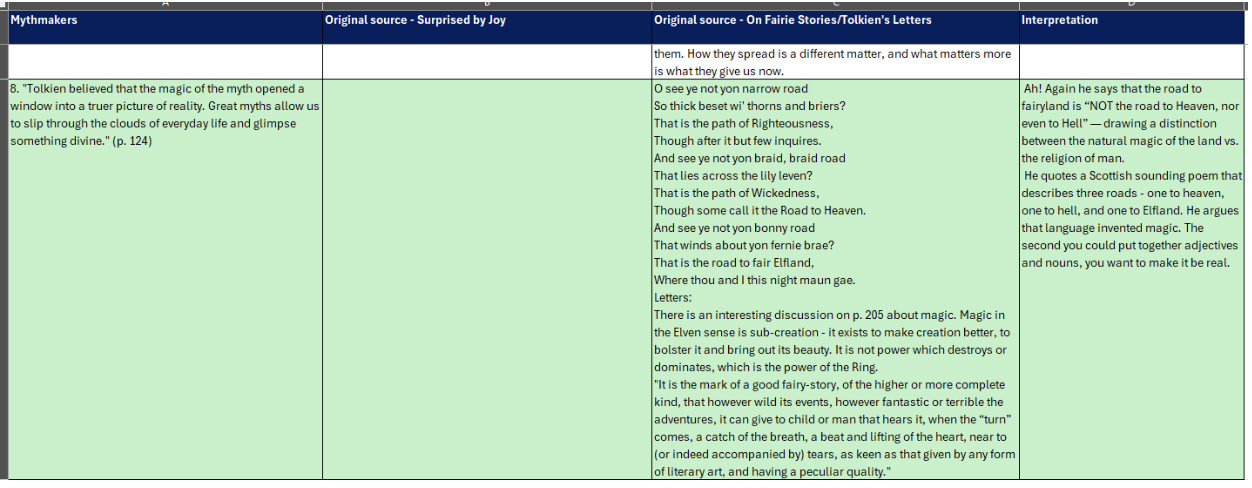
Table 2: Example of the Data Collection Spreadsheet
Evidence, Results and Analysis
My original questions were:
Why was my reading of The Mythmakers so immediately uncomfortable, when I felt so connected to the creative works of both these authors? Does anything in the philosophies or biographies of Tolkien and Lewis point to why and how the worlds that they build feel welcoming to a non-Christian?
After charting ideas from The Mythmakers against information found in primary sources, I found three distinct ways in which Hendrix tries to tidy up and close away uncomfortable information that does not fit his neat conversion narrative structure.
Finding 1:
This finding answers my first question, Why was my reading of The Mythmakers so immediately uncomfortable, when I felt so connected to the creative works of both these authors? The answer is that I felt uncomfortable reading Hendrix’s book because although The Mythmakers and Surprised by Joy are both conversion narratives, Surprised by Joy is complicated by Lewis’s yearning for something beyond Christianity, and The Mythmakers does not address the complicated nature of Lewis’s quest for “Joy.”
Evidence from Hendrix’s text, as well as Lewis’s autobiography, points to the fact that both books are conversion narratives, but Hendrix’s text is much tidier and more straightforward, while Lewis’s text emphasizes moments of struggle with conversion, his lack of joy at the conversion, and his inability to square the concept of joy with his acceptance of a Christian god.
What is a conversion narrative? Anna Mansson McGinty (2009) wrote about conversion narratives in the book Becoming Muslim : Western women’s conversions to Islam. McGinty explains that the structure of a conversion narrative is to document “a sudden and fundamental shift in worldview, which changes the individual in considerable ways” (p. 33). This is expressed through writing that explains how “the old reality [can] be interpreted within the apparatus of the new reality” (p. 33), and results in “a fundamental denial of their previous life or self” (p. 33).
Hendrix’s text is structured around Lewis’s slow conversion to Christianity after encountering a combination of factors over time. Lewis’s philosophical evolution, hastened by several conversations with J.R.R. Tolkien, Hugo Dyson (a Don at the University of Reading), and other friends, contributes to the structure of the conversion narrative. Hendrix paraphrases much from Surprised by Joy, but the central drama of the book lies in how the friendship between Lewis and Tolkien results in Lewis’s acceptance of the idea of Deity, and after Lewis’s further thought, a Christian, and specifically Anglican, version of Deity.
Hendrix’s text does not tend to complicate Lewis’s conversion with the greater context of his philosophical grappling with the ideas surrounding it, but does explain one interesting moment of complexity (see Table 3: Textual Comparison of Hendrix and Lewis for Finding 1). Hendrix describes one of the more complex parts of Lewis’s narrative—both the removal of denials to the “call of Deity,” and the reluctance that Lewis felt when he succumbed to this call. Lewis’s reluctance was my initial clue that there was more to the straightforward conversion narrative than Hendrix was portraying, and led me to begin this inquiry.
In Surprised by Joy, Lewis expands upon this resistance to his conversion, calling himself “a prodigal who is brought in kicking, struggling, resentful, and darting his eyes in every direction for a chance of escape,” (Lewis, Ch. XIV) and the call to a Christian God itself a “compulsion.”
Lewis complicates the straightforward conversion narrative. He is unwilling to rewrite his previous life in the light of his conversion, and unwilling to write his “enlightened” self as better or worthier than his previous self. He portrays himself as deciding to change, but not in a way that devalues the work he did to get there.
| The Mythmakers | Surprised by Joy | Notes |
|---|---|---|
| "One ordinary day, Lewis boarded a very ordinary bus going up the very ordinary Headington Hill. Another gray day in Oxford…Lewis was heading to Magdalen, weighed down by books and the concerns of the coming day, when he encountered something extraordinary. Lewis had the odd sensation that he was resisting something -- or someone -- knocking from inside his own heart. It felt as though he were encased in a suit of heavy armor, almost like a lobster. Yet at the same time... ...somehow Lewis also knew he could choose to take it off. But it almost felt like dread. In his quarters at Magdalen college, as the concerns of the day faded into the quiet evening, he could sense God's pursuit drawing ever closer. Finally, Lewis yielded. He knelt and prayed to God. Lewis called himself 'the most dejected and reluctant convert in all England.'" (pp. 84-85) |
(Chapter XIV) The odd thing was that before God closed in on me, I was in fact offered what now appears a moment of wholly free choice. In a sense. I was going up Headington Hill on the top of a bus. Without words and (I think) almost without images, a fact about myself was somehow presented to me. I became aware that I was holding something at bay, or shutting something out. Or, if you like, that I was wearing some stiff clothing, like corsets, or even a suit of armour, as if I were a lobster. I felt myself being, there and then, given a free choice. I could open the door or keep it shut; I could unbuckle the armour or keep it on. Neither choice was presented as a duty; no threat or promise was attached to either, though I knew that to open the door or to take off the corslet meant the incalculable. The choice appeared to be momentous but it was also strangely unemotional. I was moved by no desires or fears. In a sense I was not moved by anything. I chose to open, to unbuckle, to loosen the rein. I say, ‘I chose’, yet it did not really seem possible to do the opposite. On the other hand, I was aware of no motives. You could argue that I was not a free agent, but I am more inclined to think that this came nearer to being a perfectly free act than most that I have ever done. Necessity may not be the opposite of freedom, and perhaps a man is most free when, instead of producing motives, he could only say, ‘I am what I do.’ Then came the repercussion on the imaginative level. I felt as if I were a man of snow at long last beginning to melt. The melting was starting in my back—drip-drip and presently trickle-trickle. I rather disliked the feeling. You must picture me alone in that room at Magdalen, night after night, feeling, whenever my mind lifted even for a second from my work, the steady, unrelenting approach of Him whom I so earnestly desired not to meet. That which I greatly feared had at last come upon me. In the Trinity Term of 1929 I gave in, and admitted that God was God, and knelt and prayed: perhaps, that night, the most dejected and reluctant convert in all England. I did not then see what is now the most shining and obvious thing; the Divine humility which will accept a convert even on such terms. The Prodigal Son at least walked home on his own feet. But who can duly adore that Love which will open the high gates to a prodigal who is brought in kicking, struggling, resentful, and darting his eyes in every direction for a chance of escape? The words compelle intrare, compel them to come in, have been so abused by wicked men that we shudder at them; but, properly understood, they plumb the depth of the Divine mercy. The hardness of God is kinder than the softness of men, and His compulsion is our liberation. |
What's interesting about Lewis's conversion experience moment is that he had a terrible time -- he talks about how reluctantly he fell to his knees and prayed, and was bitter and unwilling all the while. The book was a little ironic about the moment, but Mythmakers is unable to square it with the "Joy" he is surprised by. I feel like he was always a thinker in pursuit of a God and his conversion experience, his humbling, his humiliation that his “soul was not his own“, seems to run counter to the sheer, persistent belligerence of his personality's attempts to find out his own truth. |
Table 3: Textual Comparison of Hendrix (2024) and Lewis (1955/2017) for Finding 1
But along with this finding comes another important textual clue.
Lewis wrote this clue into the very title of his book, Surprised by Joy. Shockingly, the “Joy” he describes in the title has nothing to do with his wife Joy Davidman, nor does it have anything to do with Christianity. Instead, the joy that Lewis discusses at length is his relentless longing for what he calls “Northernness,” or the experience he had when first reading H.A. Guerber’s Myths of the Norsemen. Throughout his autobiography, Lewis mentions his search for the feeling of joy, and all the different forms it took. By the end of his narrative, after his conversion, Lewis explains that his acceptance of a Christian deity has nothing to do with his quest for joy. Instead, joy functions in retrospect as a signpost that caused him to look outward for ways to find and chase it, but Christianity did not give it to him or fulfill it. Joy remained something that Lewis found in good fiction (specifically like Lord of the Rings) or mythology (specifically Norse), and good music (specifically Wagner’s Ring cycle)—in short, from certain creative works that resonated for him. Isn’t this like any reader or writer of fanfiction, who goes in search of what resonates with them the most?
In Table 4, I have excerpted the evolution of Lewis’s idea of “joy” from the beginning, middle, and end of his autobiography. The very end of it indicates that his “joy” simply existed as a signpost to a larger concept, but that he was no longer very concerned about pursuing it. Lewis does mention that he still feels it, and that it is outside of his faith. But I am not sold on his devaluing of the concept of joy, especially because he gave its name to his life’s arc. The joy that Lewis was surprised by was not Christianity, and this joy remains something outside of and other than faith, and emerges as a theme that runs alongside but separate from his conversion narrative.
The idea that Lewis’s concept of joy is outside of and other than Christianity, and in fact is spawned by creative thought, helps to answer the second part of my initial question—why do I feel so connected to the creative works of Lewis and Tolkien, despite the overt Christianity of their lives? And why and how do the worlds they built feel welcoming to a non-Christian? The answer is that Lewis carefully distinguished the “joy” of creative works from Christianity.
But what of Tolkien?
| Surprised by Joy, Chapter I | Surprised by Joy, Chapter V | Surprised by Joy, Chapter XV |
|---|---|---|
|
The second glimpse came through Squirrel Nutkin; through it only, though I loved all the Beatrix Potter books. But the rest of them were merely entertaining; it administered the shock, it was a trouble. It troubled me with what I can only describe as the Idea of Autumn. It sounds fantastic to say that one can be enamoured of a season, but that is something like what happened; and, as before, the experience was one of intense desire. And one went back to the book, not to gratify the desire (that was impossible—how can one possess Autumn?) but to re-awake it. And in this experience also there was the same surprise and the same sense of incalculable importance. It was something quite different from ordinary life and even from ordinary pleasure; something, as they would now say, ‘in another dimension’. I will only underline the quality common to the three experiences; it is that of an unsatisfied desire which is itself more desirable than any other satisfaction. I call it Joy, which is here a technical term and must be sharply distinguished both from Happiness and from Pleasure. Joy (in my sense) has indeed one characteristic, and one only, in common with them; the fact that anyone who has experienced it will want it again. Apart from that, and considered only in its quality, it might almost equally well be called a particular kind of unhappiness or grief. But then it is a kind we want. I doubt whether anyone who has tasted it would ever, if both were in his power, exchange it for all the pleasures in the world. But then Joy is never in our power and pleasure often is. |
Pure ‘Northernness’ engulfed me: a vision of huge, clear spaces hanging above the Atlantic in the endless twilight of Northern summer, remoteness, severity . . . and almost at the same moment I knew that I had met this before, long, long ago (it hardly seems longer now) in Tegner’s Drapa, that Siegfried (whatever it might be) belonged to the same world as Balder and the sunward-sailing cranes. And with that plunge back into my own past there arose at once, almost like heartbreak, the memory of Joy itself, the knowledge that I had once had what I had now lacked for years, that I was returning at last from exile and desert lands to my own country; and the distance of the Twilight of the Gods and the distance of my own past Joy, both unattainable, flowed together into a single, unendurable sense of desire and loss, which suddenly became one with the loss of the whole experience, which, as I now stared round that dusty schoolroom like a man recovering from unconsciousness, had already vanished, had eluded me at the very moment when I could first say It is. And at once I knew (with fatal knowledge) that to ‘have it again’ was the supreme and only important object of desire. | But what, in conclusion, of Joy? For that, after all, is what the story has mainly been about. To tell you the truth, the subject has lost nearly all interest for me since I became a Christian. I cannot, indeed, complain, like Wordsworth, that the visionary gleam has passed away. I believe (if the thing were at all worth recording) that the old stab, the old bitter-sweet, has come to me as often and as sharply since my conversion as at any time of my life whatever. But I now know that the experience, considered as a state of my own mind, had never had the kind of importance I once gave it. It was valuable only as a pointer to something other and outer. While that other was in doubt, the pointer naturally loomed large in my thoughts. When we are lost in the woods the sight of a signpost is a great matter. He who first sees it cries ‘Look!’ The whole party gathers round and stares. But when we have found the road and are passing signposts every few miles, we shall not stop and stare. They will encourage us and we shall be grateful to the authority that set them up. But we shall not stop and stare, or not much; not on this road, though their pillars are of silver and their lettering of gold. ‘We would be at Jerusalem.’ Not, of course, that I don’t often catch myself stopping to stare at roadside objects of even less importance. |
Table 4: The Concept of “Joy” from the Beginning, Middle, and End of Lewis’s Conversion Narrative (1955/2017)
Finding 2:
In The Mythmakers, Tolkien is characterized as being a foil to Lewis’s quest for belief, a respected collaborator who finally contextualizes Christianity in such a way that Lewis understands and recognizes it. Two passages summarize how Hendrix saw Tolkien’s role in the conversion narrative:
Through friendship and verse, Tolkien had given Jack a path to connect the worlds of his reason, his joy, and his imagination. To accept the truth of Christianity, Jack didn't have to believe that all the other myths in the world that he loved were wrong. He simply had to believe in the fulfillment of myth. It was the key that opened the door to the rest of his life. (p. 97)
What is the “fulfillment” of myth? The idea that the Christian God had always been there, and the long history of mythology is the way in which humans try to seek the “real” version of events, but Christianity (and Hinduism, according to Lewis) comes the closest to what “really” happened:
Tolkien gave Lewis a unified vision of art-making. It is too simple to say that he 'converted' Lewis to Christianity. Rather, Tolkien was a living illustration of fantasy and faith intertwined. This was the keystone that allowed the two sides of C.S. Lewis's personality to finally be at rest. Scholar Alan Jacobs says it best: 'Lewis became a Christian not through accepting a particular set of arguments but through learning to read a story the right way.’ (p. 186)
What does Tolkien mean by art-making? Tolkien’s vision of art-making was that because the Great Creator had made humans, humans were in turn inspired to create, as sub-creators. He summarized his feelings in a poem that he wrote to Lewis after their pivotal conversion discussion:
Man, Sub-creator, the refracted light
through whom is splintered from a single White
to many hues, and endlessly combined
in living shapes that move from mind to mind.
Though all the crannies of the world we filled
with Elves and Goblins, though we dared to build
Gods and their houses out of dark and light,
and sowed the seed of dragons, 'twas our right
(used or misused). The right has not decayed.
We make still by the law in which we're made. (Hendrix, 2024, p. 96)
Something about Hendrix’s explanation felt difficult to pin down, so I read two different primary sources (Tolkien’s Letters and his essay On Fairy-stories), to discover more about what Tolkien meant by “sub-creation.” Reading through these sources, I realized that although Tolkien meant the idea of “sub-creation” to fit neatly into a Christian narrative, he also clearly defines any work by a sub-creator as NOT directly or allegorically related to Christianity at all. Somehow, this messy distinction in Tolkien’s words did not inform the tidy conversion narrative of The Mythmakers.
Instead, Tolkien spends a fair amount of time in his Letters (2023) and in On Fairy-stories (1947/2014) attempting to explain the difference between Christianity and Myth, creation and sub-creation, and why these things should not be conflated (see Table 5). He takes as a given the fact that humans are inspired to create by a Christian God. However, he believes that “mythology is in itself almost devoid of religious significance,” (Tolkien, 1947/2014), and yet states in letter 131 that the Silmarillion is “cosmogonical drama … [with] beings of the same order of beauty, power, and majesty as the ‘gods’ of higher mythology, which can yet be accepted—well, shall we say baldly, by a mind that believes in the Blessed Trinity” (Tolkien, 2023).
But, Tolkien takes pains to say, although his mythology as written in the Silmarillion reflects “elements of moral and religious truth” (Tolkien, 2023), they are absolutely “not explicit, not in the known form of the primary ‘real’ world” (Tolkien, 2023), and that because he is only human, his sub-creation is “only one facet of a truth incalculably rich: finite only because the capacity of Man for whom this was done is finite” (Tolkien, 1947/2014).
| Tolkien’s Letters (#131) | On Fairy-stories | Tolkien’s Letters (#131) | On Fairy-stories |
|---|---|---|---|
| Myth and fairy-story must, as all art, reflect and contain in solution elements of moral and religious truth (or error), but not explicit, not in the known form of the primary ‘real’ world. (I am speaking, of course, of our present situation, not of ancient pagan, pre-Christian days. |
Andrew Lang said…that mythology and religion (in the strict sense of that word) are two distinct things that have become inextricably entangled, though mythology is in itself almost devoid of religious significance. The peculiar quality of the ”joy” in successful Fantasy can thus be explained as a sudden glimpse of the underlying reality or truth. |
They are ‘divine’, that is, were originally ‘outside’ and existed ‘before’ the making of the world. Their power and wisdom is derived from their Knowledge of the cosmogonical drama, which they perceived first as a drama (that is as in a fashion we perceive a story composed by some-one else), and later as a ‘reality’. On the side of mere narrative device, this is, of course, meant to provide beings of the same order of beauty, power, and majesty as the ‘gods’ of higher mythology, which can yet be accepted – well, shall we say baldly, by a mind that believes in the Blessed Trinity.
|
It is a serious and dangerous matter. It is presumptuous of me to touch upon such a theme; but if by grace what I say has in any respect any validity, it is, of course, only one facet of a truth incalculably rich: finite only because the capacity of Man for whom this was done is finite. |
Table 5: Tolkien’s (2023; 1947/2014) Mental Gymnastics as He Tries to Square Sub-creation with Christianity
In short, Tolkien wanted to sub-create a mythology (itself devoid of religious meaning) that has nothing to do with his own religion, and is limited by his humanity to be a poor reflection of religious truth anyway, even if it might contain a few moral elements of this truth. This means, to me, that Tolkien’s “mythology for England” has nothing at all to do with Christianity, and exists in a different space entirely.
But what space is this? If Tolkien’s creations, and mythic creations in general, are not about religion or Christianity at all, where does he locate this realm?
Finding 3:
The answer to this question comes from another poem. If the “Joy” that Lewis describes is derived from the creative words and music of high mythology, the realm of Tolkien’s sub-creation is to be found outside of the world entirely. In Tolkien’s address to the University of St. Andrews in 1939 (published in 1947), entitled On Fairy-stories, he begins the discussion by defining fairy-stories. For Tolkien, fairy-stories integrate the human realm with that of something far older, stronger, more dangerous, and more beautiful; his sub-creations exist in what he calls the Perilous Realm, identified by its position as a strange and Other space:
The realm of fairy-story is wide and deep and high and filled with many things: all manner of beasts and birds are found there; shoreless seas and stars uncounted; beauty that is an enchantment, and an ever-present peril; both joy and sorrow sharp as swords. In that realm a man may, perhaps, count himself fortunate to have wandered, but its very richness and strangeness tie the tongue of the traveller who would report them. And while he is there it is dangerous for him to ask too many questions, lest the gate should be shut and the keys be lost. (Tolkien, 1947/2014)
But where is this realm? Tolkien is careful to provide us with a road map. Perhaps unsurprisingly for someone who also identifies in his talk that mythology is very definitely not religion, he uses a poem to distinguish that the precise path to get to fairy does not involve heaven or hell at all:
O see ye not yon narrow road
So thick beset wi' thorns and briers?
That is the path of Righteousness,
Though after it but few inquires.
And see ye not yon braid, braid road
That lies across the lily leven?
That is the path of Wickedness,
Though some call it the Road to Heaven.
And see ye not yon bonny road
That winds about yon fernie brae?
That is the road to fair Elfland,
Where thou and I this night maun gae. (1947/2014)
Where is the road to Elfland? It is not the road to the Christian heaven. It is not the road to the Christian hell. It is its own road, a beautiful road that winds around a bank clad all in ferns. Tolkien presents Elfland, and his entire sub-created realm (see Table 6), as a third space apart from and separate from Christianity.
This answers the last part of my question:
Why was my reading of The Mythmakers so immediately uncomfortable, when I felt so connected to the creative works of both these authors? Does anything in the philosophies or biographies of Tolkien and Lewis point to why and how the worlds that they build feel welcoming to a non-Christian?
Hendrix writes in The Mythmakers (2024) that “Tolkien believed that the magic of the myth opened a window into a truer picture of reality. Great myths allow us to slip through the clouds of everyday life and glimpse something divine" (p. 124). Hendrix conflates “something divine” with Christianity, when it is actually about a glimpse of this third path. The simplified conversion narrative of The Mythmakers ignores the fact that C.S. Lewis’s “Joy” has nothing to do with religion, and that Tolkien’s sub-creation takes place in a realm that has nothing to do with Christian heaven or hell. But the primary source material proves that the realms of Tolkien’s creations, and Lewis’s greatest desires, are different from and apart from religion; they exist in a liminal space that invites all of us to enter—even Buddhists like myself—but at our own risk.
| The Mythmakers | Surprised by Joy | On Fairy-stories/Letters | Interpretation |
|---|---|---|---|
| Tolkien believed that the magic of the myth opened a window into a truer picture of reality. Great myths allow us to slip through the clouds of everyday life and glimpse something divine. (p. 124) |
Chapter V: Pure ‘Northernness’ engulfed me: a vision of huge, clear spaces hanging above the Atlantic in the endless twilight of Northern summer, remoteness, severity . . . and almost at the same moment I knew that I had met this before, long, long ago (it hardly seems longer now) in Tegner’s Drapa, that Siegfried (whatever it might be) belonged to the same world as Balder and the sunward-sailing cranes. And with that plunge back into my own past there arose at once, almost like heartbreak, the memory of Joy itself, the knowledge that I had once had what I had now lacked for years, that I was returning at last from exile and desert lands to my own country; and the distance of the Twilight of the Gods and the distance of my own past Joy, both unattainable, flowed together into a single, unendurable sense of desire and loss, which suddenly became one with the loss of the whole experience, which, as I now stared round that dusty schoolroom like a man recovering from unconsciousness, had already vanished, had eluded me at the very moment when I could first say It is. And at once I knew (with fatal knowledge) that to ‘have it again’ was the supreme and only important object of desire. |
O see ye not yon narrow road So thick beset wi' thorns and briers? That is the path of Righteousness, Though after it but few inquires. And see ye not yon braid, braid road That lies across the lily leven? That is the path of Wickedness, Though some call it the Road to Heaven. And see ye not yon bonny road That winds about yon fernie brae? That is the road to fair Elfland, Where thou and I this night maun gae. Letters: There is an interesting discussion on p. 205 about magic. Magic in the Elven sense is sub-creation - it exists to make creation better, to bolster it and bring out its beauty. It is not power which destroys or dominates, which is the power of the Ring. "It is the mark of a good fairy-story, of the higher or more complete kind, that however wild its events, however fantastic or terrible the adventures, it can give to child or man that hears it, when the “turn” comes, a catch of the breath, a beat and lifting of the heart, near to (or indeed accompanied by) tears, as keen as that given by any form of literary art, and having a peculiar quality." |
Ah! Again he says that the road to fairyland is “NOT the road to Heaven, nor even to Hell” — drawing a distinction between the natural magic of the land vs. the religion of man. He quotes a Scottish sounding poem that describes three roads - one to heaven, one to hell, and one to Elfland. He argues that language invented magic. The second you could put together adjectives and nouns, you want to make it be real. |
Table 6: The Realm of the Sub-creator (Hendrix, 2024; Lewis, 1955/2017; Tolkien, 1947/2014; 2023)
Conclusions and Impact
It is easy to pull apart my arguments, and point to all the places, even in On Fairy-stories, where Tolkien has to pause and remind himself and his audience that “[t]he Gospels contain a fairy-story, or a story of a larger kind which embraces all the essence of fairy-stories [….] The Birth of Christ is the Eucatastrophe of Man's history. The Resurrection is the Eucatastrophe of the story of the Incarnation” (Tolkien, 1947/2014).
Fair enough, but my purpose here today is to point out that even though conflating Tolkien’s work with his faith is easy, there is enough evidence in his contradictions, in his sly poetry, and in his Melkorean sub-creative ways, to point to another path.
This path is not easy, of course. It is difficult for a human to walk into Fairy—to live unchanged in the liminal space between day and night, between the forest and the fields, outside of the customs and religions that one knows. Tolkien describes the path to fairy as existing in the twilit realm between one place and another, leading to a place where unearthly beings can walk, and strange new ideas take shape and form.
The fracture in the primary source narratives are the crack in the polite ceramic veneer of Christian reality. Lewis spoke of turning away from the known and the ordinary to seek his unexpected joy. Tolkien might have reminded everyone that the Christian religion is a type of fairy-story, but he cannot take back the map he gave us—and show us by example that when the horns of Elfland called him to follow, he walked past both the path to heaven and the path to hell to follow.
Tolkien chose the twilight path, the one that allows space for sub-creation and invention of one's own. He made room for all of us to hear the horns of Fairy, calling to us from under the eaves of the forest, just off the roads we know. There, we will find Gildor's traveling company under the banner of Finrod Felagund, who will sing to us of far-off land lost under the sea, and give us counsel as long as it is neither yea nor nay, and who will not warn of danger on the road lest we pause our journey out of fear.
The Christian God is not in this place, but neither is Allah, or the deity of the Torah, or the ones from my own pantheon, or my prophet who sought to free us from the Wheel of Dharma. They do not need to be—this realm is strange enough and fair enough and LARGE enough for us all to build our fair fortresses in a corner of it. And because Tolkien has pointed us down the third path, all of the rest of us have found our way in. And maybe, in the haunting and half-heard phrase of music beyond the hill, we will find our own path to joy.
References
Althusser, L., & Etienne Balibar. (1979). Reading Capital. Verso. (Original work published 1968)
Hendrix, J. (2024). The Mythmakers: The Remarkable Fellowship of C.S. Lewis & J.R.R. Tolkien. Abrams Fanfare.
Herodotus. (2003). Herodotus: The Histories. Penguin Classics.
Knott, D. (n.d.). Critical reading towards critical writing | writing advice. University of Toronto.
Lewis, C. S. (2017). Surprised by Joy: The Shape of My Early Life. HarperOne. (Original work published 1955)
McGinty, A. M. (2009). Becoming Muslim : Western Women’s Conversions to Islam. Palgrave Macmillan.
National Archives and Records Administration. (n.d.). History in the raw. National Archives and Records Administration. https://www.archives.gov/education/research/history-in-the-raw.html
Tolkien, J. R. R., Carpenter, H., & Tolkien, C. (2023). The Letters of J.R.R. Tolkien. William Morrow, an imprint of HarperCollinsPublishers.
Tolkien, J. R. R., Flieger, V., & Anderson, D. A. (2014). Tolkien on Fairy-stories. HarperCollinsPublishers. (Original work published 1947)
Hendrix, J. (2018). John Hendrix Illustration. John Hendrix Illustration . https://www.johnhendrix.com/about
Appendix A: Data Collection Spreadsheet
| Mythmakers | Original source - Surprised by Joy | Original source - On Fairie Stories/Tolkien's Letters | Interpretation |
|---|---|---|---|
| 1. "Nearly all that I loved I believed to be imaginary; nearly all that I believed to be real I thought grim and meaningless." -- CS Lewis excerpted by Mythmakers | Surprised by Joy was an autobiography, but it was the autobiography of an internal process. Lewis wrote about his slow conversion to Christianity from his experiences as a boy discussing God, through meeting people involved in other kinds of spirituality and reading about the history of different religions, and finally to its final form. | The joy of thinking a fairy tale to be true is just like the joy of being a Christian, and it has been verified. "God is the Lord, of angels, and of men—and of elves. Legend and History have met and fused." | |
| 2. "For [Lewis's] years with Kirkpatrick, from 1914 to 1917, he made logic and rationality his North Star" (p. 40). | We need, in any case, to clean our windows; so that the things seen clearly may be freed from the drab blur of triteness or familiarity—from possessiveness. | ||
| 3. "The trenches only confirmed the world to be a godless, random existence. Despite the constant fear of death and injury during the war, [Lewis] said 'I never sank so low as to pray'." (p. 55) | So -- fantasy provides recovery by letting us see and be in the world in a clean new way. “For reasons which I will not elaborate, that seems to me fatal. Myth and fairy-story must, as all art, reflect and contain in solution elements of moral and religious truth (or error), but not explicit, not in the known form of the primary ‘real’ world.” (Letters, p. 203) |
||
| 4. Like Tolkien, Lewis also wrote while in the trenches of France. But as Tolkien was drawn deeper into the fortress of his imagination, Lewis was enraged by the absence of God. The snatches of verse he wrote at the Western Front were the first drafts of what became his first book, published in January 1919, titled Spirits in Bondage. (p. 68) | “Fantasy, the making or glimpsing of Other-worlds, was the heart of the desire of Faërie.” “But fairy-stories offer also, in a peculiar degree or mode, these things: Fantasy, Recovery, Escape, Consolation…” |
||
| 5. "Lewis came home to England doubly injured: A splinter of shrapnel was lodged near his heart, but the true wound Lewis carried was the fear that his deepest longings for joy were lies. Jack's heart would not rest. With every beat, it throbbed for meaning." (p. 69) | Surprised by joy, explained? "The peculiar quality of the ”joy” in successful Fantasy can thus be explained as a sudden glimpse of the underlying reality or truth." The Christ story has the Eucatastrophy of the resurrection, which is why it feels so good; it is true because it feels true. “Anyway all this stuff is mainly concerned with Fall, Mortality, and the Machine. (It is, I suppose, fundamentally concerned with the problem of the relation of Art (and Sub-creation) and Primary Reality.) With Fall inevitably, and that motive occurs in several modes. With Mortality, especially as it affects art and the creative (or as I should say, sub-creative) desire which seems to have no biological function, and to be apart from the satisfactions of plain ordinary biological life, with which, in our world, it is indeed usually at strife.” (P. 204) |
The author of Mythmakers seems to be conflating this desire for meaning and joy was about the desire for religion, when evidence from Lewis's writing indicated that the two were extremely different. 'Surprised by Joy', for example, is not about religion at all, but about moments of finding happiness in art. Yes, every bit of this book conflates Lewis's overarching quest for God and Christianity with their love for mythology and their creation of mythologies. |
|
| 6. "Tolkien was missing a creative confidant. He had been without a peer who could challenge and inspire him for some time. And Lewis needed a guide to get back home. Tolkien was his navigator. Lewis didn't know it, but he was desperately looking for a path that could finally join his heart and his mind. In Tolkien, six years his senior, he also found a role model." (p. 73) | |||
| 7. There is an explanation of the study of myth in the back of Mythmakers. It covers James Frazer's The Golden Bough, Müller's theory that words turn into stories, Andrew Lang's idea that mythology was part of the 'childhood of humanity,' and that "mythology's function was now supplanted and replaced by science. The purpose of myth was no longer needed. We had outgrown it." (p. 189) Also Joseph Campbell and the idea of mythic archetypes. |
The question was no longer to find the one simply true religion among a thousand religions simply false. It was rather, ‘Where has religion reached its true maturity? Where, if anywhere, have the hints of all Paganism been fulfilled?’ With the irreligious I was no longer concerned; their view of life was henceforth out of court. As against them, the whole mass of those who had worshipped—all who had danced and sung and sacrificed and trembled and adored—were clearly right. But the intellect and the conscience, as well as the orgy and the ritual, must be our guide. There could be no question of going back to primitive, untheologised and unmoralised, Paganism. The God whom I had at last acknowledged was one, and was righteous. Paganism had been only the childhood of religion, or only a prophetic dream. Where was the thing full grown? or where was the awaking? (The Everlasting Man was helping me here.) There were really only two answers possible: either in Hinduism or in Christianity. Everything else was either a preparation for, or else (in the French sense) a vulgarisation of, these. Whatever you could find elsewhere you could find better in one of these. But Hinduism seemed to have two disqualifications. For one thing, it appeared to be not so much a moralised and philosophical maturity of Paganism as a mere oil-and-water coexistence of philosophy side by side with Paganism unpurged; the Brahmin meditating in the forest, and, in the village a few miles away, temple prostitution, sati, cruelty, monstrosity.
|
“I do not deny, for I feel strongly, the fascination of the desire to unravel the intricately knotted and rarified history of the branches on the Tree of Tales. It is closely connected with the philologists’ study of the tangled skein of Language, of which I know some small pieces. But even with regard to language it seems to me that the essential quality and aptitudes of a given language in a living monument is both more important to seize and far more difficult to make explicit than its linear history.” “So with regard to fairy stories, I feel that it is more interesting, and also in its way more difficult, to consider what they are, what they have become for us, and what values the long alchemical processes of time have produced in them.” His argument that the ‘origin’ of fairy stories is some guy who told them. How they spread is a different matter, and what matters more is what they give us now. |
His very first paragraph is to rail against anthropological dissections of stories in things like The Golden Bough, which conflates a lot of stories out of context that have similar elements. Hilarious that this takedown has been largely forgotten, while the ideas of the original books stand firm. |
| "Tolkien believed that the magic of the myth opened a window into a truer picture of reality. Great myths allow us to slip through the clouds of everyday life and glimpse something divine." (p. 124) |
Chapter I: The second glimpse came through Squirrel Nutkin; through it only, though I loved all the Beatrix Potter books. But the rest of them were merely entertaining; it administered the shock, it was a trouble. It troubled me with what I can only describe as the Idea of Autumn. It sounds fantastic to say that one can be enamoured of a season, but that is something like what happened; and, as before, the experience was one of intense desire. And one went back to the book, not to gratify the desire (that was impossible—how can one possess Autumn?) but to re-awake it. And in this experience also there was the same surprise and the same sense of incalculable importance. It was something quite different from ordinary life and even from ordinary pleasure; something, as they would now say, ‘in another dimension’. I will only underline the quality common to the three experiences; it is that of an unsatisfied desire which is itself more desirable than any other satisfaction. I call it Joy, which is here a technical term and must be sharply distinguished both from Happiness and from Pleasure. Joy (in my sense) has indeed one characteristic, and one only, in common with them; the fact that anyone who has experienced it will want it again. Apart from that, and considered only in its quality, it might almost equally well be called a particular kind of unhappiness or grief. But then it is a kind we want. I doubt whether anyone who has tasted it would ever, if both were in his power, exchange it for all the pleasures in the world. But then Joy is never in our power and pleasure often is. Chapter V: Pure ‘Northernness’ engulfed me: a vision of huge, clear spaces hanging above the Atlantic in the endless twilight of Northern summer, remoteness, severity . . . and almost at the same moment I knew that I had met this before, long, long ago (it hardly seems longer now) in Tegner’s Drapa, that Siegfried (whatever it might be) belonged to the same world as Balder and the sunward-sailing cranes. And with that plunge back into my own past there arose at once, almost like heartbreak, the memory of Joy itself, the knowledge that I had once had what I had now lacked for years, that I was returning at last from exile and desert lands to my own country; and the distance of the Twilight of the Gods and the distance of my own past Joy, both unattainable, flowed together into a single, unendurable sense of desire and loss, which suddenly became one with the loss of the whole experience, which, as I now stared round that dusty schoolroom like a man recovering from unconsciousness, had already vanished, had eluded me at the very moment when I could first say It is. And at once I knew (with fatal knowledge) that to ‘have it again’ was the supreme and only important object of desire. |
O see ye not yon narrow road So thick beset wi' thorns and briers? That is the path of Righteousness, Though after it but few inquires. And see ye not yon braid, braid road That lies across the lily leven? That is the path of Wickedness, Though some call it the Road to Heaven. And see ye not yon bonny road That winds about yon fernie brae? That is the road to fair Elfland, Where thou and I this night maun gae. Letters: There is an interesting discussion on p. 205 about magic. Magic in the Elven sense is sub-creation - it exists to make creation better, to bolster it and bring out its beauty. It is not power which destroys or dominates, which is the power of the Ring. "It is the mark of a good fairy-story, of the higher or more complete kind, that however wild its events, however fantastic or terrible the adventures, it can give to child or man that hears it, when the “turn” comes, a catch of the breath, a beat and lifting of the heart, near to (or indeed accompanied by) tears, as keen as that given by any form of literary art, and having a peculiar quality." |
Ah! Again he says that the road to fairyland is “NOT the road to Heaven, nor even to Hell” — drawing a distinction between the natural magic of the land vs. the religion of man. He quotes a Scottish sounding poem that describes three roads - one to heaven, one to hell, and one to Elfland. He argues that language invented magic. The second you could put together adjectives and nouns, you want to make it be real. |
| 9. "Writing stories, to Tolkien, was a holy act. In fact, he felt humanity's desire to take the created order and rearrange it into new worlds was ordained by God. He called it 'sub-creation.'" (p. 124) | 1. "We make in our measure and in our derivative mode, because we are...not only made, but made in the image and likeness of a maker.'" (p. 124) Dear Sir,” I said—Although now long estranged, Man is not wholly lost nor wholly changed. Dis-graced he may be, yet is not de-throned, and keeps the rags of lordship once he owned: Man, Sub-creator, the refracted Light through whom is splintered from a single White to many hues, and endlessly combined in living shapes that move from mind to mind. Though all the crannies of the world we filled with Elves and Goblins, though we dared to build Gods and their houses out of dark and light, and sowed the seed of dragons—'twas our right (used or misused). That right has not decayed: we make still by the law in which we're made." Art is the link between Imagination (the creation of mental images) and Sub-creation, the result of expressing it. |
So yes, Tolkien did say that he created things because it flowed from his faith in God, and his desire to be like a creator, like God. So why were his books so intentionally irreligious? | |
| "Author's note: The writings of C.S. Lewis and J. R. R. Tolkien illuminated my childhood like the sun. Their shape and mass bent my early interior life so dramatically, I doubt my thinking will ever escape their gravitational pull. My desire to tell their story comes largely from the debt I owe them as an artist and a Christian." (p. 184) |
[McGinty, 2009, conversion narratives] Conversion is often viewed as a sudden and fundamental shift in worldview, which changes the individual in considerable ways. William James wrote in 1906 that to be converted signifies the change “by which a self hitherto divided, and consciously wrong, inferior and unhappy, becomes unified and consciously right, superior and happy” (Harding 2000:33). In the classic study The Social Construction of Reality, Berger and Luckmann (1984 [19661) describe the alternation of religious conversion and the transformation of subjective reality. A successful alternation requires, among other things, that the old reality be reinterpreted within the apparatus of the new reality. They argue that this reinterpretation results in a rupture in the subjective biography of the individual in terms of “B.C.” and “A.D.,” that is, pre- and postconversion. Everything in life before the conversion is now understood as leading toward it, and everything following it as flowing from its new reality. Formulations such as “Then I thought… now I know,” which are common in the conversion narratives, reflect this kind of reinterpretation of earlier experiences and actions (ibid.:179). However, for the women in this study there was no “biographical rupture” in the sense of what Berger and Luckmann call a “cognitive separation of darkness and light” (ibid.:180). Naturally, the women reject certain values and ways of living but they seldom express a fundamental denial of their previous life or self. Instead the women reorganize their biography and through a conversion narrative they create self-coherence and continuity by negotiating meaning between past and present, between the one I was then and the one I am today.
|
||
| "C.S. Lewis wrote, 'I believe in Christianity as I believe that the Sun has risen, not only because I see it, but because by it I see everything else.' For me, Lewis's and Tolkien's writings were a light that helped me see my place in the world." (p. 184) | |||
| "I wrote this book as both a fan and a fellow traveler. I am not alone. The instant feeling of kinship that many readers find in Lewis's and Tolkien's writings is often hard to precisely articulate. … These were artists and men of faith who shared a radical confidence in the fantastical. To Tolkien and Lewis, the imagination was not a vehicle for escapism or shoddy entertainment, but humankind's true 'organ of meaning.' For many, myself included, encountering their works felt like that astonishing realization in anyone's life, as Lewis said, that 'there do exist people very, very like himself.'" (p. 185) |
The question was no longer to find the one simply true religion among a thousand religions simply false. It was rather, ‘Where has religion reached its true maturity? Where, if anywhere, have the hints of all Paganism been fulfilled?’ With the irreligious I was no longer concerned; their view of life was henceforth out of court. As against them, the whole mass of those who had worshipped—all who had danced and sung and sacrificed and trembled and adored—were clearly right. But the intellect and the conscience, as well as the orgy and the ritual, must be our guide. There could be no question of going back to primitive, untheologised and unmoralised, Paganism. The God whom I had at last acknowledged was one, and was righteous. Paganism had been only the childhood of religion, or only a prophetic dream. Where was the thing full grown? or where was the awaking? (The Everlasting Man was helping me here.) There were really only two answers possible: either in Hinduism or in Christianity. Everything else was either a preparation for, or else (in the French sense) a vulgarisation of, these. Whatever you could find elsewhere you could find better in one of these. But Hinduism seemed to have two disqualifications. For one thing, it appeared to be not so much a moralised and philosophical maturity of Paganism as a mere oil-and-water coexistence of philosophy side by side with Paganism unpurged; the Brahmin meditating in the forest, and, in the village a few miles away, temple prostitution, sati, cruelty, monstrosity.
|
Letter 131: Myth and fairy-story must, as all art, reflect and contain in solution elements of moral and religious truth (or error), but not explicit, not in the known form of the primary ‘real’ world. (I am speaking, of course, of our present situation, not of ancient pagan, pre-Christian days. Letter 131: They are ‘divine’, that is, were originally ‘outside’ and existed ‘before’ the making of the world. Their power and wisdom is derived from their Knowledge of the cosmogonical drama, which they perceived first as a drama (that is as in a fashion we perceive a story composed by some-one else), and later as a ‘reality’. On the side of mere narrative device, this is, of course, meant to provide beings of the same order of beauty, power, and majesty as the ‘gods’ of higher mythology, which can yet be accepted – well, shall we say baldly, by a mind that believes in the Blessed Trinity. |
Why can’t JRRT make an explicitly Christian work? Why be very plain about this difference between the two? |
| "Looking back, Jack and Tollers's truly extraordinary act was not just their ideas, but their community." (p. 186) | |||
| "Tolkien gave Lewis a unified vision of art-making. It is too simple to say that he 'converted' Lewis to Christianity. Rather, Tolkien was a living illustration of fantasy and faith intertwined. This was the keystone that allowed the two sides of C.S. Lewis's personality to finally be at rest. Scholar Alan Jacobs says it best: 'Lewis became a Christian not through accepting a particular set of arguments but through learning to read a story the right way.'" (p. 186) | “Such stories have now a mythical or total (unanalysable) effect, an effect quite independent of the findings of Comparative Folklore, and one which it cannot spoil or explain; they open a door on Other Time, and if we pass through, though only for a moment, we stand outside our own time, outside Time itself, maybe.” | He argues that language invented magic. The second you could put together adjectives and nouns, you want to make it be real. * “Small wonder that spell means both a story told, and a formula of power over living men.” - Gospell. God’s spell. God’s story. CRAZY! The joy of thinking a fairy tale to be true is just like the joy of being a Christian, and it has been verified. "God is the Lord, of angels, and of men—and of elves. Legend and History have met and fused." |
I feel like he was always a thinker in pursuit of a God and his conversion experience, his humbling, his humiliation that his “soul was not his own“, seems to run counter to the sheer, persistent belligerence of his personality's attempts to find out his own truth. |
| "Did Lewis and Tolkien ever find the source of their joy?" (p. 187) |
Surprised by Joy: What is most interesting is that his concept of joy of seeing the pure creative power of mythology building imaginary worlds such as the tales of the Norseman, in the end on the very last few pages of his book had nothing to do with Christianity at all. The joy that he discusses finding had nothing to do with his conversion or his relationship with God, as between a man praying on his knees and the great creator. But what, in conclusion, of Joy? For that, after all, is what the story has mainly been about. To tell you the truth, the subject has lost nearly all interest for me since I became a Christian. I cannot, indeed, complain, like Wordsworth, that the visionary gleam has passed away. I believe (if the thing were at all worth recording) that the old stab, the old bitter-sweet, has come to me as often and as sharply since my conversion as at any time of my life whatever. But I now know that the experience, considered as a state of my own mind, had never had the kind of importance I once gave it. It was valuable only as a pointer to something other and outer. While that other was in doubt, the pointer naturally loomed large in my thoughts. When we are lost in the woods the sight of a signpost is a great matter. He who first sees it cries ‘Look!’ The whole party gathers round and stares. But when we have found the road and are passing signposts every few miles, we shall not stop and stare. They will encourage us and we shall be grateful to the authority that set them up. But we shall not stop and stare, or not much; not on this road, though their pillars are of silver and their lettering of gold. ‘We would be at Jerusalem.’ Not, of course, that I don’t often catch myself stopping to stare at roadside objects of even less importance. |
In fact, he said that the joy that he was surprised by still came every now and again, but in the end, it was a false hope or false paradise, and if not leading him astray, at least was besides the point of a daily practice of religion. In fact, despite drawing a conclusion that religions evolve overt time toward an ideal like Christianity or Hinduism, Lewis is hesitant to not allow those moments of joy in creation and myth their own importance and significance. In fact in the end, Lewis tries to hide these moments of joy by saying that they are unimportant to his eventual conclusion and Christianity kind of pulling the rug over his earlier experiences and saying, but that’s not important now. But they are important. They are important because they show that Lewis himself made in other space for the idea of the importance and residence of other religions and other mythos and other kinds of creativity to impact his life and his religious life. They might have even been more important to him, even if not Christian than his Christianity, because if they were not, why would he go to great pains to delineate each one in its own specific way and then say it had nothing to do with his further quest. |
|
| Mythmakers author wrote about the schism between JRRT and Lewis. Lewis could not become a Catholic; JRRT was disappointed that he wouldn't. The fundamental question that divided them was marriage. | Surprised by Joy: At times, his argument for being Christian was extremely confusing. He seemed to indicate that being a spiritualist or being too enamored with the cool elements of spirituality were not part of religious practice, either or should not be at times it seemed that his learning of many religions and of the evolution of myth overtime also created in him a weary desire to just settle upon the one thing that he could hold to be true. | ||
| "Through friendship and verse, Tolkien had given Jack a path to connect the worlds of his reason, his joy, and his imagination. To accept the truth of Christianity, Jack didn't have to believe that all the other myths in the world that he loved were wrong. He simply had to believe in the fulfillment of myth. It was the key that opened the door to the rest of his life." (p. 97) | “Andrew Lang said…that mythology and religion (in the strict sense of that word) are two distinct things that have become inextricably entangled, though mythology is in itself almost devoid of religious significance.” | This might be where I begin to find my opening! Because Tolkien is writing a MYTHOLOGY of England, not a religion of it. And so religion does not need to have any part whatsoever in the tales — no, more that he has written them with a greater truth than any one religion has to offer, he has dipped from the soup itself. | |
| "Christ is the myth that entered history. He is the myth that actually came true!" (p. 94) | |||
| "All the ancient myths are the refraction and splintering of God's true white light into the many colors we see throughout the world. We write myths…because our hearts were written by a mythmaker." (p. 95) | Surprised by joy, explained? "The peculiar quality of the ”joy” in successful Fantasy can thus be explained as a sudden glimpse of the underlying reality or truth." So the sub-creator really wants to create something that is True and Real; if they provide a good Eucatastrophe, they provide a 'brief vision that the answer may be greater - it may be a far-off gleam or echo of evangelium in the real world.'" But "It is a serious and dangerous matter. It is presumptuous of me to touch upon such a theme; but if by grace what I say has in any respect any validity, it is, of course, only one facet of a truth incalculably rich: finite only because the capacity of Man for whom this was done is finite." |
||
| "Lewis didn't know it just yet, but he was playing a game of chess with God. 'All over the board my pieces were in the most disadvantageous positions…my adversary began to make his final moves.'" (p. 82) | |||
| "He could not account for how to legitimize the joy of his imaginative life without conceding some ground. The world needed to be more than just material parts if anything inside him was to truly matter. To hold the tension at bay, Lewis mentally labeled his precious moments of joy as 'aesthetic experiences.' But even with this clinical label, Lewis knew in his heart that joy was more than just a feeling." (p. 83) |
In so far as we really are at all (which isn’t saying much) we have, so to speak, a root in the Absolute, which is the utter reality. And that is why we experience Joy: we yearn, rightly, for that unity which we can never reach except by ceasing to be the separate phenomenal beings called ‘we’. Joy was not a deception. Its visitations were rather the moments of clearest consciousness we had, when we became aware of our fragmentary and phantasmal nature and ached for that impossible reunion which would annihilate us or that self-contradictory waking which would reveal, not that we had had, but that we were, a dream. There was no doubt that Joy was a desire (and, in so far as it was also simultaneously a good, it was also a kind of love). But a desire is turned not to itself but to its object. Not only that, but it owes all its character to its object. |
||
| "Lewis couldn't advance his pawns past a simple realization: If he could use his mind alone to understand the world (and thereby learn real and true things), then he must be co-participating in a kind of universal logic. Or perhaps, the greater cosmic mind was working in concert with his own. He decided that God had to, at the very least, be accepted as merely a logical possibility." (p. 83) | |||
| "With every passing day, Lewis was doubting his doubts in God." (p. 84) | |||
| "One ordinary day, Lewis boarded a very ordinary bus going up the very ordinary Headington Hill. Another gray day in Oxford…Lewis was heading to Magdalen, weighed down by books and the concerns of the coming day, when he encountered something extraordinary. Lewis had the odd sensation that he was resisting something -- or someone -- knocking from inside his own heart. It felt as though he were encased in a suit of heavy armor, almost like a lobster. Yet at the same time... ...somehow Lewis also knew he could choose to take it off. But it almost felt like dread. In his quarters at Magdalen college, as the concerns of the day faded into the quiet evening, he could sense God's pursuit drawing ever closer. Finally, Lewis yielded. He knelt and prayed to God. Lewis called himself 'the most dejected and reluctant convert in all England.'" (pp. 84-85) |
The odd thing was that before God closed in on me, I was in fact offered what now appears a moment of wholly free choice. In a sense. I was going up Headington Hill on the top of a bus. Without words and (I think) almost without images, a fact about myself was somehow presented to me. I became aware that I was holding something at bay, or shutting something out. Or, if you like, that I was wearing some stiff clothing, like corsets, or even a suit of armour, as if I were a lobster. I felt myself being, there and then, given a free choice. I could open the door or keep it shut; I could unbuckle the armour or keep it on. Neither choice was presented as a duty; no threat or promise was attached to either, though I knew that to open the door or to take off the corslet meant the incalculable. The choice appeared to be momentous but it was also strangely unemotional. I was moved by no desires or fears. In a sense I was not moved by anything. I chose to open, to unbuckle, to loosen the rein. I say, ‘I chose’, yet it did not really seem possible to do the opposite. On the other hand, I was aware of no motives. You could argue that I was not a free agent, but I am more inclined to think that this came nearer to being a perfectly free act than most that I have ever done. Necessity may not be the opposite of freedom, and perhaps a man is most free when, instead of producing motives, he could only say, ‘I am what I do.’ Then came the repercussion on the imaginative level. I felt as if I were a man of snow at long last beginning to melt. The melting was starting in my back—drip-drip and presently trickle-trickle. I rather disliked the feeling. You must picture me alone in that room at Magdalen, night after night, feeling, whenever my mind lifted even for a second from my work, the steady, unrelenting approach of Him whom I so earnestly desired not to meet. That which I greatly feared had at last come upon me. In the Trinity Term of 1929 I gave in, and admitted that God was God, and knelt and prayed: perhaps, that night, the most dejected and reluctant convert in all England. I did not then see what is now the most shining and obvious thing; the Divine humility which will accept a convert even on such terms. The Prodigal Son at least walked home on his own feet. But who can duly adore that Love which will open the high gates to a prodigal who is brought in kicking, struggling, resentful, and darting his eyes in every direction for a chance of escape? The words compelle intrare, compel them to come in, have been so abused by wicked men that we shudder at them; but, properly understood, they plumb the depth of the Divine mercy. The hardness of God is kinder than the softness of men, and His compulsion is our liberation. |
What's interesting about Lewis's conversion experience moment is that he had a terrible time -- he talks about how reluctantly he fell to his knees and prayed, and was bitter and unwilling all the while. The book was a little ironic about the moment, but Mythmakers is unable to square it with the "Joy" he is surprised by. I feel like he was always a thinker in pursuit of a God and his conversion experience, his humbling, his humiliation that his “soul was not his own“, seems to run counter to the sheer, persistent belligerence of his personality's attempts to find out his own truth. |
|
|
Chapter XV: It may be asked whether my terror was at all relieved by the thought that I was now approaching the source from which those arrows of Joy had been shot at me ever since childhood. Not in the least. No slightest hint was vouchsafed me that there ever had been or ever would be any connection between God and Joy. If anything, it was the reverse. I had hoped that the heart of reality might be of such a kind that we can best symbolise it as a place; instead, I found it to be a Person. For all I knew, the total rejection of what I called Joy might be one of the demands, might be the very first demand He would make upon me. There was no strain of music from within, no smell of eternal orchards at the threshold, when I was dragged through the doorway. No kind of desire was present at all.
|
|||
| (From an interview with the author): To tell the story of Lewis and Tolkien, you must understand their shared faith. While they were different in the sense that was a Catholic and Lewis grew up as an Anglican (though when they met he was an atheist.) What they shared was a belief, and a longing, to be a part of a greater story. In the book I talk about this pivotal conversation that Lewis and Tolkien had on Addison’s Walk, on the grounds of Oxford in September of 1929. They talked for hours, late into the night, about the nature of story, myth and God. The title of my book, “The Mythmakers” is a reference to this pivotal moment. Tolkien famously convinced Lewis that humanity writes myths, not because we long to be told comforting lies, but because our hearts were created by a Mythmaker. “We make in the manner in which we were made,“ Tolkien said. This single notion was the turning of the key in Lewis’s heart. It allowed him to write the rest of his works. Scholar Alan Jacob says that Lewis was convinced that the Christian story was true not by a set of facts but by “learning to see a story the right way.” | You must picture me alone in that room at Magdalen, night after night, feeling, whenever my mind lifted even for a second from my work, the steady, unrelenting approach of Him whom I so earnestly desired not to meet. That which I greatly feared had at last come upon me. In the Trinity Term of 1929 I gave in, and admitted that God was God, and knelt and prayed: perhaps, that night, the most dejected and reluctant convert in all England. I did not then see what is now the most shining and obvious thing; the Divine humility which will accept a convert even on such terms. The Prodigal Son at least walked home on his own feet. But who can duly adore that Love which will open the high gates to a prodigal who is brought in kicking, struggling, resentful, and darting his eyes in every direction for a chance of escape? The words compelle intrare, compel them to come in, have been so abused by wicked men that we shudder at them; but, properly understood, they plumb the depth of the Divine mercy. The hardness of God is kinder than the softness of men, and His compulsion is our liberation. |


This is a fascinating…
This is a fascinating examination of how Tolkien and Lewis's writings and ideas are more slippery and complicated than the neat boxes that they are often assigned for the sake of tidiness or efficiency. I particularly liked the use of True Thomas's rhyme to explore the walking away from a good/evil binary.
Thank you for reading it! I…
Thank you for reading it! I need to add:
- Tolkien’s Melkorean creative nature
- Lewis finding his joy from Fandom, writing Squirrel Nutkin fanfiction that became Narnia
😆
This is so beautiful. As…
This is so beautiful. As someone who's sort of constantly conflicted and confused about faith and religion (about the only thing I'm certain of is that I'm neither Christian nor Atheist), it's comforting to think about a place we can share (and certainly one I hope the gods/spirits/prophets/etc also approve of)
Appreciate it! It was so…
Appreciate it! It was so hard to reduce this paper into a presentation, so I’m extra glad you took the time to read this!
A wonderfully clear and…
A wonderfully clear and inspiring analysis of what makes Tolkien's works so meaningful to so many people. Thank you for sharing this research!