
Marach by NelyafinweFeanorion
Posted on ; updated on
This article is part of the newsletter column Character of the Month.

Marach is one of the leaders of the Edain, the Men who came over the Blue Mountains from the East in the First Age. The Silmarillion tells of the advent of Men in Middle-earth in Chapter 17, “Of the Coming of Men into the West.”1 That chapter focuses most intently on the House of Bëor, the Haladin, and the House of Hador. The histories of the House of Hador and the House of Bëor are intimately related to Marach, as Hador himself is a descendant of his, as is Beren Erchamion. The people of Marach essentially progressed to become the House of Hador and marriage into the House of Bëor connected these two great lineages of the Edain.
Bëor and his people had come from the East over the Blue Mountains and were the first Men to enter Beleriand, passing Marach’s host which had already started the journey.2 Bëor’s initial encounter with Finrod Felagund and their subsequent history in the First Age is discussed in detail in Bëor’s biography and in that of his descendant Beren.
The Haladin were the next to come into Beleriand, eventually settling in Thargelion.3
A year after the Haladin arrived, Marach led his people over the mountains into Beleriand. They are described in the text as a tall and warlike people, marching in well-ordered companies. They did not encounter the Elves of Ossiriand at that time, as those folk hid from them and did not engage.4
Marach chose to follow the people of Bëor and brought his host to dwell in the lands south and east of the location settled by Baran, son of Bëor.5 This was Estolad.
While many of the Edain, as Men were named in the speech of Beleriand, later chose to migrate further into the land, Marach chose to remain in Estolad until his death.6
Though the narrative does not give many details of Marach’s life, his family tree ties him to many of the key figures among the Edain of the First Age and through them to key individuals in later ages as well.
Marach’s birth year is given as 282 FA. He arrived in Beleriand in 314 FA and died in Estolad in 376 FA.7
The family tree for Marach, detailed in The History of Middle-earth, Volume XI: The War of the Jewels the Later Quenta Silmarillion,8 delineates that Hador is his great-grandson (through the line of Marach’s son Malach and grandson Magor), and thus he is an ancestor to both Húrin and Túrin.
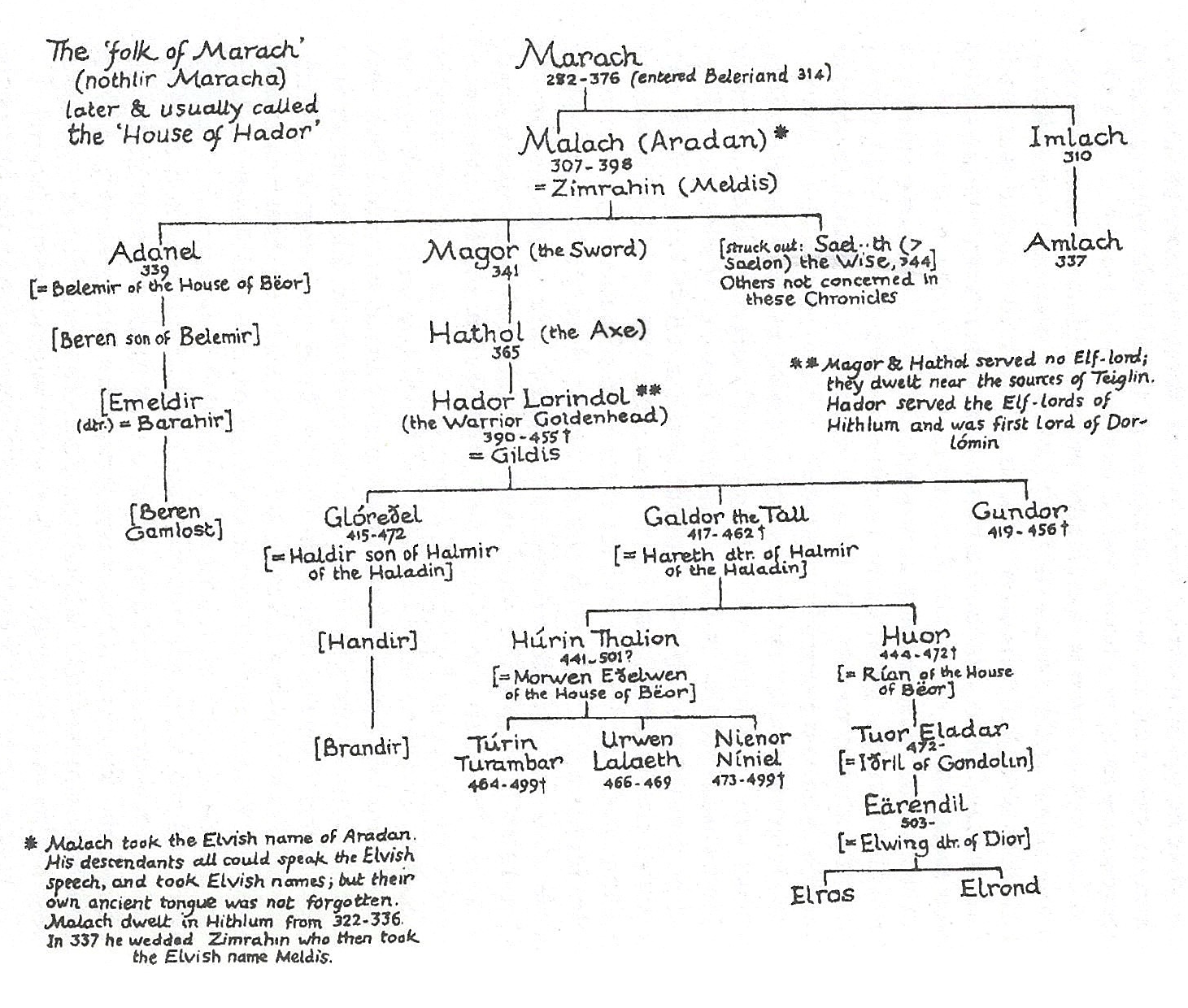
Through Marach’s granddaughter Adanel (Malach’s daughter) the line leads directly to Beren Erchamion. These familial relationships tie Marach into the larger history of Men in the First Age and directly tie his family to the line of both Elros Tar-Minyatur (and thus Aragorn), as well as that of Elrond Half-elven (and thus Arwen), through Beren’s son Dior and granddaughter Elwing.
Marach had a second son, Imlach. His son was Amlach, who figures in The Silmarillion as an antithesis in many ways to Hador, Bëor, and Beren, who had allied themselves deeply with the Elves. The character biography of Amlach, on this site, delves into this different viewpoint and also how he was used by Morgoth and his minions to sow disagreement and division in the ranks of Men and their dealings with the Elves.
Although we do not get much detail about Marach as a person, it is clear that he is close to Bëor, as he chooses to settle in an area near Bëor’s people. Some of his descendants had very clear and close relationships with the Elves of Beleriand, particularly the Noldor of the House of Finwë,9 Finrod and Maedhros in particular. He also is notable for his descendants—Beren, Elros, Elrond, Arwen, Aragorn—characters who are pivotal to the history of Middle-earth and the eventual defeat of Morgoth and Sauron.
Works Cited
- The Silmarillion, "Of the Coming of Men into the West."
- Ibid.
- Ibid.
- Ibid.
- Ibid.
- Ibid.
- The History of Middle-earth, Volume XI: The War of the Jewels the Later Quenta Silmarillion, "The new genealogies of the Edain: The House of Hador."
- Ibid.
- Ibid.


Marach, as you point out, is…
Marach, as you point out, is very important to all sorts of later developments, even if we get don't get all that much sense of him as a person.
It is good that there is a bio of him now; thank you for writing it!
I enjoyed reading this…
I enjoyed reading this compilation of the facts we have relating to Marach - it's very clear and helpful. Thank you!