
Fandom before the Time of the Trees: Revelations from Marquette's Fanzine Dataset by Dawn Walls-Thumma
Posted on ; updated on
This article is part of the newsletter column Cultus Dispatches.
Last month, Marquette University released the Tolkien Fanzine Dataset, 1967-2017, a spreadsheet of 4,113 entries from Tolkien fanzines. Marquette's library holds a special collection of Tolkien fanzines and has made some effort to digitize these, but permissions going back decades are difficult to obtain, and most of the contents of the collection are accessible only if you can visit the university in-person. This dataset, then, is the most significant effort to bring those zines to light that I've yet seen, and what can be gleaned from it reveals what pre-internet Tolkien fandom looked like.
Like a lot of artifacts and products made obsolete by the revolution in digital technology that took off running in the 1990s, fanzines became unnecessary in a post-internet fandom but carry a nostalgia for those who participated in analog fandoms and a romanticism for those of us who have only ever participated in fandom in front of a screen. There is something about holding printed fanworks in your hands—I experienced it when I held the proof of the Mereth Aderthad fanzine—that nothing online can equal. (There are also, to be fair, advantages to online fandom that analog fandom cannot equal!) Fanzines also exist temptingly out of reach for most of us. Where online fandom is relatively accessible—especially within the past decade—fanzines are finite, adding an aura of mystery that makes them even more romantic.
I've paged through the fanzines that Marquette has digitized, but I know these represent only a cupful of the sea, and as a fandom historian, I've wondered how Tolkien fanzines compare to the online fandom that evolved in the '90s. Did the fandom I know so well today grow out of these analog fandoms, or was it a new permutation of the fannish impulse that I believe is part of the human impulse to make sense of our world through folklore and story?
Today's analyses use Marquette University's "Tolkien Fanzine Dataset, 1967-2017." As the publication itself cautions, "The dataset does not claim to document all fanzines that were created during this period." Furthermore, while I cleaned the data, I did so quickly and may have missed small mismatches here and there. I also don't know how consistently items were tagged or what (if any) data validation practices were in place. That's a lot of grains of salt, but I hope we don't lose sight of the bigger picture here: the wealth of information on fanzines that we've been given and what we can discern from the dataset, even if imperfectly.
The Contents of Zines
One of the columns in the dataset was called "Item Type" and broadly classified zine items based on their purpose. I used these data as a basis1 for analyzing what exactly was contained within Tolkien fanzines. The graph below shows what I found.
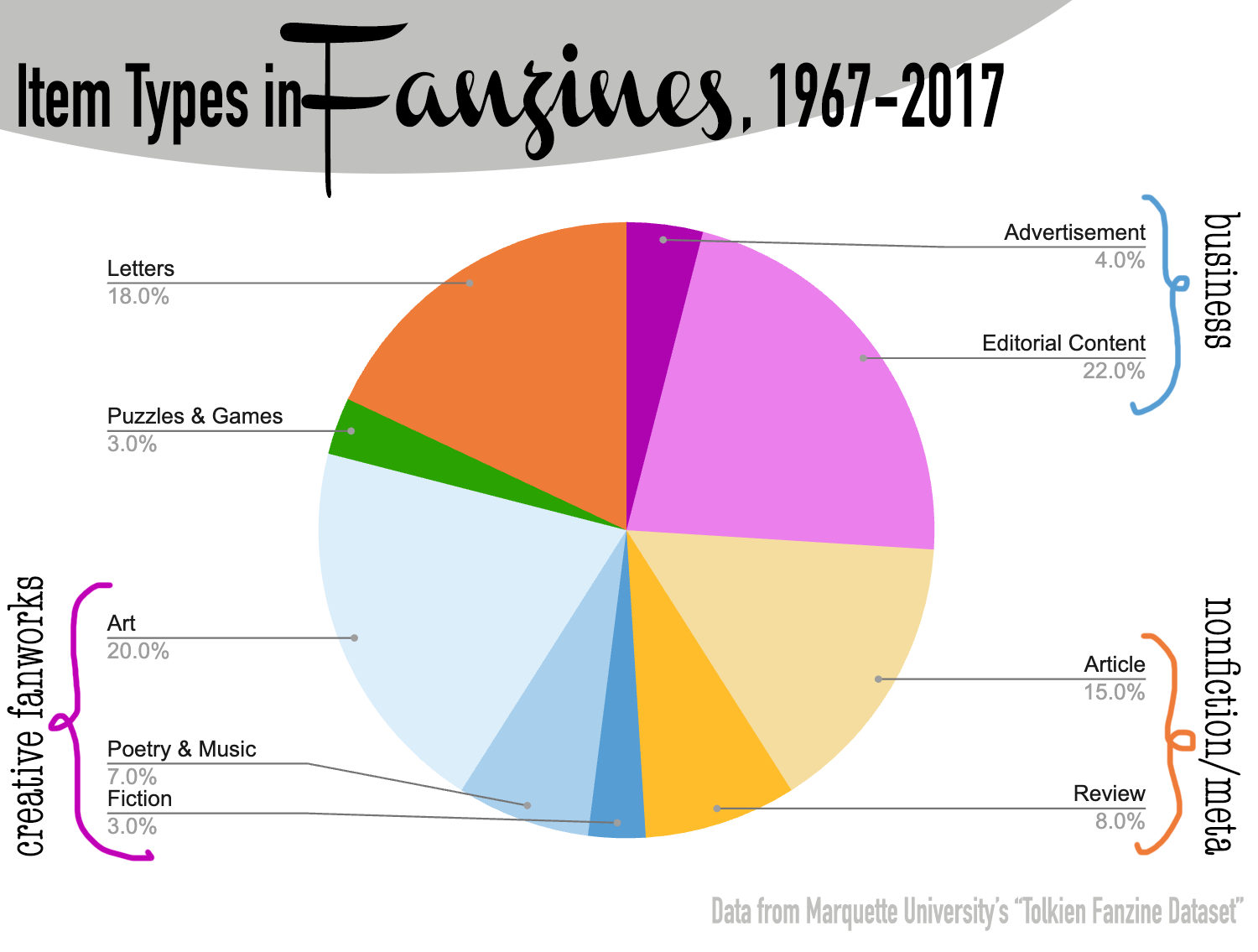
I clustered Marquette's item types into broader groupings of similar items.
- Creative fanworks make up 30% of zine items, but this is somewhat misleading because zines include original as well as fanworks. Eliminating items tagged "Fantasy - Non-Tolkien" turns up about 26% of items that are in fact Tolkien-based fanworks. Art dominates and, interestingly, poetry is more than twice as common as fiction. Of course, a print format imposes hard limits on written works that impact poetry less than fiction. No one is sharing a 500,000-word fanfiction novel in a zine spun off biannually on a mimeograph machine, but a sonnet? That's more reasonable under the constraints of print publication.
- Business includes editorial content and advertisements, which are more what we'd term signal boosts: not ads for businesses but for other fandom-related events and zines. Business items comprise 26% of zine items, which suggests a more top-down organization than most online fandom spaces—and this makes sense. A zine by definition has a leadership core in a way that online communities may not (as anyone who has participated on an online community long-deserted by its moderators can attest). My sense is that the organizational and governance structures of fandom communities have become increasingly diffuse—either in democratic or anarchic terms—possibly showing an early homage to the organization underlying fanzines and other analog fan communities that is no longer as common today.
- Nonfiction—what we'd call meta today—describes 23% of zine items. 21% of those are Tolkien-related, so like the creative fanworks, the non-Tolkien content is minimal. My first reaction was that this seemed much higher than what it is today. Even among fanworks, one in five is not meta. Meta is relatively rare. But as I thought more about the data and what online fandom participation looks like, I realized that this sort of research-oriented writing is structured around conversations in online communities rather than organized into formal articles and essays.
- Puzzles and games make up just 3% of zine items, but this type of fanwork is almost entirely absent in online fandom—oddly, given that online tools make constructing certain types of puzzles (like my Tolkien Connections puzzles) relatively easy.
- Letters, finally, make up 18% of zine items. Recognizing that letters were how fans around the world communicated with each other before the internet made conversations with fans a half-world away a matter of a few clicks and split seconds, the fact that letters made up nearly one in five zine items attests to the centrality of conversations and interactions to the fandom experience. It's easier now, but even in a format that resisted easy communication, fans were eager to share with and hear from each other.
Silm, Films, and Hype Spikes
In last month's article, Speak Friend and Enter: Trends in Fandom Entry Year, I noted that new fans entered the Tolkienfic fandom not only in the years following the releases of major media adaptations but in the year or two before as well. Bearing in mind that The Silmarillion was published in 1977, I offer the following graph of zine issues published per year.
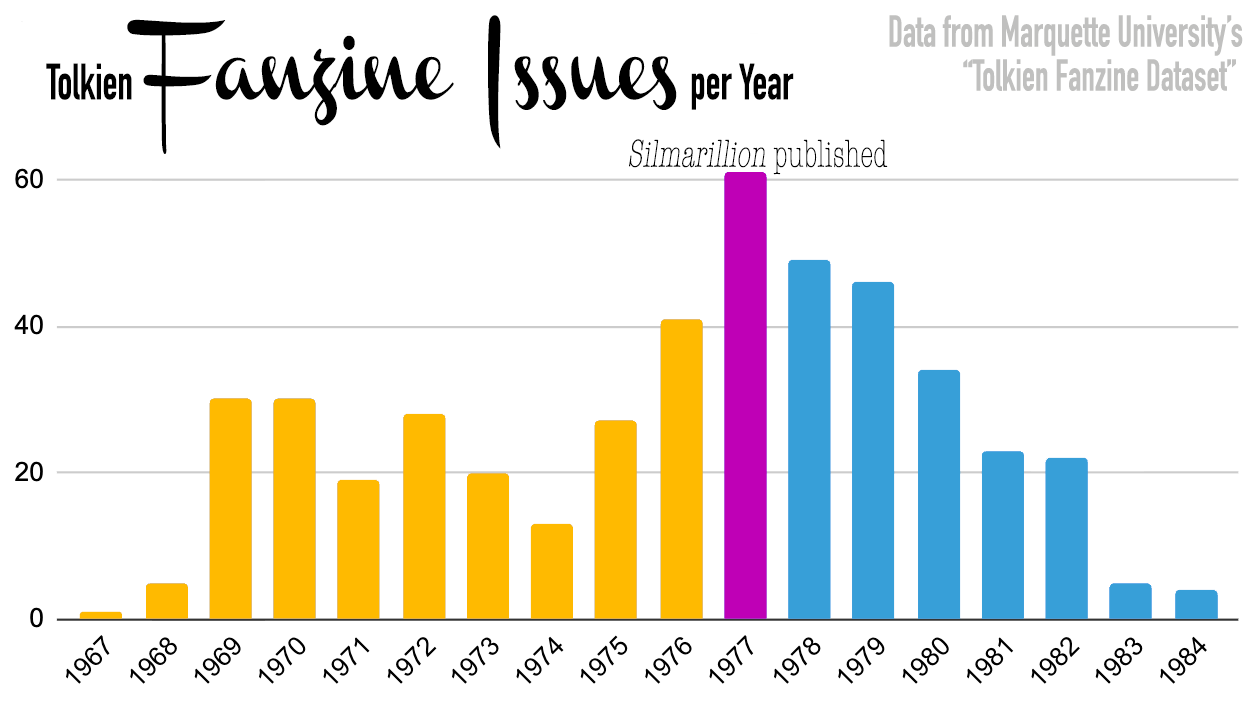
Now comparing the number of new fans to enter the fanfiction fandom to the number of zine issues published is an apples-to-oranges comparison in some regards, but I think that we can see important parallels here all the same. What both datasets show is that there is an uptick in fannish interest and activity in the years preceding a major release, whether (in this case) a new book or, in the 2000s, a new media adaptation.
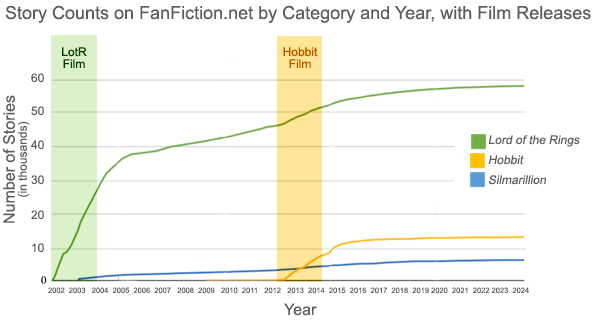
In "Speak Friend and Enter," I also included a graph I made for Fanlore that shows the number of stories posted on FanFiction.net for each of the three major texts. (An updated version of this graph is below.) Now these data show that the number of stories began to climb once a film was released. For this metric, hype didn't have much impact. I proposed in "Speak Friend and Enter," and suspect it is true here as well, that the pre-release "hype spike" is actually existing Tolkien fans drawn back into the fandom by the excitement of a forthcoming release. The increase in stories during the films represents the large contingent of new fans drawn to write stories because of the films but who didn't necessarily stay in the fandom long.
The year with the most fanzines in the dataset was 1977, not surprisingly—the year of The Silmarillion's release. It makes sense that every zine was eager to talk about the new book and its hundreds of pages of new backstory about The Hobbit and The Lord of the Rings.
After The Silmarillion's release, zines hang around for a few more years, but by 1985, they are gone completely—and remain gone until one single fanzine release in 2017. This reminds me of the pattern seen in the Fanfiction Archive Timeline: the Lord of the Rings films were out of theaters, and within a few years, most fanfiction archives were gone too, especially the hand-coded archives, which like a zine, require sustained effort from a webmaster to ensure new works are published. After 2007, I have only been able to document activity on three hand-coded Tolkien fanfiction archives, and all of them were inactive or closed beyond 2010, almost precisely the pattern seen in the zine data.
I suspect the reasoning is the same too, in that hand-coded archives and fanzines are a lot of work. Yes, you might say, but fanzines were no less work in the ten years leading up to the publication of The Silmarillion, yet the fandom produced 214 zine issues without any new books or adaptations behind them. The difference, I suspect, post-1977, is that once fan interest trailed off post-Silmarillion, it was hard to continue to put in that effort for a fandom that had diminished. Same with archives. The effort feels worthwhile when hundreds of readers are clamoring for updates; less so when one feels one is posting into the Void.
The Silmarillion Powers Fanfiction
I also compiled data looking at the number of works of fanfiction posted in the selected zines per year. As shown above, fanfiction in Tolkien zines appears to be fairly rare—only about 3% of zine items.
Before the 1977 release of The Silmarillion, fanfiction was even more rare. Only 28% of fics were published in 1977 or before, meaning that the majority (62%) of fics appeared between the years of 1978 and 1982. The graph below shows the data.
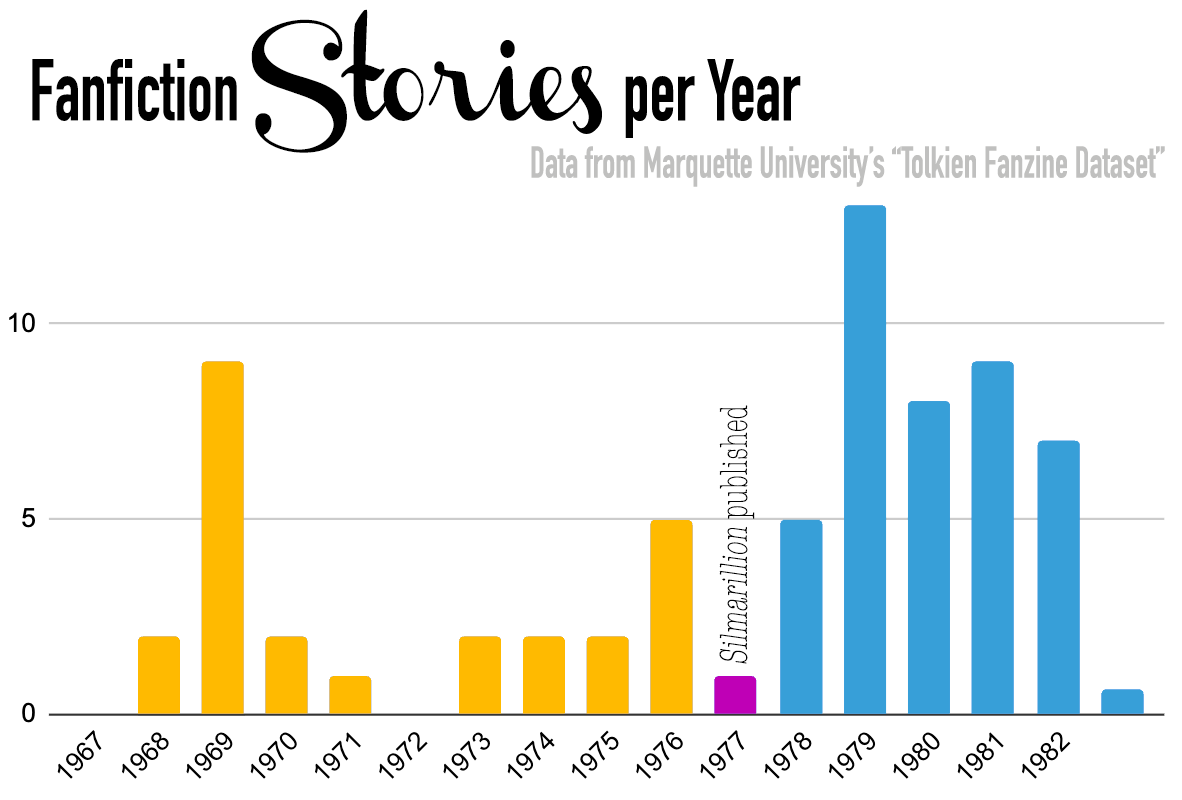
My theory as to what is happening here is possibly a product of my own bias. Certainly, it is possible that the dataset—which begins more than a decade after the publication of Return of the King—represents a fandom that had already exhausted its creative interest in The Lord of the Rings (LotR). However, I also tend to think that The Silmarillion powers fanfiction, not because it is a better book but because it is a less complete and more elusive one.
The Lord of the Rings is extremely satisfying as a story taken all on its own. Of course, there are imaginative inroads that can be made and side quests to be taken, but it's also a very complete story and one that doesn't necessarily have to invite those kinds of questions. The Silmarillion, on the other hand, feels much less complete. It covers millennia and involves a cast of more than two hundred characters in a small fraction of the words spent on a single year in LotR. It recalls Tolkien's musing about the appeal of "unattainable vistas"2: that to approach the barely-glimpsed crystal city in the mist is to ruin the magic. It is hard to glance anywhere in The Silmarillion without catching sight of an unattainable vista.
I think the spike in stories after the publication of The Silmarillion in September 1977 reflects the book's tendency to inspire creative works. This is true even today. There has never been a film or other adaptation about The Silmarillion to inspire popular engagement, yet it is into its third decade of steadily accumulating fanworks in the online fanfiction era. The graph to the right is an updated version of the one I made for Fanlore in 2019, showing the number of stories for the three major Tolkien books on FanFiction.net: LotR and The Hobbit show dramatic jumps but The Silmarillion trudges along, never really flagging, even when a lack of new adaptations means the other two segments of the fandom slow down. In the 2025 Tolkien Fanfiction Survey, "Silmarillion" writers overtook the other two books for the first time in the survey (and very likely, therefore, fandom history), a sign that interest in writing stories about the book is still going strong even as LotR- and Hobbit-based stories continue to tail off.
It's also worth noting that the archive where you're reading this now is the only regularly active Tolkien-specific fanfiction archive remaining—and it is a "Silmarillion" archive.
Again, as a Silmfic writer (and the owner of this archive), I have a clear bias in favor of the book. More than twenty years in, I have not been able to let go of creative engagement with it. However, even leaving aside my belief that The Silmarillion is particularly well-suited to fanfiction, its fandom has remained active and steady for a long while now, and the Marquette dataset shows that fandom's origins.
The Age of the Elves Has Never Ended
As long as I've been involved in the Tolkien fanfiction fandom, there have been hard feelings—sometimes subtle, sometimes overt—about which groups of characters receive the most attention. When I first read Kristi Lee Brobeck's 2004 article Under the Waterfall: A Fanfiction Community’s Analysis of their Self-Representation and Peer Review about the Henneth-Annûn Story Archive (HASA), I remember being struck (and amused) by how she arranged the replies she received to highlight the opposing perceptions of HASA, which was quite embattled at the time. I've included two that seem to me—having joined the fandom at the time Brobeck is writing about—to embody what these kinds of discussions tended to look like then:
I usually compare HASA unfavorably to other fanfiction communities. HASA is conceited, vain, arrogant and anti-hobbit. (6)
HA is very Hobbit and Men oriented. This is starting to make elf writers feel unwelcome, and slash writers feel like they are the plague! (26)
As the fandom chilled out post-LotR films, this shifted (again, in my experience) to a more muted grumbling and occasional pointed remarks about writing characters and pairings that weren't fandom favorites. In recent years, it has undergone a reversal, with the grumbling turned into events that encourage and highlight fanworks about groups, characters, and pairings both popular and neglected. No matter the approach, some character groups are written about more often, and this reality has created feelings of both community and alienation within the fandom.
So what about the fandom before the internet? It is important to note here that I am looking at data for all zine items, not just fanfiction or fanworks; the researchers do not seem to have tagged fanfiction based on the character groups featured. In addition, most zine items are not tagged with a character group at all, so these data represent a very small proportion of the entries.
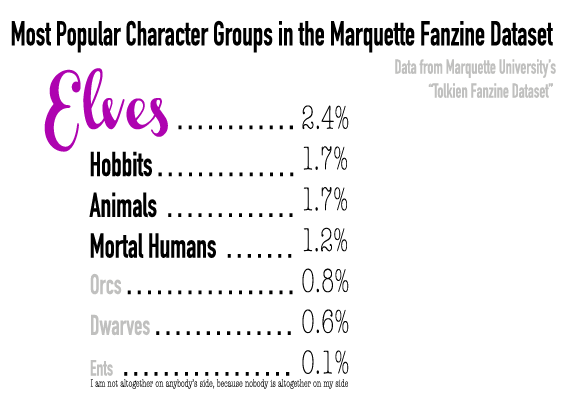
Zine entries about Elves were the most common, followed by Hobbits and Mortal Humans (called "Men as Race" in the dataset), which aligns with early online Tolkien fanfiction fandom as well. In a later column, it would be interesting to compare these data with historic data from various archives.
Works tagged "Animals" are unexpectedly popular, and looking at these entries more closely, they appear to largely include artwork of a nonspecific nature, perhaps decorative pieces given that many are untitled and identified by a description provided by the researchers. Only two name a specific Tolkien animal—Shadowfax in both cases. Orc and Dwarves are less popular still, and Ents barely register at all.
What makes Elves so popular? Nearly all of the entries tagged "Elves" were pre-Silmarillion, so the preponderance of this tag is not capturing the hype generated by this book, discussed above, nor does it reflect The Silmarillion's Elven focus. Elves are fantasy beings—but so are Ents and Dwarves, and all are present in LotR, and the case can be made that Dwarves are a focus in The Hobbit, yet none command the interest that Elves do. Here, I think we are again seeing the allure of unattainable vistas. In both The Hobbit and LotR, Tolkien drew on existing histories he'd created about Elves, creating a genuine sense of depth for this character group that isn't felt in the same way for other groups, whose histories were less comprehensive and more contrived.
Conclusion
As a fandom historian, my work has largely focused on internet fandom due to simple accessibility. I am fairly good at sleuthing out old websites but pre-internet fandom—largely preserved in zines—requires traveling to where those zines are held, and that hasn't been possible for me as of yet. The almost overnight adoption of internet spaces by communities that clearly had existing, long-enduring cultures has always suggested to me that pre-internet fandom may have loaned some of the values and practices we see in early online fandom, but finding proof of that was difficult without a trip out to Marquette.
The Marquette dataset brings pre-internet Tolkien fandom—and Tolkien fanfiction—a little closer to the light. In it, we can see some of those pre-internet practices that would make the jump online: interest in certain character groups, centralized leadership and governance, the importance of communications between fans, and a quiet but steady "Silmarillion" fandom. And some of what can be seen in these zines remains true even to this day, emphasizing the longevity of Tolkien fandom and its fan cultures.
Acknowledgements
My sincere gratitude goes out to those who made this project possible: Robinson Ensz, Gabriel Marotto, Aidan Oakey, Ivy Stanich, and Ethan Thomas; Dr. Gerry Canavan and Dr. William Fliss; and Jason and Shannon Swiatek and Judy Mitchell.
Notes
- I grouped a few of the Marquette item types with very small numbers into broader categories: Art (includes Artwork, Cartoon, and Map), Poetry & Music (includes Poem, Music, and Filksong), and Editorial Content (includes Editorial Content and Call for Submissions). I did not include Family Tree or Tolkien Film, which had only two items each and therefore rounded to 0%.
- The Letters of J.R.R. Tolkien, "Letter 247 To Colonel Worskett."

