
Eönwë by NelyafinweFeanorion
Posted on ; updated on
This article is part of the newsletter column Character of the Month.
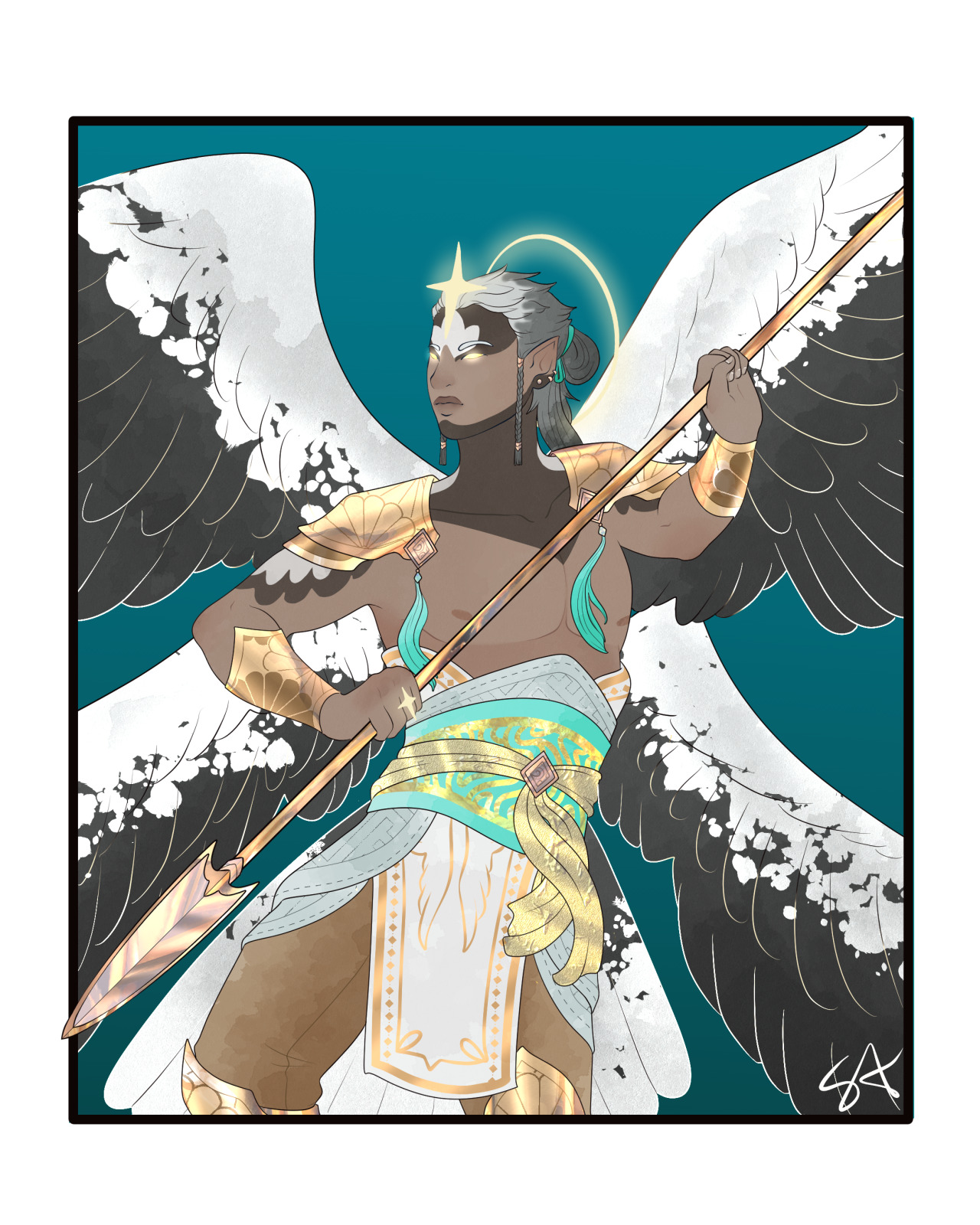
Eönwë is a character with only a few, brief mentions in the legendarium; however, those mentions have significant importance. In The Complete Guide to Middle-earth, he is variously described as a Maia, the herald and standard bearer of Manwë, a frequent messenger of Manwë, the mightiest in arms in all of Arda, and a judge of the Eldar and instructor of the Dúnedain after The War of Wrath.1 These are significant and varied attributes and are not even a complete description of him.
In early concepts of Tolkien’s legendarium he was listed as a son of Manwë and Varda, referred to as Fionwë-Urion, later changed to Eönwë.2 The Book of Lost Tales, Part 1 also notes that in an earlier version of the story a Valar named Nornorë was the Herald of the Valar, but this was abandoned at a later date and the Herald of Manwë was subsequently identified as Eönwë.3
Eönwë is first mentioned in The Silmarillion in the Valaquenta, under the heading "Of the Maiar." He is named chief among the Maiar, along with Ilmarë, and is noted to be the banner-bearer and herald of Manwë, with “a skill in arms surpassed by none in Arda.”4 This is an interesting attribute to have noted in the text, as many individuals are highly praised for their skill at arms and are known to be skilled warriors in the narrative, but Eönwë is clearly noted as being unrivaled.
Eönwë appears again, much later in The Silmarillion, in Chapter 24, “Of the Voyage of Eärendil.” In this chapter he is the one to greet Eärendil on his arrival on the shores of Aman. Eönwë not only welcomed him but summoned him to appear before the Powers of Arda, in the halls of Valimar.5
Once Manwë gave his judgment on Eärendil’s petition and on his fate, Eönwë spoke to Eärendil’s companions and procured a boat for them in order for the Valar to send them back east.6
When Manwë determined that a host of the Valar would be gathered to aid the Elves and Men of Beleriand, this included Maiar, Vanyar, Noldor (led by Finarfin), and Eärendil with his ship Vingilot, but Eönwë led this host and "the sound of his trumpets filled the sky.”7
The War of Wrath decimated Morgoth’s armies and his Balrogs, but he then unleashed his dragons from the pits of Angband and drove the host of the Valar back. Eärendil in Vingilot defeated Ancalagon the Black and turned the tide of the battle, as Ancalagon’s fall smashed the towers of Thangorodrim and the host of the Valar overtook the stronghold.8
Morgoth fled into the depths, and when he was eventually found he begged for mercy. Eönwë, as leader of the host, is presumed to have led this attack and the search for Morgoth, as well as succeeded in his subsequent capture:
… but his feet were hewn from under him, and he was hurled upon his face. Then he was bound by the chain Angainor which he had worn aforetime, and his iron crown they beat into a collar for his neck, and his head was bowed upon his knees. And the two Silmarils which remained to Morgoth were taken from his crown, and they shone unsullied beneath the sky; and Eönwë took them, and guarded them.9
The way the passage is written it can be inferred that Eönwë, already described as unparalleled in skill at arms, is the one performing these actions (or they were done under his direct orders). This reinforces his role as a leader, or the overall leader, of the host of the Valar in this conflict. It is not explicitly written this way; however, support for the inference can be found in "The History of the Akallabêth" where Christopher Tolkien notes that Fionwë, son of Manwë, was written as the leader and commanding authority in the war against Morgoth, but Eönwë did not retain “so mighty and elemental a rôle.”10 He states in that section that he believes this diminution of his role was a mistaken treatment of the original text.11
After this decisive victory, Eönwë summoned the Elves of Beleriand to depart Middle-earth. Maedhros and Maglor, mindful of their oath, sent a message to Eönwë asking him to yield the Silmarils to them, as Morgoth had stolen them from Fëanor, their father.
Eönwë refused:
Eönwë answered that the right to the work of their father, which the sons of Fëanor formerly possessed, had now perished, because of their many and merciless deeds, being blinded by their oath, and most of all because of their slayings of Dior and the assault upon the Havens. The light of the Silmarils should now go into the West, whence it came from the beginning; and to Valinor must Maedhros and Maglor return, and there abide the judgement of the Valar, by whose decree alone would Eönwë yield the jewels in his charge.12
In the night the two sons of Fëanor came into the camp of Eönwë, slew the guards and took possession of the jewels. But even while the alarm was raised and arms were raised against them, “Eönwë would not permit the slaying of the sons of Fëanor; and departing unfought they fled far away.”13
But Eönwë's previous words had been true:
But the jewel burned the hand of Maedhros in pain unbearable; and he perceived that it was as Eönwë had said, and that his right thereto had become void, and that the oath was vain.14
Eönwë has a significant central role in the war itself, in the defeat and capture of Morgoth, in the administration of justice after the definitive battle, and as adjudicator for the Elves of Beleriand and the sons of Fëanor in particular. The reader sees the great responsibility he holds and how he balances retribution and forbearance in the aftermath. His latter is particularly notable in his treatment of Maedhros and Maglor, in preventing his followers from apprehending them or killing them.
Eönwë is again present in the Akallabêth. Even though Manwë shut Morgoth beyond the World in the Void, his followers and servants still persisted. The Eldar were summoned to return to the West, to dwell in the Isle of Eressëa. The faithful Men of the three great houses were also rewarded:
Eönwë came among them and taught them; and they were given wisdom and power and life more enduring than any others of mortal race have possessed.15
In this instance he imparts knowledge and goodwill to the faithful Men.
Mention of Eönwë is also found in Of the Rings of Power and the Third Age. In this section, after the destruction of Thangorodrim and the defeat of Morgoth:
Sauron put on his fair hue again and did obeisance to Eönwë, the herald of Manwë, and abjured his evil deeds. And some hold that this was not at first falsely done, but that Sauron in truth repented, if only out of fear, being dismayed at the fall of Morgoth and the great wrath of the Lords of the West. But it was not within the power of Eönwë to pardon those of his own order, and he commanded Sauron to return to Aman and there receive the judgment of Manwë. Then Sauron was ashamed, and he was unwilling to return in humiliation and to receive from the Valar a sentence, it might be, of long servitude in proof of his good faith; for under Morgoth his power had been great. Therefore when Eönwë departed he hid himself in Middle-earth; and he fell back into evil, for the bonds that Morgoth had laid upon him were strong.16
In this instance, as with the sons of Fëanor, Eönwë is not putting himself forward to mete out justice. He offers an avenue of repentance and possible rapprochement, but he does not punish or subjugate the free will of these individuals. It is a contrast to the immediate and ruthless subjugation of Morgoth, who had proven himself faithless and false more than once.
Despite his few mentions in the narrative, Eönwë has a commanding and memorable presence. He is a fascinating character and gives the reader a very nuanced portrait of a leader: a skilled warrior but also someone who takes his role as an emissary, spokesperson, and aide to Manwë very seriously. He may be a leader in the War of Wrath but his role as Manwë’s herald, messenger, and representative/agent is paramount to him. He is doing Manwë’s will but he does not overstep his responsibilities. In the case of Sauron, Maedhros, and Maglor he does not administer justice—he admonishes, he delineates the course of action for both their retribution and rehabilitation, but he does not coerce them. They retain their free will. It is a testament to the type of leader he is, supremely competent at the tactics, strategy, and force of arms necessary, but also explicitly noted to be a tactful emissary, teacher, and diplomat.
Works Cited
- Robert Foster, The Complete Guide to Middle-earth (New York: Del Rey, 2022), 158.
- The History of Middle-earth Volume 1: The Book of Lost Tales Part One, The Music of the Ainur.
- Ibid.,The Coming of the Valar.
- The Silmarillion, Valaquenta.
- Ibid., “Of the Voyage of Eärendil.”
- Ibid.
- Ibid.
- Ibid.
- Ibid.
- The History of Middle-earth, Volume XII: The Peoples of Middle-earth, “The History of the Akallabêth."
- Ibid.
- The Silmarillion, "Of the Voyage of Eärendil."
- Ibid.
- Ibid.
- Ibid., Akallabêth.
- Ibid., Of the Rings of Power and the Third Age.


I am sometimes inclined to…
I am sometimes inclined to be a bit more critical of Eonwe's interactions with the Eruhini than he deserves. Thank you for the reminder!
Fascinating look at Eönwë as he appears in the texts....
It is interesting what fanfiction writers have done with him from this starting point!