
Speak Friend and Enter: Trends in Fandom Entry Year by Dawn Walls-Thumma
Posted on ; updated on
This article is part of the newsletter column Cultus Dispatches.
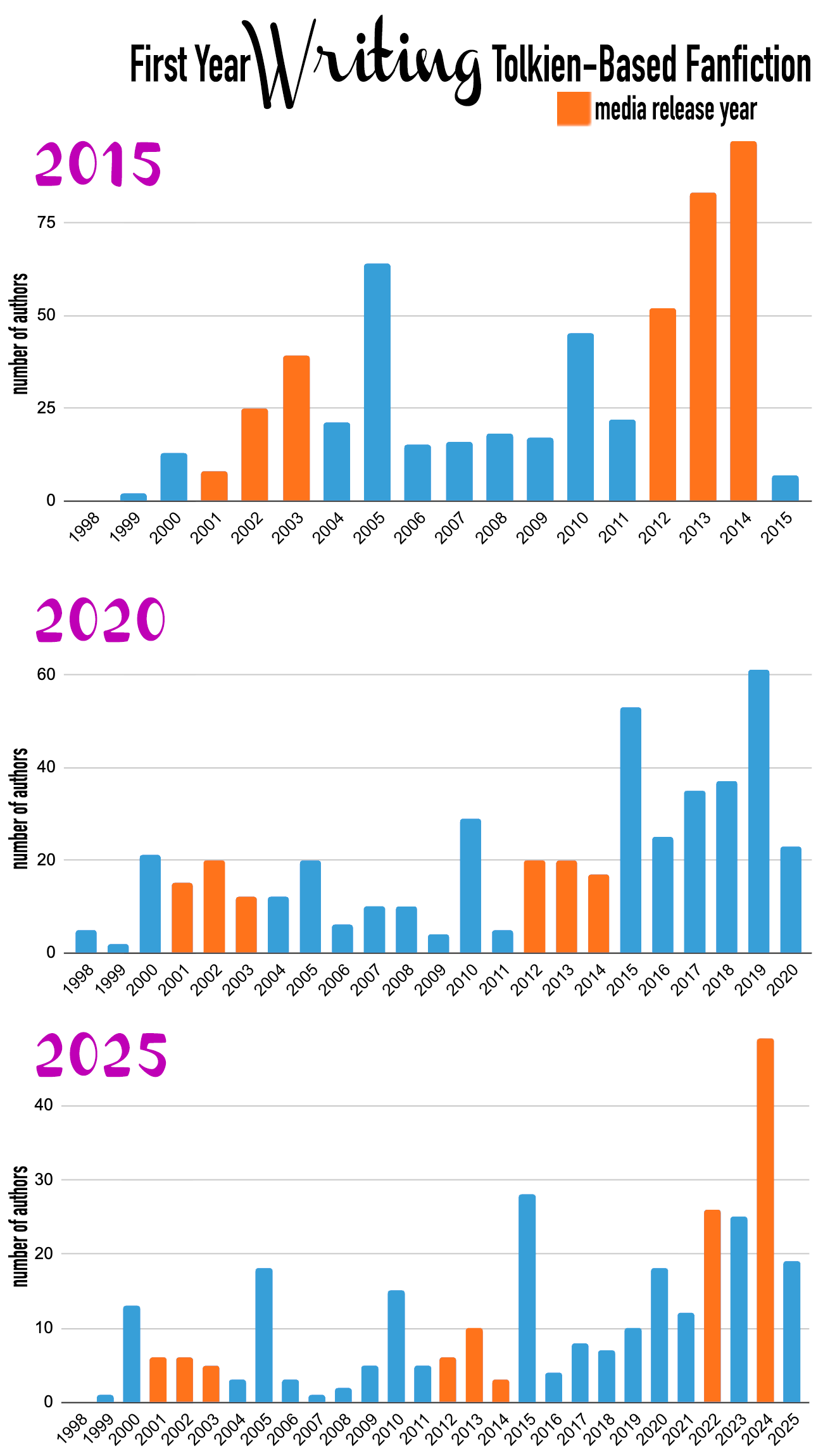
In last month's article, The Rings of Power Is a Ripple (So Far), I offered up the graph below without much commentary. It shows, across three years of the Tolkien Fanfiction Survey, the number of participants who began writing fanfiction in a particular year.
These data (and the graphs that represent them) have been among my favorites since I first started working with the 2015 data and created the graph below. After ten years of living with these numbers, it is hard to remember back to 2015, when I wasn't certain what the data would show. I had an inkling, but it was based on my own experiences and perceptions, and in a fandom as vast and long-enduring as the Tolkien fandom, it was possible that those perceptions wouldn't pan out in the data. When I first started sharing the data, I used them to document not just the impact the films had on new fans entering the fandom but the enduring impact. People brought to Tolkien-based fanfiction by the Lord of the Rings films still formed a substantial bump on the graph, even ten years later.
Now, ten years after that, I want to spend time with just these graphs because, when I laid them out side by side last month, I noticed all sorts of things that exceeded the scope of last month's Rings of Power-focused column.
Like that column, this column uses data from three iterations of the Tolkien Fanfiction Survey, a project initiated in 2015 and continued in 2020 and 2025; the latter two surveys were administered in collaboration with Maria K. Alberto. Anyone eighteen or older who writes or reads Tolkien-based fanfiction was invited to participate, and we had 907 participants in 2015, 746 in 2020, and 436 in 2025. The survey collected demographic information, then presented a series of statements about the participant's attitudes, beliefs, and behaviors related to writing and reading Tolkien-based fanfiction. One survey item for authors asks simply: "For how many years have you been writing Tolkien-based fanfiction?" Using the answer to that item,1 I can estimate the year the person began writing. Those data are the focus of this month's analysis.
Trend #1: Fanfiction writers "endure longer than Tulkas"
All three graphs show a spike2 in participants who entered in the last full year before the survey was opened. From this, we can conclude that if you trip on a Tolkien fanfiction writer, chances are they are new (or at least newish). Most of those writers will not remain in the fandom long enough to take the next survey. The three graphs all show waves of interest among new fans that more or less flatten by the time the next survey comes out (and brings its own wave of newcomers crowding the rightmost bars on the graph).
But the graphs also show that a not-significant subset of writers will stick around. In the first survey, 53% of authors had started writing in 2010 or earlier. In the 2020 survey, that number was 37%—still more than one in three authors. In the most recent survey, 27% of authors started writing in 2010 or earlier.
2010. Smartphones were cutting-edge technology. A devastating earthquake struck Haiti, and South Africa hosted the World Cup. Barack Obama was in the early years of his first presidency. Instagram was launched. Kesha, Lady Gaga, and Katy Perry were top artists. Many of the new, young fans beginning to write Tolkien-based fanfiction now were small children (or maybe not even born!)
Put another way, when you trip on that fanfiction writer, there is a one-in-four chance that they have been around since at least that time, maybe longer.
Like any new hobby or interest that people try, most won't stick with it, but a substantial number of Tolkien fanfiction writers will. The fact alone that the graph needs to stretch back to 2000 twenty-five years later is evidence itself.
Trend #2: An unexpected bump
When I used to present the 2015 data after the first survey, I would point to the spike in 2010—a year when Tolkien-based fanfiction was in a lull and that should have held little appeal for new authors—and laugh and say, "I don't know what happened in 2010!" and write it off as a fluke in the data.
Two datasets later, I've gained insight into what happened in 2010. When I couldn't explain it after the first survey, this was because I was thinking in terms of the films' impacts after fanfiction writers had all of them available to draw on as inspiration or sources. I wasn't considering the enormous promotional machine that grinds into motion the moment there is enough grist for "hype" to feed into its mill. Yet the data strongly suggest that these promotions encourage entry into writing Tolkien-based fanfiction.
There are spikes in the data in 2000, 2010, and 2020. Here's what else was happening in the fandom on those years:
- On April 10, 2000, the online promotional trailer for The Fellowship of the Ring garnered more downloads in its first day than any film to that point, including giants like Stars Wars: Episode 1.3
- Throughout the late 2000s, protracted and convoluted legal battles about the Hobbit films culminated, in 2009 and 2010, with enough progress on the script and development that fans could expect the films would actually be made.4
- In 2019, casting began for The Rings of Power, and filming commenced in 2020 before being shut down due to the COVID-19 pandemic.5
In other words, we see an increase in new fanfiction authors in years where a critical mass of information about a forthcoming adaptation creates a sense of certainty—and perhaps anticipation—that the adaptation will be made, and cognizance of Tolkien escapes the fandom bubble and into the mainstream. (2020 is, of course, complicated by the pandemic and lockdowns. A lot of folks picked up new hobbies that year.)
I hope to dig more into the details of authors who entered the fandom in those years. I expect the bump in new authors was likely driven by existing Tolkien fans who, curious about or interested in the new adaptations, went online to learn more and found themselves snagged into the vast online Tolkien fandom, including spaces where they would have encountered fanfiction.
Trend #3: "… and all that may come after"
Less surprising to me is the bump in entry that comes during and after the films. As I noted above, I initially used data from the first survey to illustrate this trend. However, having three surveys' and ten years' worth of data reveals some intriguing complexities.
Looking back at the two film trilogies in the 2025 graph, the big spikes in entry occur a year or two after the films leave theaters. This isn't surprising, and I've always explained it as fans who saw all three films and then picked up one or some of the books. I first made the case in Becoming Bookverse that the primary impact of the films was to drive new fans (who would become fanfiction writers) to the books.
Interestingly, it is these authors (and those who seem to have entered the fandom as publicity grew for the films) who stick around. By the 2025 data, the number of authors who started writing during the film years flattens considerably.
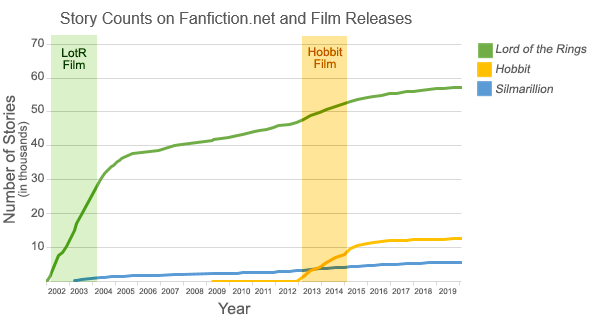
Yet the graphs here don't provide the whole picture. Looking at fandom participation in another way, the biggest spikes in stories posted occur during the film releases. Some of that activity is undoubtedly coming from new fans, energized by the films. The graph to the right, which I made for the Tolkien Fanfiction article on Fanlore, shows this—and it also shows stories tailing off in the years that survey data show more authors entering the fandom.
So what is going on here? The answer lies in what the survey data actually shows. The 2025 survey data for entry year shows primarily people who have remained in the fandom; it will almost never capture people who once participated and do no longer (especially those who only wrote for a short while). Furthermore, none of the survey data is likely to capture casual fans who, excited by a media adaptation, write ardently but ephemerally. Even though they would be welcomed to participate in the survey, these writers may not think of themselves as "enough" of Tolkien fans or fanfiction writers to participate, or they might not feel enough attachment to the fandom to commit to responding to a lengthy survey. I suspect the survey largely misses these fans.
Putting the survey and FanFiction.net data together leads me to stick by my original theory. The years the films were in theaters brought about massive amounts of new fanfiction, but the authors who wrote those stories by and large didn't stay around. It is the fans who made it through all of the films and then possibly picked up one or more of the books who remained, sometimes decades after the fact. Put another way, the films generated stories; the books—revisited by fans enticed by news of a forthcoming adaptation or picked up by filmgoers eager to remain in Middle-earth—generate authors.
This also reiterates what I concluded in "The Rings of Power Is a Ripple (So Far)": Assuming a release schedule similar to what the show has followed so far, we will not know the impact of the show until the 2035 survey.
Trend #4: "These tales are new …"
All of this focus on the films neglects that the explosion of Tolkien-based fanfiction is accounted for by more than just a popular movie trilogy. I've made the case that the timing of the films alongside increased internet access in the West and the start of Web 2.06 came together to create the conditions for a megafandom.
The data you don't see point to the importance of the internet especially. As discussed above, the online promotional trailer for the Fellowship of the Ring—released in 2001—certainly explains some of the entry of new fanfiction authors. Is it the full picture, though? Almost two years earlier to the day, on April 11, 1999, TheOneRing.net was reporting on a "secret set" being built for Hobbiton, quoting a spokeswoman who defended the secrecy around the film: "You just have to look on the Internet to see the fanatic interest."
Given that, one would assume some increase in Tolkien fans looking online for more about the films and possibly stumbling onto fanfiction—both FanFiction.net and Yahoo! Groups existed, as did other mailing lists (which eventually merged with Yahoo! Groups) that included fannish activity. Least Expected, an email list that would morph into the first Tolkien slash archive, was around in 1999. We've also seen that a subset of fanfiction writers will stick around for decades so the lack of new fans pre-2000 can't be explained solely by attrition.
Instead, it is possibly explained not by a lack of "internet hype" but a lack of internet. US Census data shows that, between 2000 and 2001, home internet access underwent its largest single-year jump,7 from 42% of American households to just over half. (Our World in Data shows that the US was about middle of the pack: some Western nations had more access; some had less.) About one in ten Americans, in other words, were newly online when the online promotional trailer for The Fellowship of the Ring dropped, perhaps eager to engage with others around a shared interest and without many existing online community connections.
I often wonder what would have happened if the Lord of the Rings films came out five years later, at a time where social media was making its debut and when the novelty of "getting online" had worn off for most people. The Hobbit films show that newness to the internet isn't a prerequisite for a fanfiction explosion, and it's likely that the Lord of the Rings films would have generated a burst of fanfiction in 2006 as well, but I suspect not as much.
Conclusion
Tolkien fanfiction can claim to be both one of the longest-running fanfiction fandoms and one of the most intensely active. As Tolkien fans, it's easy for us to assume this is a foregone conclusion because the source material is so rich, complex, and enjoyable. Why, we might ask, wouldn't every viewer and reader want to stay in Middle-earth a bit longer? But there are many books, films, shows, and games that are rich, complex, and enjoyable without nearly the fanfiction presence of Tolkien.
When I closed the 2025 survey last January, I was very excited because three datasets seemed the point where I could begin to identify trends. These three graphs are an example of what I looked forward to. They show that the conditions that produce entry into fanfiction writing are not simple. A media adaptation that captures the imaginations of audiences may result in an uptick in fanfiction, but only certain conditions of engagement may mean the writer remains in the fandom for years or even decades. Big-buck PR campaigns may stoke sales at the box office—and grassroots fandom engagement that persists long after profits have flatlined. And behind it all are historical contexts that seem divorced from stats on FanFiction.net but are in fact driving them in subtle ways: signing up for home internet, the availability of fan-friendly social platforms, the pandemic. As we consider what the fandom will look like in the years to come, Tolkien's appeal remains unchanged—but what conditions and contexts will drive (or stall) fan engagement are yet to be discovered.
Notes
- I also used the survey item that asked, "Have you been writing Tolkien-based fanfiction continuously since you started?" If the author indicated they had stopped writing fanfiction at some point, that response plus the "how many years" item were used to estimate the entry year.
- If you want to define "spike" with specific numbers, 18% of authors in 2015, 13% in 2020, and 16% in 2025 began writing in the year before the survey's release (2014, 2019, and 2024, respectively).
- Lord of the Rings online promotional trailer press release, posted by Michael Martinez (Xenite.org). April 10, 2000, accessed August 22, 2026.
- The Hobbit (film series) on Wikipedia has a recap of all the drama around getting the Hobbit films off the ground, for those who want to relive those days. Accessed August 22, 2026.
- The Lord of the Rings: The Rings of Power (season 1) on Wikipedia documents the development of the show. Accessed August 22, 2026.
- Web 2.0 is the term used to describe dynamic, participatory websites versus static websites that existed to provide content unidirectionally.
- The largest among the data recorded by the Census Bureau. (The data until 2011 can be found here.) They did not collect data in 1999, but estimating the increase in home internet access that year still puts it below the 8% jump between 2000 and 2001.


As ever, fascinating data
The link between the films and fanfiction writing makes sense, but what has to sustain the fans in-between the advance promotion and release dates is the bookverse. I do wonder about the fanfiction written in the 60s-70s-80s, circulating amongst friends and early fanzines.... and whether there is a treasure trove of paper somewhere!
I agree! Media fandoms…
I agree! Media fandoms appear to be faster-moving than book-based fandoms (in terms of fanfic that is), exploding rapidly and fading just as fast. It seems to me that the archive data showing story counts coupled with the entry year data shows both the flash-fire nature of popular media fandoms and the longer-enduring book fandoms.
This is leading me to wonder if there are data out there comparing the longevity of writers in the two (probably could be gleaned for FFN and AO3 if nothing else ...)
Thank you always for reading and commenting! You're a treasure! <3
This was a truly captivating…
This was a truly captivating read - Data! Tolkien! Stories! Yummy. Thank you <3