
Fandom Draws the Line: Fanworks, AI, and Resistance by Dawn Felagund, Grundy
Posted on ; updated on
This article is part of the newsletter column Cultus Dispatches.
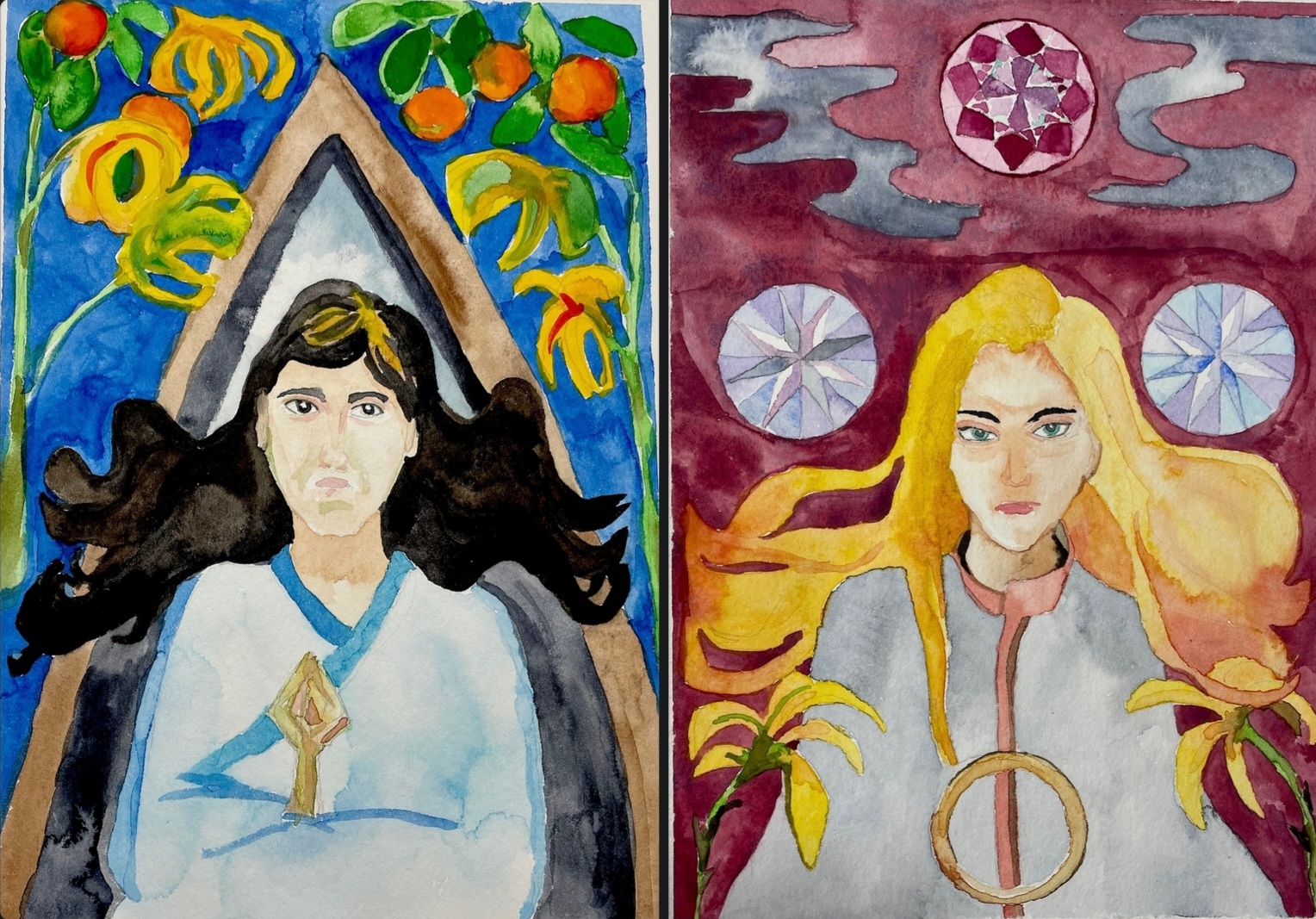
Three weekends ago, we presented to other Tolkien scholars at a roundtable about artificial intelligence (AI) in Tolkien fandom and scholarship. When we originally signed up to do this presentation, our intention was to share how our moderator team and members collaborated to develop the SWG's AI policy. As is often the case when given a relatively straightforward story to tell, the tale grew in the telling, and we ended up asking questions and gathering data and heading off in directions apart from the SWG's story (although that remained a central part of the presentation).
As our research expanded, boundaries became a dominant and consistent theme. Fanworks fandom typically does not draw a lot of boundaries; in fact, the act of creating fanworks is a transgression of boundaries, most obviously, creating art and stories in a realm defined by rights and driven by profits, but also in how fans will often push their own communities' limits in how texts are interpreted and represented (or re-presented). Anything goes. Don't like, don't read. These are the mantras of fanworks fandom. In Tolkien fandom, this is complicated because, historically, there have been fan communities that have circumscribed tight limits on how Tolkien's texts should be read. Dawn has critiqued many times the tendency of some fan scholars to breathlessly assert that all fanworks communities are peopled by freewheeling subversives eager to overturn the canon because that is certainly not true of many Tolkien fanworks communities across the decades of that fandom's history and to ignore one of the oldest and most-enduring fandoms is to be remiss. Yet if we look at the long arc of Tolkien fanworks history, even here, even in the fandom where the word "canatic" once emerged out of necessity, we have seen those boundaries slowly effaced.
Yet like the Meatloaf song, it seems that even fanworks creators have their "I won't do that." And while various fans draw boundaries individually—and that is generally respected—the fandom at large has scribed a heavy dark line between itself and fanworks produced with generative AI. We won't judge and will in fact defend the rights of creators to all manner of approaches to the texts that are hard to explain outside of our communities (and that even make us, personally, uncomfortable), but genAI? It seems we won't do that.
The SWG's Story
On November 30, 2022, ChatGPT was released, and generative AI entered the popular consciousness. On 5 May 2023, the potential impact of genAI on the SWG entered the moderators' consciousness. A newcomer to our Discord server mentioned using Bing AI to create images, and Janeways, one of our server moderators and a professional artist, raised the question in our moderator channel: "Do we need a rule about AI art, by the way?"
Some of us knew very little about genAI, but we all agreed that we needed a policy in place for both AI-generated art and writing before it became necessary and that policy should reflect our community values and involve member input. So we set out learning, and our thinking on the question evolved very quickly from there. It took forty-one minutes for us to progress from a fandom-typical approach of labeling and allowing people to avoid it, to feeling we should accompany this with education about the ethical issues around it, to deciding that those ethical issues were too profound for us to welcome AI-generated fanworks on the SWG at all. Over the next couple of hours, other moderators jumped into the conversation to express their support for an anti-AI stance on the SWG, and less than seven hours after Janeways raised the initial question, the moderators were poised to ban AI-generated fanworks. Dawn posted to the moderator channel:
I am well aware that my Feanorian inclinations sometimes make me a hasty human. I'm willing to leave this discussion open for the mods for the weekend, in case there is a dimension to this that I'm missing. But honestly? I don't see a place for this on our archive, and I think our organization in general should make a pretty clear statement that we're not going to use it for official SWG purposes (i.e., banners or site graphics) at all.
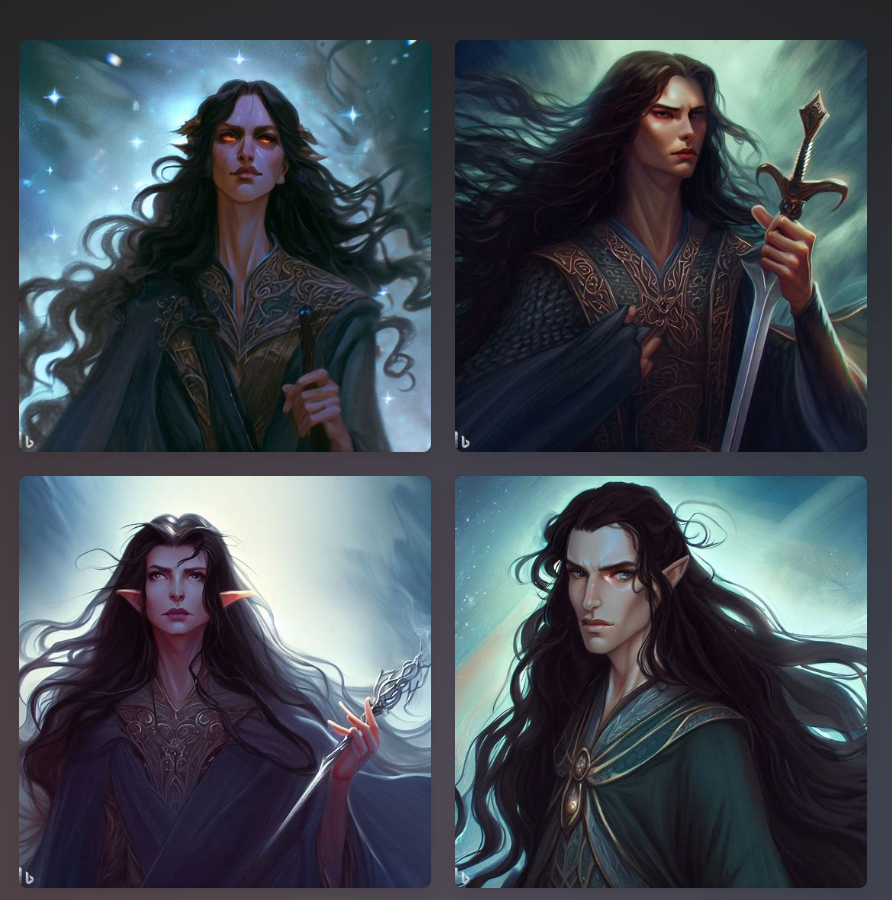
There were two key issues behind our decision: skill and theft. Some of us had never used genAI and weren't sure what getting a quality image or written work entailed. We wondered, was prompting genAI similar to using the various effects available in software like Photoshop, where the ability to select, apply, and adjust those effects was itself a skill? So Dawn tried it, for the only time in her life as of this writing, using the Bing AI image generator to create art using the prompt "feanor and silmarils," concluding: "Getting past the CAPTCHA to access Bing AI was the hardest part of the whole process." The ease of producing a decently good work of fanart in three nongrammatical words—you can see the image to the right—was a shock.
So no, skill was not required to make a passable piece of AI fanart. This brought ethics to the fore of our discussion.
Because, as fanworks creators, we were no strangers to flirting with the unethical. We'd been dismissed as thieves by prominent authors; we were labeled as miscreants for our interest in particular ships, genres, and kinks. Something being tagged "unethical" didn't necessarily mean that we agreed—or that we agreed to the extent that we'd impose our value judgment on every member of the SWG. As already noted, boundaries in the fanworks world are lightly scribed in chalk. But genAI crosses boundaries to important to wave away under the truism of "different strokes for different folks."
Chief of those boundaries was the second issue that defined the SWG moderators' opposition to AI-generated fanworks: theft. Anything may go in your creative work, but how you treat fellow fans and their work is governed by strong social norms in fandom, one of which centers on acceptable use of and credit for other fans' work. Some have remarked on the irony that creators who do what they please to characters created by someone else are scrupulous in asking permission and crediting work that they use from other fans in excess of the expectations of, say, academia. Additionally, fanworks fandom is—with some exceptions for art—rigorously not-for-profit. The specter of rights holders shutting down entire fandoms shadows the imaginations of fans who weren't even born when fanfiction exploded on the internet in the early 2000s and Anne Rice was fandom's bogeyman. Generative AI, which is "trained" on the work of creators who neither give permission nor receive their share of the profits, flouts both the norms of permission and fandom's insistence on remaining strictly not-for-profit. These key values of fanworks fandom are what led to the moderators' decision to ban AI-generated fanworks.
Synchronicity
The day after the moderators arrived at our "no genAI" decision, before we had even finished putting our AI discussion into a written policy for moderator review, the Organization for Transformative Works (OTW) posted the May edition of the OTW Signal and swung the spotlight upon AI-generated fanworks. In this edition, the OTW's Legal Chair, Betsy Rosenblatt, was quoted in an interview about AI and fanworks. Her view was rose-colored, to say the least, asserting the fanworks creators should be glad to have their works scraped for training AI because “[t]hat means that machines will learn how to describe and express a much more contemporary, broad, inclusive, and diverse set of ideas.” The interview veered next into truly bizarre territory, imagining fanfiction featuring AIs as characters buying houses and forming relationships; the Signal article ended by breezily chirping, "Will fans take up this challenge?"
The answer was no. Fans were stoked by neither the unsanctioned donation of their works to train more "inclusive" AIs nor the creative possibilities of fanworks about ChatGPT. From our perspective, on the SWG moderator team, the timing was … well, timely. We were mid-draft on our AI policy, which took nearly the opposite approach of the OTW, derived before the OTW Signal made it abundantly clear that fans were not excited by the intrusion of AI into their spaces. On 11 May, we put a draft policy in front of SWG members for discussion and public comment. On 13 May, the OTW stated unequivocally that AI-generated fanworks were allowed on the Archive of Our Own (AO3). "If fans are using AI to generate fanworks," they wrote, "then our current position is that this is also a type of work that is within our mandate to preserve."
Democracy
The parallel unfolding of AI policies on two different archives provided an interesting contrast in archive governance, this time around how democratic norms in fandom are drawn and defined. The SWG and AO3 are different types of archives, according to the archive taxonomy put forth by Abigail De Kosnik in her 2016 book Rogue Archives. AO3 is a universal archive; it exists to collect everything under the umbrella of "fanworks," with very few exceptions. The SWG, on the other hand, is a community archive, striving not to be comprehensive but representative of the fanworks of its community, including that community's interests and values.
Ostensibly, AO3 is democratic. It has bylaws and holds elections. And ostensibly, the SWG is not. Its governance policy makes clear that Dawn reserves the final say in decisions, although the moderator team is "committed to soliciting member input on issues of concern to our members." However, the purpose of each archive—universal versus community—means each serves different priorities, which means that democratic participation on the two archives manifest in surprising ways with community voice playing a much more significant role on the archive that, on paper, is less democratic.
While the SWG moderators reached quick consensus on AI, the public comment period on the SWG's Discord server was much more involved. Hundreds of comments raised questions and points of consideration. The draft policy was revised twice based on this feedback during the two weeks of public comment. Despite this, the overall message from the SWG community was clear: We do not want AI-generated fanworks on our archive, and we do not want AI bots "learning" off of our fanworks. Our AI policy, bettered by the contributions of our members, ultimately reflects the values of our community. As a community archive, when our policies drift from those values, members will go elsewhere and our archive will not survive.
On the other hand, AO3 has more than ten million users. Speaking of it as a community is as ridiculous as speaking of "the community of Sweden." It serves not a community of fans but a mission-driven goal—hence the use of the words "mandate to preserve" in the OTW's statement about AI-generated fanworks. As SWG members were reviewing, commenting on, and asking questions about our AI policy and the moderators were responding with revisions, the OTW was deciding that its mission obligated it to accept AI-generated fanworks, no matter the outcry of its members. It's important to note that AO3 users were sending the same message to the OTW that our members sent to us—same community need, opposite outcomes.
It is important to clarify that both community and universal archives play an important role in preserving fanworks. We absolutely need an AO3 that serves as a repository for everything. AO3 plays an essential historical and cultural role. But as AI slop proliferates across large archives, many fanworks creators find themselves without options to archive somewhere where the community's needs and values are the sole reason for the archive's existence and where they will be heard not as users but as members of that community.
The NaNoWriMo Digression
On 29 May 2023, the SWG's AI policy—written by its moderators and refined by its members across weeks of discussion—went into effect. AI-generated fanworks had not yet become an issue on the SWG, and our swift attention to writing and publishing an AI policy was intentional so that they never would. And having thus drawn that thick black line excluding AI-generated fanworks from the archive, we went back to blithely pretending genAI fanworks did not exist.
A little over a year later, another well-known and well-loved fandom nonprofit blundered on the issue of AI. National Novel Writing Month, or NaNoWriMo, invited authors to compose a 50,000-word novel in just thirty days, and while not an event specific to fandom, many "NaNovels" were fanfiction, and as a result, NaNoWriMo was included in many fandom calendars, including the SWG's. On 30 August 2024, NaNoWriMo posted its "position on Artificial Intelligence":
We believe that to categorically condemn AI would be to ignore classist and ableist issues surrounding the use of the technology, and that questions around the use of AI tie to questions around privilege.
Less than a year later, NaNoWriMo announced that it was closing its doors after twenty-five years. While the AI misstep was not the only factor in its closure, it certainly played its part, and as we will see below, it is possible that NaNoWriMo's stance on AI, even more than the OTW's, would come to shape how Tolkien fandom events have responded to the possibility of genAI fanworks.
Paper Activists and the Practice of Social Justice
OTW/AO3 and NaNoWriMo were both large nonprofits with deep roots in the fandom world, where both received a lot of goodwill from fans. Both embraced AI—and both were rebuked for it.
What stands out in both instances as well was how each organization co-opted social justice language to justify their adoption of pro-genAI policies. Fanworks fandom tends toward progressive values around social justice, aiming to draw boundaries to include diverse fans. Again, we must acknowledge the Tolkien fandom's complex history in this regard, for there was certainly a time, not all that long ago, where racism, sexism, and homophobia were tolerated under the guise of "canon" from both individual fans and fandom institutions. Likewise, the work is not done in Tolkien fandom spaces, but considering where we were twenty or even ten years ago, we are moving in the right direction.
Presumably, Rosenblatt and whomever authored NaNoWriMo's position statement assumed fans would be accepting—even excited—about AI as a tool to further the aims of social justice. How disappointing it must have been for them when fans distinguished between social justice on paper and in practice!
Both policies misstepped primarily in assuming social justice as a foremost self-serving value, but fanworks creators—many of whom are in groups that benefit from social justice—did not see the benefits to themselves as worth the tradeoffs for allowing genAI into fandom spaces. (Low-income and disabled NaNo writers, in particular, were livid at being made the pretense to usher in genAI companies who served to profit from widespread use of their tools as part of events like NaNoWriMo.) Instead, learning to see through a social justice lens necessitates seeing beyond oneself, and that is precisely what fanworks creators did.
In our research, we located three fan-created AI policies that also leverage the language of social justice but do so by expecting creators will look beyond their own benefits from using AI to consider the wider ethical implications. The SWG's policy includes a section "SWG Position on AI" that allows the organization to state its values without those values carrying the weight of policy. This section mentions economic justice (tech companies should not turn a profit from the theft of the work of low-paid or unpaid creators—or really any creator who doesn't consent to the use of their work) and notes the devastating impact on the "AI trainers" in the developing world who eliminate heinous content from datasets without adequate access to mental health care or labor protections. The SWG bans all fanworks that are produced wholly or in part through prompting generative AI.
Fandom Trumps Hate (FTH) raises money each year to benefit "progressive nonprofits that are working to protect marginalized people." Given the social justice focus of the event, it is no surprise that their list of grievances against generative AI is extensive, citing its impact on the environment, immigrants, democracy, workers, students, creatives, and anyone whose wants and needs are not aligned with "right-wing tech bros." Like the SWG, FTH places these concerns in a section separate from policy.
Scribbles & Drabbles (S&D) is an annual event where artists create fanart that writers use as prompts for short fics. Like the SWG and FTH, S&D's AI policy recognizes the complexity of defining "AI tools" and acknowledges that many tools that are technically AI are in fact acceptable in creating fanworks and have been for some time. S&D likewise nods to the ethical concerns around the "training" of genAI tools but takes a different approach than the SWG and FTH in how event participants are permitted to use generative AI. The policy opens with, "Generative AI is not allowed for the complete creation of creative works for this event, end of story," but goes on to explain "that AI is part of the future landscape of creation, and if done in a mindful and ethical manner, can be beneficial as a brainstorming tool, an adaptive tool, and a modeling tool." The S&D moderator team requires creators who wish to use AI tools to receive approval to do so, drawing on the experience of the event founder, Zhie, who is an academic librarian with more than twenty years of experience with AI, in helping creators to select only ethical tools.
What all three events have in common is that they center ethics and social justice in their stance against the wholesale creation of fanworks using generative AI. All three events also maintain dialogues about AI with the communities they serve. While the core stance is anti-genAI, all three events acknowledge complexities and value the voices of community members in navigating nuanced decisions. This is not a top-down imposition that attempts to soften its message by spoonfeeding excitement about genAI to the presumed naïve masses or paternalistically granting "some people" an unasked-for edge under the assumption that they otherwise won't keep up. Though padded in the language of social justice, the AI stances articulated by the OTW and NaNoWriMo are conspicuously missing the voices of those they claim to serve while serving the interests of the monied, powerful, and privileged at tremendous cost to the underprivileged.
Community Events/Community Values
De Kosnik's idea of the community archive assumes that such repositories grow out of social networks, typically a website that contains the fanworks of a mailing list, forum, or other fandom community. Tolkien fandom once contained hundreds of examples of community archives, but in 2026, they are almost nonexistent. Four Tolkien-specific community archives had new works posted to them in 2025*, with the SWG the only Tolkien community archive with new fanworks posted or updated weekly.
As moderators of that lone thriving community archive, we understand why. It is not easy to maintain a website today—one can no longer simply drop eFiction onto a web server and be ready to rock and roll within the hour—and the consolidation of the internet away from small, independent sites to large social media platforms does not favor the survival of community archives, which were born from the late 1990s and early 2000s internet with its email lists and forums. People used to visit multiple sites and platforms across the web, darting among them like bees among flowers; they expected some effort and even inconvenience. Social media behemoths have replaced the field of wildflowers with a single, sugary trough where one can socialize simultaneously with a cousin, a colleague, and one's tenth-grade lab partner while playing a casino game, posting vacation pictures, and shopping for used lawnmowers—all in one place. Going to a hand-coded website that updates sporadically with Elrond/Gil-galad stories or checking individual threads on a forum for interesting updates seems akin to taking a horse and buggy to pick up milk.
Today, instead, "community archives" are better represented by fandom events hosted on these larger, multifunctional platforms. Unlike De Kosnik's community archives, they do not arise from shared social communities but shared interests in a character, pairing, or genre. Appreciation weeks are the flagship example. What they shared in common with community archives, however, is the desire to collect in one place—usually Tumblr, sometimes AO3—the fanworks produced by people united by that interest (even if not a shared social group).
We found that these neo-community archives don't draw many boundaries around what is allowed and not allowed. Generative AI is the exception. Here, they drew a hard line with genAI firmly on the side "not allowed."
We looked at fifty-eight events that have run since 2022, when ChatGPT debuted. We selected events three ways. In the first week of March 2026, we looked at the most recent postings on the Tumblr community Tolkien Fandom Events and the #signal-boost channel on the SWG's Discord server, then we added any from the Silmarillion Events list on Fanlore that we were missing. Of these events, 59% of them had a policy against generative AI. No event had a policy allowing AI, which is itself significant—objection to a type of content in fandom often produces communities conspicuously centered in offering an alternative approach, i.e., if there was a fandom clamor for spaces more accepting of genAI, they would exist. They don't.
Furthermore, the trend toward banning AI-generated fanworks is growing. Forty-eight events in our dataset ran within the past year (including those that were scheduled to run but had not begun as of when we collected data), and 67% of these had a policy against AI. Eliminating "classic" events—those that started before the fandom migration to Tumblr in 2012 (see the discussion below about why these events may not have AI policies yet)—leaves 73% of Tumblr-era fandom events that ran within the past year with an anti-AI policy. These data are illustrated in the timeline below.

NaNoWriMo opening its arms to AI-generated fiction in mid-2024 may have been a factor in fandom events beginning to include anti-AI policies in their rules. Because it was itself an event (versus an archive, like AO3), it may have made event organizers cognizant of the possibility of participants (perhaps emboldened as well by NaNoWriMo's stance) submitting AI-generated fanworks to fandom events.
We noticed as well that "classic" events did not have AI policies. These events originated prior to the fandom migration to Tumblr in 2012, making their policies well over a decade old. We considered that it may have been some time since their policies were revisited and updated. Furthermore, because some of these events are still centered on platforms other than Tumblr (though some have a tumblr as well), they are more often grounded in fandom communities more along the lines of what De Kosnik describes and may have less concern that their participants—who may have been a part of the event for many years or even decades—would find an AI-generated fanwork an acceptable substitute for a fanwork produced by their own efforts.
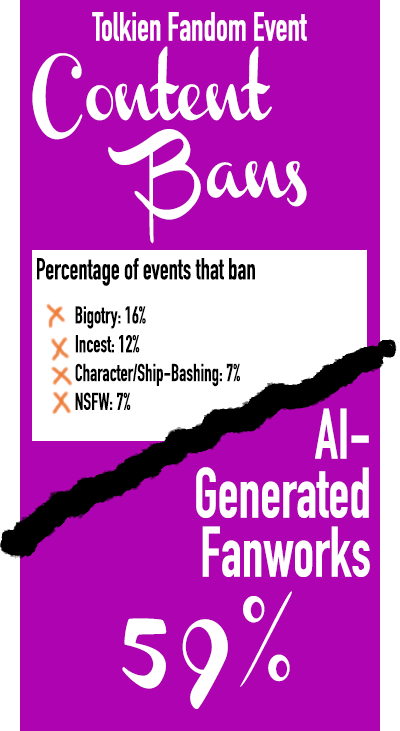
We were also curious if any other prohibitions approached the fandom's near-universal ban on AI fanworks in its events. After all, other types of fanworks have received discussion and sometimes disapprobation over the past twenty-five years of online Tolkien fanworks: incest; underage; works depicting rape or abuse; works expressing racist, misogynistic, homophobic, alt-right, and other dehumanizing ideas; and character- and ship-bashing. We reviewed the policies for the fifty-eight events we'd selected for other content they banned.
Nothing came close to the ban on AI-generated fanworks. The next most likely type of fanwork to be disallowed in a fandom event was works involving bigotry; 16% of events had a rule banning those types of works. Incest, character- and ship-bashing, and not-safe-for-work (NSFW) fanworks were also banned by a few events; the data can be seen to the right. However, 62% of the events included in our investigation did not include additional content restrictions in their rules.
Fandom has drawn a boundary on AI-generated fanworks like they have on no other type of work. This is often underscored by the policies themselves, where alone of the rules listed, the anti-AI language was sometimes in ALL CAPS, bolded, or set off in different colors. As our dataset grew and we began to get a picture of how fandom perceives AI-generated fanworks, we wondered at the impetus for what is about as close to a collective decision to ban something as likely to be seen in a fandom as large as the Tolkien fandom. Namely, we wondered if AI-generated fanworks were truly the existential threat that they appeared to be, or if fandom groups were simply following one another in taking an ethical stance absent much actual risk. To answer this question, we turned to large archives that don't have AI policies.
AI Fanworks on Big Archives
The collage below shows a sampling of recent posts about AI-generated fanworks on the subreddits of four large fanworks archives: AO3, Fanfiction.net (FFN), Wattpad, and DeviantArt. Reddit is a powerful tool for learning about fandom platforms because the subreddits are not run by the platforms themselves and often serve as informal help desks and complaint departments. A search of the term "AI" in AO3's tags—which likewise function as a sort of soapbox in the town square—similarly returns fewer results labeling a work as AI-generated than it does screeds against genAI.
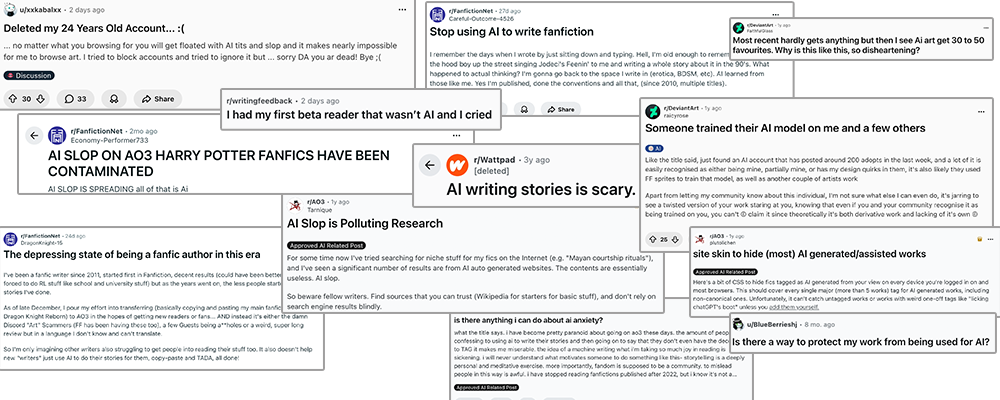
None of the three fanfiction archives (AO3, FFN, Wattpad) have AI policies. As discussed above, AO3 allows AI-generated fanworks, but it is noticeably silent about this permissiveness in its policies. The AO3 Terms of Service bluntly state that "using AO3 may expose you to material that is offensive, atrocious, immoral, obscene, triggering, blasphemous, bigoted, erroneous, or objectionable in other ways"; the first line of its Content Policy asserts that "[u]nless it violates some other policy, we will not remove Content for offensiveness." The OTW, and by extension AO3, are not known for being silent about potentially objectionable content that they accept and why they are proud to do so—it is part of the organization's mission and raison d'être—so its silence here feels significant and essentially declares that, while AI-generated content is allowed, this tolerance for slop will in no way be advertised, even insofar as becoming part of a policy or FAQ buried deep in the site's documents. Not that this is surprising, its leadership possibly envisioning an archive overrun by AI slop and trying to fundraise to sustain that archive's existence.
DeviantArt has embraced genAI through its DreamUp AI art generator. Purportedly, DeviantArt works used in generated works using DreamUp are credited, but in order to not have their works masticated and spit out as someone else's "art," DeviantArt artists must opt out of DreamUp, which ensures that artists who are no longer active or are deceased will have their art used in ways they never imagined when they posted it on DeviantArt years or decades ago. AI-generated works using DreamUp are eligible to be posted to the archive just like any other work of art made using traditional or digital tools and skills.
As archive moderators ourselves, we questioned whether these large archives could police AI-generated fanworks in an evenhanded way. When a site receives thousands of new works each day, how does that site filter out the AI-generated works, short of relying on unreliable AI detectors that would potentially penalize creators who have done nothing wrong (while allowing a share of AI slop to seep through anyway)? The old fandom convention of "label and let people choose"—what the SWG considered for all of five minutes before becoming fully cognizant of the ethical disaster that is genAI—would probably be the most successful approach but still requires a level of moderation to ensure rules are followed and community buy-in—which is hard when the platform in question is disconnected from any form of community.
Conclusion
So yes. It is existential. All those anti-AI policies in fandom events aren't just organizers trundling heedlessly after other events that ban genAI, adding their own anti-AI rules because it's the hip thing to do. Fanworks spaces that operate at the community level, where member and participant needs must be met to ensure the event or site's continuance, perceive that generative AI threatens their survival. (Community spaces stand in contrast to institutional-level spaces, which prioritize missions and policies and where change is slow, if at all.) As seen by the posts and commentary by fans who read and view fanworks in fandoms inundated by AI slop, fans are not by and large interested in reading and viewing AI slop. Fanworks are about craft, commentary on the source texts, and community: the opportunity to create something about a source text, share it with others, and have them react.
What emerged from our research on fandom AI policies was how definitively fandom spaces have drawn the line to exclude genAI in a way that they have never drawn similar boundaries before. Tolkien fanworks fandom has always disagreed on fanworks involving elements like incest, racism, and character hate, but these are internal debates, conducted within our communities and, if anything, proliferating the options available to fans as events and communities arise to meet diverging needs. The threat posed by generative AI is external, powerful, monied, and increasingly ubiquitous. In four short years, "artificial intelligence" has gone from the stuff of science fiction for most people to threatening the livelihoods of people we know (or ourselves!), saturating online social spaces with misinformation and slop, and endlessly peppering familiar digital tools with invitations to try its AI this or that, mosquitolike in their resistance to being swatted away.
It's easy to be hopeless, but our data about Tolkien fanworks spaces is anything but. As is often the case, fighting the large and (increasingly) entrenched takes the small, nimble, and people-driven: our fan communities. We have taken a stance against genAI, and in spaces small enough for community norms to matter and a moderator or two to step in when those norms aren't enough, we have withheld the enemy outside the walls.
*Erratum: This article originally stated that only four Tolkien fanfiction archives were active in 2026; these data in fact represent the year 2025. See Dawn's Fanfiction Archive Timeline for documentation of active, inactive, and closed archives.


♡
"mosquitolike in their resistance to being swatted away" is so accurate. *sob*
Thanks for digging into this, it's really interesting. I tend not to follow much stuff (there's too much humanmade as it is (why on earth would anyone want botspewed as well?)) and only read some mentions on our discord of NaNo, AO3 and DA allowing GenAII, but didn't realise how much they embraced it. (It seems a no-brainer to me, but clearly the awfulness of it is not all that obvious to everyone.) I was however (very naively) unaware of DeviantArt offering up artist's work to AI-scrapers and am thoroughly disgusted that they made that an opt-out. (Actually the whole concept of "opt-out" instead of "opt-in" is odious.) I'm also sad: I'll be deleting my account now, not that I've posted much and nothing since 2023, but I've favourited over 400 great fanarts going back over 15 years that are not posted anywhere else (and would probably be all but impossible to find in searches now among the slew of AIslop), but I will not knowingly give any indication of support of such ethics.
I do find it uplifting how this fandom, in all its wonderful diversity, is so united in this respect. That speaks volumes about the people and community.
Also, slightly off-topic, but your point about AO3 being democratic whereas you have the ultimate say in the SWG really drives home how a form of governance is actually irrelevant, and that it's the people steering the governance — their intentions, motivations, ethics — that really make the difference.
I am 100% with you that AI…
I am 100% with you that AI anything needs to be opt-in ... but then they know that no one will opt in, and the tool will be "useless," i.e., fail to make a profit. (: These data all but prove it.
Grundy and I didn't include DA in our original presentation three weeks ago. I follow some fannish stuff on Reddit, and something DA-and-AI-related drifted into my feed last week, so I went on the site and ... oh boy. I had to add it in, given what I learned. The big fiction archives have "it's allowed but we're not going to announce that" policies but DA has full-out embraced it. It's sad because DA started in 2000, so I know there are thousands of artworks on the site from artists who haven't been active in years and maybe aren't even alive to opt out (if they even know about ... and since you have work posted there and didn't know about it, I'm guessing they didn't do due diligence in letting their artists know).
Re: archive governance ... working on this project really drove home for me an aspect of the universal vs. community archive divide, which I think about entirely to much (including governance), but AI policies were a case study that felt really salient to me. As a community archive, the SWG is paid for by me and I am ostensibly in charge. I could, in theory, decide we are no longer a Silmarillion archive but now only accept Pac-Man fanfic. More likely, I could crack down on genres and interpretations I don't like. However, if I did, the SWG would almost certainly die. People would go elsewhere. It is sustained by the community and does not have the inertia of large archives, where people feel they have no choice but to stay. As it is—and as you know—I believe very strongly in democratic governance on the SWG whenever possible, but even if I didn't, my hand would likely be forced if I wished the archive to survive. People would tire quickly of me enforcing my whims.
AO3 has all the right democratic structures, but it is mission-driven, and that mission is going to run counter to the wishes of the community some of the time. We saw the same thing with the community's opposition to openly racist fanworks that AO3 permits and that site users were asking simply that they be tagged so that readers weren't suddenly encountering dehumanizing depictions of themselves while perusing fanfiction. Not a big ask ... but AO3 didn't make it happen. Some fans left over that, and I'm sure some left over the AI policies, and that will never matter because of the inertia AO3 has. Plenty of people will hold their noses and post with them because their work won't have a home otherwise.
Although I have had (my DA…
Although I
havehad (my DA account is now deleted) email notifications turned off for comments, favourites, etc.., one would expect that a new AI modus operandi would fall under essential notification emails. I've had a quick read about the whole DA AI thing and they really seem to have been devious about it all. (Initially the only way to opt out of their own genAI tool was to delete your works!) *sigh*As for governance, while you could do whatever you like with the SWG, simply put, what you like is aligned with community interests. It's that understanding that community is key to thriving that is sorely lacking in the governance of many (flailing) democracies of various forms, but that's going off on a whole other tangent.
I'm not surprised it didn't…
I'm not surprised it didn't rise to the level of "essential notification" because they don't want people know, just like OpenAI didn't want us to know our work was being harvested for ChatGPT until the deed was done. There's old wisdom that if you have to hide what you're doing, you might wonder if you should be doing it ... but these tech companies know full right well they aren't on the side of ethics here and have chosen, yet again, profits over everything else.
There is definitely parallels there with the current state of governance in many places.
Fear of AI....
I would like to think (hoping I could tell!) that I haven't read any AI-written fanfics on AO3, and the stand of SWG against it is heartening. I think AI work shows up in Tolkien art on Tumblr from time to time, but I try to stick to artists I know who I believe aren't AI.
The information you have set out here about the different website and policies is so interesting, and a little frightening.
Thank you Dawn, and Grundy, for everything you do here.
If there is hope to be found…
If there is hope to be found, it is that individuals and communities like ours can resist this. I do feel for AO3, FFN, Wattpad, and dA. (Less dA since they have embraced AI and, of course, been skeevy about it! Which I continue to say ... if AI is so wonderful and not in any way a threat, then why does the embrace of AI always happen in the shadows? If it's such a positive force for good, then why is the adoption of AI by websites like dA never shouted from the rooftops but quietly foisted upon site users?) They are such large sites that there is no way they can monitor AI fanworks. Even if they wanted anti-AI policies, I don't see how they'd be more than on paper only (unless employing AI detectors, which given the false positives, are just as bad! Perhaps the only thing worse than encountering the occasional slopfic is having one's own carefully crafted fanwork yeeted as AI and the reputational damage that comes with that.) We have a rule among the SWG mods that we do not make policies that we can/will not enforce, and I wonder how much of that we're seeing on these large sites.
But small communities can meaningfully monitor and stop the use of AI on their platforms. The SWG has seen a surge in membership and participation in the last year or so, and the number of events like appreciation weeks on Tumblr is surging as well. One wonders if the era of consolidation is coming to an end and how much AI has to do with that.
Thank you as always for you comment! You are truly a gem here and everywhere with your commitment to commenting. <3
Deeply fascinating and…
Deeply fascinating and compelling read! I appreciate that this uses the Tolkien fandom as a jumping-off point to explore issues of AI in fandom as a whole (via OTW and NaNo). I’m curious whether there are Tolkien fandom events beyond the scope of Tumblr and Fanlore (which I know are anti-AI-leaning as a rule) that took a different approach. Or do community events mostly occur in the spaces where anti-AI creators gather? Regardless, that 59% stat speaks volumes.
Some of the old (pre-Tumblr)…
Some of the old (pre-Tumblr) events are centered on platforms like DW or Proboards (though most also have a Tumblr presence, Tumblr is not their primary platform). We found that these do not have AI policies as a rule, and Grundy and I discussed why this is. In some cases, their policies/rules are years if not decades old, and we wondered if it was as simple a matter of not revisiting them in the past few years since AI entered the fandom consciousness. We also wondered if these events don't tend to have a core contingent of participants such that community values (the intrinsic value of creativity, the importance of ethically using others' work) are strong enough that the organizers don't worry as much about slopfics/art as much as a Tumblr event, where participation is less community-centered and also rewarded with the types of engagement (likes, reblogs) that seem to motivate slop production.
Thank you for reading and commenting! <3
Very interesting and…
Very interesting and insightful discussion!
I do think (as you are already suggesting) that anti-AI policies (written or unwritten) work best in more tightly-knit communities.
With AO3 in particular, some of the initial messaging was a bit unfortunate. But in any case, I think the type of archive that AO3 is can't practically implement anti-AI without being swamped by false accusations and witch-hunts. There seem to be enough of those even without such a policy. And that is even apart from the conflict with their ultimate mission, as they interpret it.
I agree. Write this day down…
I agree. Write this day down ... I feel bad for the big sites, actually. There is no way for them to stop the slop tide. They do not have the community backing that will establish the social norms needed for people to mostly regulate themselves, and I think the false accusations you mention would actually be worse than the slop itself. I've heard said in writers' spaces that we don't sound like AI ... AI sounds like us! It learned from those of us that post a lot of our writing online, hitting us with the double-whammy of competing with AI slop even as human writers are being accused of sounding like the AI that stole their voices from them.
We rarely have people-moderation issues on the SWG, but when we do, it can suck hours of time from multiple mods' days; I cannot imagine the staffing it would take to handle AI accusations in a fair way, if that could be done at all. (The only way I can think is what I do as a teacher, which is look at the history of the original document for how it was edited, but that's incredibly invasive—as I said above, worse than the slop itself!)
Thanks for reading and commenting as always! <3
This was fascinating to read…
This was fascinating to read; thank you, Dawn and Grundy, for doing all this research and putting it together! And I was not aware of those policies by Ao3 and Deviant Art...that is quite disappointing to hear. (Apologies for not having a longer comment; my sun-fried brain is finding things harder to word XD But I did thoroughly enjoy reading this and learning more about the topic.)