
Communities Do Comment: Expanding the 3C's of Commenting with SWG Data by Dawn Walls-Thumma
Posted on ; updated on
This article is part of the newsletter column Cultus Dispatches.
More than a year and a half ago, I posted a revised and updated version of my 2018 article Why People Don't Comment: Data and History From the Tolkienfic Fandom, which included commenting data from FanFiction.net and Archive of Our Own (AO3). I was supposed to follow it up the next month with commenting data from the Silmarillion Writers' Guild (SWG), which is ostensibly easier to come by, seeing as I have access to the entire database and don't have to use various janky methodologies to coax data out of Wayback Machine captures. However, in September 2024, planning for Mereth Aderthad 2025 got seriously underway, and "next month" became "next month" became … until Mereth Aderthad was over, and then I kept Cultus Dispatches on hiatus until the 2025 Tolkien Fanfiction Survey data was in. Well, May 2026 and it is "next month" at last!
I have been involved in the Tolkien fanfiction fandom for twenty-two years now, and I have never known a time when authors haven't angsted over comments. "Why People Don't Comment" was spurred by a moment in 2018 when evidence pointed to a drop-off in comments—cue deepening despair. And rightly so! I often say that I write for myself, but I post for you, my readers. Posting is a hassle, and if my work isn't being read, I might as well skip that part.
The commenting situation seems to have since improved but, at the time, many wondered, including me, why people weren't commenting. It seems such a small action that meant so much to the writers who received it. "Why People Don't Comment" was my attempt to use Tolkien Fanfiction Survey data to uncover the answer to the eponymous question.
The theory where I landed was summed up as "the 3C's": community, confidence, and commenting as a learned skill. As I investigated site data, I considered adding a fourth C—challenges—but quickly realized that what I was seeing in these data can likely be subsumed under community, which looms large as a factor that encourages people to comment.
A Brief History of Tolkien Fanfic Communities
Tolkien-based fanworks have existed since at least the late 1950s, and online Tolkien fanworks communities since at least the 1990s. However, as I have written before, it was the early 2000s that brought the Tolkien fanworks boom: the confluence of the Lord of the Rings films, increased access to home internet, and the advent of the participatory internet, or Web 2.0. I call this the first-wave online fandom. Fans were very eager to hang out together online, but for most of us, the rules for how to do that were being written. (Google Ngrams show the the word "netiquette" rapidly peaked in 1998, then tailed off for the next two decades.) There were not a lot of options for platforms that could be used to fan communities. Building something online required a measure of tech skill.
The second wave of Tolkien fanworks communities arose in the first years of the 2000s. Fan communities began adopting platforms like LiveJournal, Yahoo! Groups, and ProBoards. eFiction debuted in 2003. These made it possible for people without a lot of tech expertise—I am raising my hand here—to start fan communities. This was an era of proliferation of communities and sites. During the first and second waves, fanworks arose from community interaction: people socializing fannishly and producing fanworks, much of the time, at least partly in response to those interactions.
The third wave began in the 2010s as many of those independent groups and sites began to close down or die of inactivity. Fan-unfriendly decisions by platforms like LiveJournal and the demise of eFiction made it harder to start an independent community, ushering in an era of consolidation as a lack of options pushed fans toward large, multifandom platforms. AO3 opened in 2008. Tumblr became a central Tolkien fandom space in 2012. These would become the Two Towers of Tolkien fandom with most fans using both. What set Tumblr and AO3 apart from earlier platforms, however, was that they did not arise from fan communities. They were more like the agora: open to everyone and reaching a vast audience but without offering much in the way of more affable connections.
In my "Why People Don't Comment" article, I suggested that shifts to platforms disconnected from fan communities—Tumblr and AO3, mostly—are part of the reason why comments dropped off in the first part of the 2010s. When fanworks archives—and I use that term loosely to include any platform used to share fanworks—were associated with fan communities, creators often knew (or were at least familiar with) each other. The agora-like vastness of Tumblr and AO3 offered a potential audience size inconceivable to that point but with a catch: much like approaching a stranger in a big city feels uncomfortable—even risky—commenting on a large site where most people were unknowns likewise felt more difficult.
Changes in Commenting Behavior Over Time
Looking at comment counts over time corroborates that access to communities potentially influences commenting behavior. In the original article, I looked at comment counts for AO3; this time, I expanded that to the SWG as well.
I looked at comments on single-chapter, English-language written fanworks posted on the SWG and AO3 July 22 for each year that the archive's Silmarillion section was open (2007 for the SWG and 2011 for AO3 through 2025 for both). I chose July 22 because it was unremarkable, without regular holidays in the English-speaking world and little overlap with the school calendar in Anglophone countries. There are also no major fandom events happening at this time, such as the Tolkien Reverse Summer Bang, that might produce changes in commenting behavior (though Mereth Aderthad in 2025 possibly explains the SWG's data that year). I counted only top-level comments beginning on July 22 until I had at least ten data points. If I had to proceed forward on the calendar beyond July 22, I counted comments on all eligible works posted on that date. All averages are median.
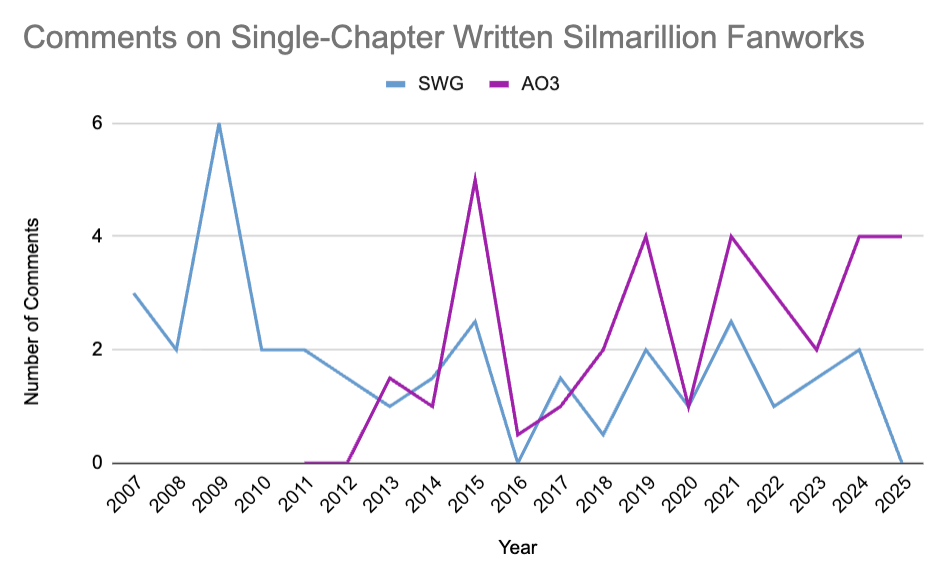
The graph above shows an overall trend where comments on the SWG tended to be high for the first few years of the archive's existence before plateauing in the 2010s through present. AO3 shows the opposite trend: a low number of comments (especially considering that hit counts on fanworks tend to be much higher on AO3 than the SWG) that have gradually trended upward in the last several years.
Where the graph becomes interesting is when considering other fandom history alongside it. 2010 was the last year that the SWG had significant amounts of activity in its Yahoo! Group, the initial platform used by the group for most of its community interactions. Commenting drops off at this point as well. Was this because of a lack of participation in the group's community space? Or did the dropoff on both the archive (in terms of comments) and the Yahoo! Group show diminishing activity in the Silmarillion fic fandom overall?
In 2012, two important things happened: the first Hobbit film was released in theaters, and Tolkien fandom migrated to Tumblr. These were the years that provoked the original "Why People Don't Comment" article, where people accustomed to the higher comment counts of the 2000s were wondering what happened. Certainly, with the Hobbit films, interest in the Tolkien fandom was spiking; why weren't comment counts keeping pace with more clicks, more readers, more interest?
Discord started in 2015. I have not found research documenting the fandom migration to Discord as I have for Tumblr (it probably exists), but the SWG opened its Discord in 2018, which means that the platform had achieved a critical mass in the Tolkien fic fandom (we don't open "social satellites" lightly), and toward the end of the year, Tumblr issued its ban on adult content, which was likely to further drive fandom activity toward Discord. This is around the time when comments on AO3 begin to trend upward.
There are certainly many ways to read this (and the possibility that the sampling method I've used is still too small to smooth out the leaps and troughs that remain obvious on the graph. Data analysis rarely has a terminus, and adding additional "unremarkable" dates to the methodology would be valuable moving forward.) What I see, through the lens of my 3C's theory, is that when platforms for building fandom communities are in widespread use, comments increase. When those platforms are not widely used—the years between the demise of Yahoo! Groups and the rise of Discord—comments decrease.
Challenges and Community
I was curious if people's commenting behavior changed on the SWG when the fanwork was created as part of our site challenges. The SWG has run a regular challenge since September 2005, making it one of the longest-enduring features of our group. To wit, challenges are older even than the website—part of the highly community-centric second-wave fic fandom.
To analyze how commenting behavior changes (or doesn't) for challenge fanworks, I pulled comment data for all fanworks posted to the SWG archive beginning on 15 April 2021, when the Queens of the Quill challenge began. On 9 April, we had reopened our archive after rebuilding it in Drupal, and Queens of the Quill was the first challenge to run in its entirety on the rebuilt site. While we migrated all comment data from the earlier eFiction site, I decided not to include it because the possibility of error was too high. Before running the data, I reviewed it to eliminate comments posted on challenges and new items and comments posted as part of moderator documentation. I pulled the data on 27 April 2026.
In those just-over-five years, readers posted 4,415 top-level comments to the archive. The rebuilt SWG archive allows for threaded comments, so any comment can be replied to by anyone, allowing for conversations in the comments. A top-level comment is written in response to the fanwork, not as a reply to another comment.
In that same timeframe, 1,443 fanworks were posted to the SWG archive. Of them, 738 were challenge fanworks—or 51%, just over half. Presumably, if challenges don't impact people's commenting behavior, then roughly half of comments would be made on challenge fanworks as well. Instead, readers and viewers comment much more frequently on challenge fanworks than they do non-challenge fanworks: 69% of comments were left on challenge fanworks. In terms of stats that creators look for, the average fanwork on the SWG that was not created for a challenge receives just under two comments, but the average challenge fanwork receives more than twice that, with four comments.
The easiest explanation for why challenge fanworks receive more comments is the stamps we give out as a "reward" for commenting on challenge fanworks. However, if the long history comment angst shows anything, it is that readers cannot be easily goaded into leaving comments, i.e., I doubt that a tiny graphic on a member's profile is going to serve as that much of an incentive, especially since—as my research has demonstrated—commenting is also a product of confidence and skill. Neither magically appears because we offer a PNG postage stamp.
Challenges are a manifestation of community. First, by participating in a challenge, a creator signals that they are interested in joining a community activity. The SWG archive is, after all, just that: an archive. People can and do use it simply as a place to post fanworks without engaging in the community beyond that. (Especially when AO3 is receiving bad press, we see an uptick in registrations where members explicitly state that they are looking for a second site in which to backup their Tolkien fanworks.) When a creator participates in a challenge, however, they are engaging with the group as more than just an archive. They are signaling their awareness of community activities and their interest in creating fanworks alongside other SWG members.
Beyond that, the challenge process remains communal. Participants often request prompts in a communal setting. Then the time-delimited process of making a fanwork begins for everyone. If a challenge is proving difficult or if the words just pour out as though already written, these experiences are often shared with the community; people commiserate because many of them are completing the same challenge. It is the same reason people get together to do any endeavor that could just as easily be completed solo. Finally, creators share their challenge fanworks with the community. The creative process—one that is typically independent, even lonely—becomes communal through challenges. And to wind the process up, challenge fanworks are tagged as such on the archive, and creators receive a stamp on their profile for each challenge they complete, providing small but meaningful symbols of community membership.
Challenge creators are also more likely to be involved in other community endeavors. For instance, they are frequently participants in discussions on the Discord. They are often volunteers on the SWG or for other fandom events. They often join for communal events like instadrabbling or live readings. All of these things help dissolve the awkwardness that arises when a reader stares at the comment box on a fanwork by an author they don't know.
Conclusion … or How to Get More Comments
I used to tell people who wanted more comments that they had to leave comments to receive comments. I was wrong. This was much too simple, as many people who commented hundreds of times to rarely receive anything in reply can attest.
The truth is that what makes a reader pick up a story to read is complicated, and what makes that person reach out to the author with a comment is more complicated still. As I begin analyzing data from the Tolkien Fanfiction Survey, I hope to shine light on what causes someone to choose one story over another another.
The original "Why People Don't Comment" article is eight years old. Two Tolkien Fanfiction Surveys have passed since I wrote it, and I've done a lot more thinking and analysis of why people do what they do in the Tolkien fanfiction fandom. Generally, I stand by my conclusions there, the 3C's: community, confidence, and commenting as a skill. Increasingly, however, evidence points to the prominence of community as a factor. Community, it seems, would alleviate at least somewhat the other two. Even a reader who lacks the confidence to comment would possibly feel comfortable telling a friend that they enjoyed a story. Likewise, "commenting as a skill" broadens to include a variety of different responses other than literary analysis, which is sometimes viewed as the default when commenting to an unknown author. For instance, a comment to a friend might mention shared interests, allude to previous discussions, or simply celebrate the fanwork as an achievement—no literary analysis required.
I wish there was One Weird Trick that would double your comments overnight. Alas, the solution seems to be much bigger than even commenting: building and sustaining fandom communities. When people feel comfortable interacting with each other and know each other as people, they talk more, including about their fanworks. The good news is that vibrant communities are a reward in their own right.


Thank you, for this Dawn!…
Thank you, for this Dawn! Very interesting data!
I would add that the lesser known factors of why someone would be most likely, as appose to less likely not, comment, could also include individual preference. Which is something I’ve noticed over the years.
Also, I would like to congratulate you on the success of the new revamped SWG archive! Since returning to this space and community, I have noticed a rather large upswing in readers and viewers of my creations since I was away. I have noted that the sense of community and the events therein play a significant part in this. There just seems to me, to be more creators joining and participating in this archive, more than ever before! I know it has its problems and annoyances, but, well done! This is what keeps me coming back!
You're welcome! And thank…
You're welcome! And thank you for reading and commenting! :D
Doing this research for a decade now at least, the reasons people do/don't comment are so many and complicated. I have a lot of Tolkien Fanfic Survey data around commenting that I look forward to digging into. I like that, no matter where the data point, they likely point away from the narrative that was so prevalent, when I wrote the 2018 "Why People Don't Comment" article, that readers are lazy, ungrateful, and don't care. This was producing a sense of disconnect and despair that felt really unhealthy at the time.
Thank you so much for your kind words about the site! It is often a huge pain. It always crashes when I'm on a field trip with my students, for instance (or it seems that way!) But it is also one of the best things I've ever done. When I think about the lifelong friendships and connections that have been forged because this website exists, it's honestly overwhelming, to say nothing of the incredible creative works that creators here produce. It has seen an uptick in participation across the past few years; I hope to gather data on that at some point too. It's cool that it was enough that you noticed!
This was really interesting…
This was really interesting to read! It makes sense that the community idea would be an especially strong reason behind commenting; my personal commenting habits show that I'm more likely to comment on the works of people I know or have something of a rapport with. And thank you for collecting all that data and explaining how and why you collected it the way you did - it's always interesting to read!
(Though I might be something of an exception to the stamps not being motivating; I sometimes comment on challenges mostly because of the commenting stamp XD)
You're welcome! Regarding…
You're welcome! Regarding methodology, I started my academic life in the social sciences and grew accustomed to writing methodologies. I figure people who aren't interested can skip that paragraph, but for those who want to know how I landed where I did, there is no mystery!
I definitely think the stamps are motivating! Some of them are just stunning; I always feel such gratitude for the artists willing to donate their work to us. Would stamps have the same motivation, do you think, if you just stumbled on this website and didn't know the community behind it?
Thanks so much for commenting!
I've been sitting on…
I've been sitting on replying to this comment for so long because it really made me think XD Your question about whether I would find it as motivating is a hard one to answer, in part because I don't remember exactly why I decided to join this archive and if I joined the Silmarillion Writers' Guild before or after I joined the server. But in one sense, I didn't know the community behind SWG when I joined; I didn't know who was here or if I knew anyone who was part of it. And I think I joined for the challenges, but I'm not sure. In addition, I don't participate much in the server as a whole, and when I do, most of my interactions are there to gain information for myself.
On the other hand, one glance at my profile shows that I have very few commenting stamps compared to creator stamps. (I do find creator stamps motivating, but since we're talking about commenting, I'll focus on those. Part of this might be the time limit on creator stamps compared to comment stamps, but I'm speculating at this point.) So maybe I find those factors that you've talked about in the article that discourage commenting a more compelling force than whatever motivation the commenter stamps give me. Which if true would ultimately support your conclusion, I suppose. And obviously my comments on this aren't in pursuit of any stamp.
I think that creator stamps…
I think that creator stamps work differently for sure! Back in 2016, we realized our challenges were not working—they were getting zero participants—and the mods at the time and I faced the decision of whether to give them up entirely or change something up in an attempt to entice participation. We clearly chose the latter! :)
One of the things we tried was adding the stamps. This was based on many years of running Back to Middle-earth Month (B2MeM); the SWG was one of the groups behind that event for many years, and then once we separated B2MeM into its own event independent of any archives, I was the lead mod for some years after. It was a very successful event, especially given that it occurred in the lull between films, and one thing we learned worked was rewarding people with graphics: banners, icons, stamps on passports or bingo cards, etc.
I think the difference is that most of us are here because we like to write stories, create art, and make other types of fanworks. Those acts are motivating unto themselves. The stamps for creators work because this impulse that we would engage in already is simply directed toward a task that receives a reward. There is a community aspect as well; I've made the comparison before with scouting badges. I complete a scouting badge for swimming because I'm interested in it to begin with, and by directing my energy in that way, I show off my accomplishment and membership in the community. There are relatively few consistent barriers; I might choose swimming over, say, outdoor survival because I find it more appealing or there are specific barriers to the outdoor survival badge for me, but the concept itself is inclusive enough that I can become involved if I want to through some form of participation that results in a badge.
Commenting does present consistent barriers, however: confidence, not knowing what to say, worrying about saying the wrong thing, finding tech hard to use (e.g., commenting on a phone versus laptop), worrying about making the right/wrong impression or that the comment won't matter to the author, lacking the emotional/social energy ... Most of us probably aren't here because we inherently like to comment in the same way that we are here because we inherently like to write, draw, etc. so stamps aren't motivating in the same way because the barriers will still be there, stamps or not, and the fact that they are tiny graphics and actually not worth much becomes abundantly clear when they are expected to motivate people to overcome sometimes significant barriers.
... and thanks for reading my dissertation! XD I read your comment when you wrote it and have had it starred in my inbox since but was swamped with the end of the school year, then on vacation, and have clearly turned it over in my mind a lot since!
One distinction between…
One distinction between creator versus commenter stamps rooted in the inherent motivation of creating and commenting makes a lot of sense! Thank you for going through and explaining it so thoroughly; it definitely helped clarify the matter for me.
Lovely work, as always! My…
Lovely work, as always!
My data scientist brain SUPER wants to know whether those very intriguing trends would pass a significance test. Also, I love your conclusions--and I would argue that the stamps really are emblematic of the community? I mean I feel like if the stamps were just pretty pictures people wouldn't care but at least to me they are really imbued with a sense of meaning because of all the care and meaning that goes into them (so congratulations on making a little png into something so much more).
I agree that the stamps work…
I agree that the stamps work because they mean something deeper. They are beautiful and definitely motivating, but I just asked Artano: Would they have the same intrigue if you stumbled on this website for the first time and didn't know anything of the group/community behind it? My inclination is that, for most people, that answer would be no, but I'd be curious how others would answer that question!
They're like scout badges. They represent individual achievement, but they also signify membership in the group and an achievement reached among the company of others working toward similar goals.
I'd be really curious about the significance too. It's been more than 20 years since I had statistics, so I don't know that that task is within my skills anymore, but if you bring it up because you want to run the numbers, I'm happy to share! I do hope to gather two more "insignificant" dates/year for each site using this methodology, but I also have a pile of 2025 Tolkien Fanfic Survey data calling my name, so who knows when I'll get to it. If I do a couple data points every day this summer, that becomes more manageable, maybe?
Thank you for commenting!
Thanks!
Thanks for taking the time to do this. I'm a writer and absolutely love receiving reactions to my stories when I post. For the same reason, I try to leave comments when I've read and enjoyed a story. I suspect that comes from having been indoctrinated by Mrs Do-as-you-would-be-done-by as a kid! I often feel that my comments pale into insignificance set against some of the long and really insightful ones I see from some others, but I hope they're still received with some pleasure. I mainly read and comment from my phone, and I'm very much not a quick typist on that, so it's only when I get on my laptop that I can leave longer ones. Also, if I download a fic to my phone, I can only easily comment when I get to the final comment button on the fic.
I agree about a sense of community making a difference. I certainly found that when running a comm in the heydays of LiveJournal. I do like the fact that people can rec and self rec fics on the Discord, and I very much like the existence of the Discord as it's a great place to chat and get to know people.
I really, really wish more people would comment, but I think we are increasingly in a world where people consume without engagement and feel entitled to their consumption without thinking that a lack of encouragement and simple giving something back, the supply could easily dwindle.
Thanks for all you do for the fandom, Dawn!
You're welcome, and thank…
You're welcome, and thank you for commenting (and apologies for the delay in responding; I'm catching up after the end of the school year!)
I likewise have a strong do-as-you'd-have-done value, perhaps to a fault. If I neglect doing something I know I should do, then I tend to catastrophize that in my mind, like, "You didn't comment, Dawn. This is why authors feel discouraged and fandom communities are becoming harder to build," like those things are the entire fault of my one neglected comment! But I also have skills that make commenting relatively easy for me. I have an advanced humanities degree and teach humanities, so talking about literature is not a struggle for me. I am fairly self-confident and don't tend to worry about my comments; if it doesn't mean much to an author, so what? I still wanted to say it. And I do very little on my phone, so typing up a quick note is a breeze. So I also don't come with many valid excuses!
Indeed, the biggest struggle is finding time to read! :D I don't read fanworks much anymore because work, my research, and caring for the SWG keep me very busy.
Doing this research has made me more empathetic to those who don't comment and to approach it less as a personal failing that, if the person wanted to do better, they just would, and more in terms of how we can build the kinds of communities where people feel they can give something back to the authors whose work they enjoy.
Thank you again for reading and commenting always! <3
Thank you for this! Thinking…
Thank you for this!
Thinking about the question you are raising about those stamps: for me, yes, they are a noticeable element in my motivation, but a very significant part of that, for me, is that I know the people who make the stamps and who are giving them out. And that I know the challenge participants, even more so.
Fascinating look at the reverse of the previous study....
....why readers don't comment. Reading as many fics as I do (DO NOT LOOK at the TBR folder behind the curtain!), it requires time and commitment. I attribute your 2018 article read on AO3 to giving me the confidence. 🪻
One of the most joyful things outside of reading has been joining the community on Discord, especially finding new authors in the Fic recs and SSP to read. SWG on Discord isn't so big that I get lost or overwhelmed, and the worldbuilding insights are fascinating.
Thank you for this article, and for SWG. 💜
I've found I struggle with…
I've found I struggle with confidence since my wordability went wonky a few years ago and Community is certainly an aspect that makes it easier for me. It's the reason I prefer commenting on the SWG, which I often do even if I've download a crossposted fic from AO3.
Lately I've been reading more challenge fics than regular fics (and thus comment on more challenge fics) because of people putting notifications in the Discord challenge channel. Stamps, especially knowing they're specially created by community members, do also provide an extra little boost of motivation to read more of the challenge fics. They are also often short enough to conveniently dip into when there's a spare moment and I feel better about leaving a simple "I liked this" comment on shorter fics, which means that it's easier and quicker to leave a comment straight away. (Unlike longer fics that I read on my Kobo at night, which I then need to remember not only to comment but what aspects I wanted to comment on, which requires more dedicated time and energy.)
(I've deleted and recomposed most of what I typed for this comment and it's taken me 40 minutes to wrangle! It's only the irony that's preventing me from chickening out and reverting to "thanks for yet another insightful and thought-proviking article"!🙈😂)